
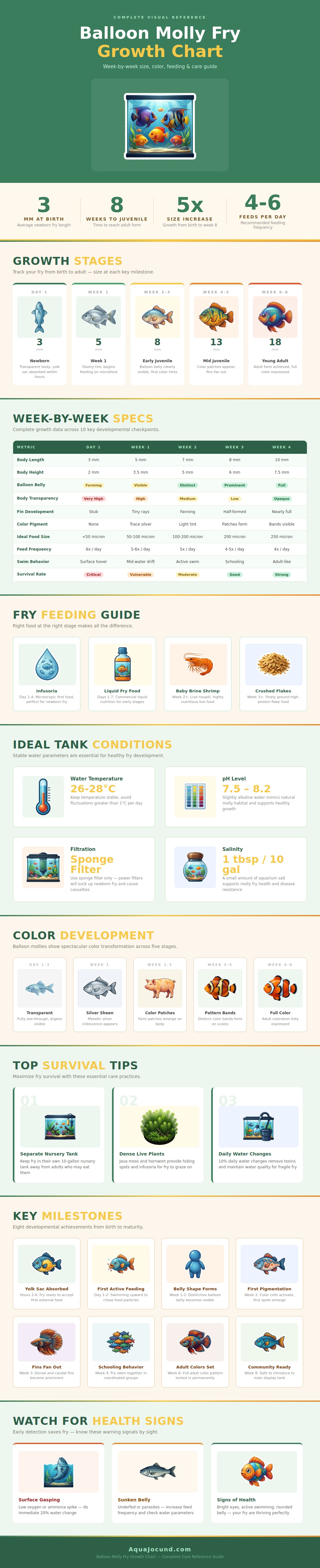
To successfully raise balloon molly fry, it’s important to understand the different needs of balloon molly fry at each stage during the first two months of life. Many people believe that the difficulties in raising balloon mollies end once the babies is born from the mother fish. However, the first few week of life of balloon molly fry usually see the highest number of deaths of the fry.
If you understand the different needs of fry according to there age, though, it’s possible to raise a tank of juvenile balloon mollies. If not understood, however, the mortality rate of fry will be high. Balloon mollies is livebearers, which means that the newborn balloon mollies are fully formed when they are born.
How to Raise Balloon Molly Fry in the First Two Months
The newborn balloon mollies dont have any nutrients stored within they bodies, though, so you must feed them within hours of there birth. The newborn balloon molly fry are too small to eating flake foods, and their digestive systems are too delicate to eat regular food products. Instead, you must provide infusoria or liquid fry foods to newborn balloon mollies.
After the balloon molly fry reach approximately one week of age, though, they can begin to eat newly hatched brine shrimp. The round body shape of the balloon mollies is not developed overnight after birth. The young balloon mollies have a slim body shape when they are first born, but their bellies begins to round out over the following two weeks.
By the third week, they have their characteristic balloon molly body shape and profile. The roundness of the fry can be used to assess there development. If the fry do not begin to develop into a round body shape despite being active and feeding, then you should adjust the water or diet of the fry.
Color development begins after body shape development. Balloon molly fry are see-through when they are born. A faint silver sheen begins to appear on the fry prior to patches of color appearing on their bodies.
The bands and areas of color characteristic of balloon mollies begin to appear around an one month of life mark for the fry. By eight weeks of age, most fry have developed there full color characteristic. Color can be used to determine the development of the fry.
If the fry are pale in color at six weeks of age, though, they may be stressed. Balloon molly fry have different water requirements during there first month of life compared to adult balloon mollies. Balloon mollies prefer water that is slightly alkaline.
Balloon molly fry are very sensitive to ammonia and nitrite spike in the water. A sponge filter is required for fry care, as stronger filters will pull the fry into the filter. Water changes of ten percent of the water in the tank each day are recommended, as the fry produce alot of waste.
A small amount of aquarium salt can be added to the tank for the fry to encourage there immune system, but it isnt a replacement for clean water. It is a mistake of many aquarium keeper to leave newborn fry in the main display tank with the adult balloon mollies. The adult balloon mollies will eat the fry.
A dedicated tank of at least ten gallons is required to house the fry. The tank should contain dense plant cover, such as Java moss or hornwort. Both the fry will use the dense area of the tank for hiding, and the area will contain food for the fry.
Balloon molly fry require different feeding schedules at different times. Six meals per day is provided to the fry for the first week of life. After one month of age, the fry can be fed four meals per day.
Feeding must be provided daily and the fry fed enough food to last the day. Any leftover food should be siphoned out of the tank after one hour. Smaller portions of food should be provided to the fry each day, rather than more large portions.
Large portions of food may sit uneaten in the water in their tank. By eight weeks of age, the fry have completed the critical stage of development. At eight weeks of age, the fry have fully developed fins, there color is set, and they can eat the same food as the adult balloon mollies in the tank.
At this stage, the fry can be moved to the main community tank. By paying close attention to the development of the balloon molly fry, you can catch problems early in there development cycle. By adjusting the care of the fry according to there age and development each week, it is possible to successfully raise the next generation of balloon mollies.
