🐟 Flat-Back Hexagon Volume Calculator
Estimate aquarium volume from flat back width, front width, side panels, height, fill level, glass thickness, and substrate displacement.
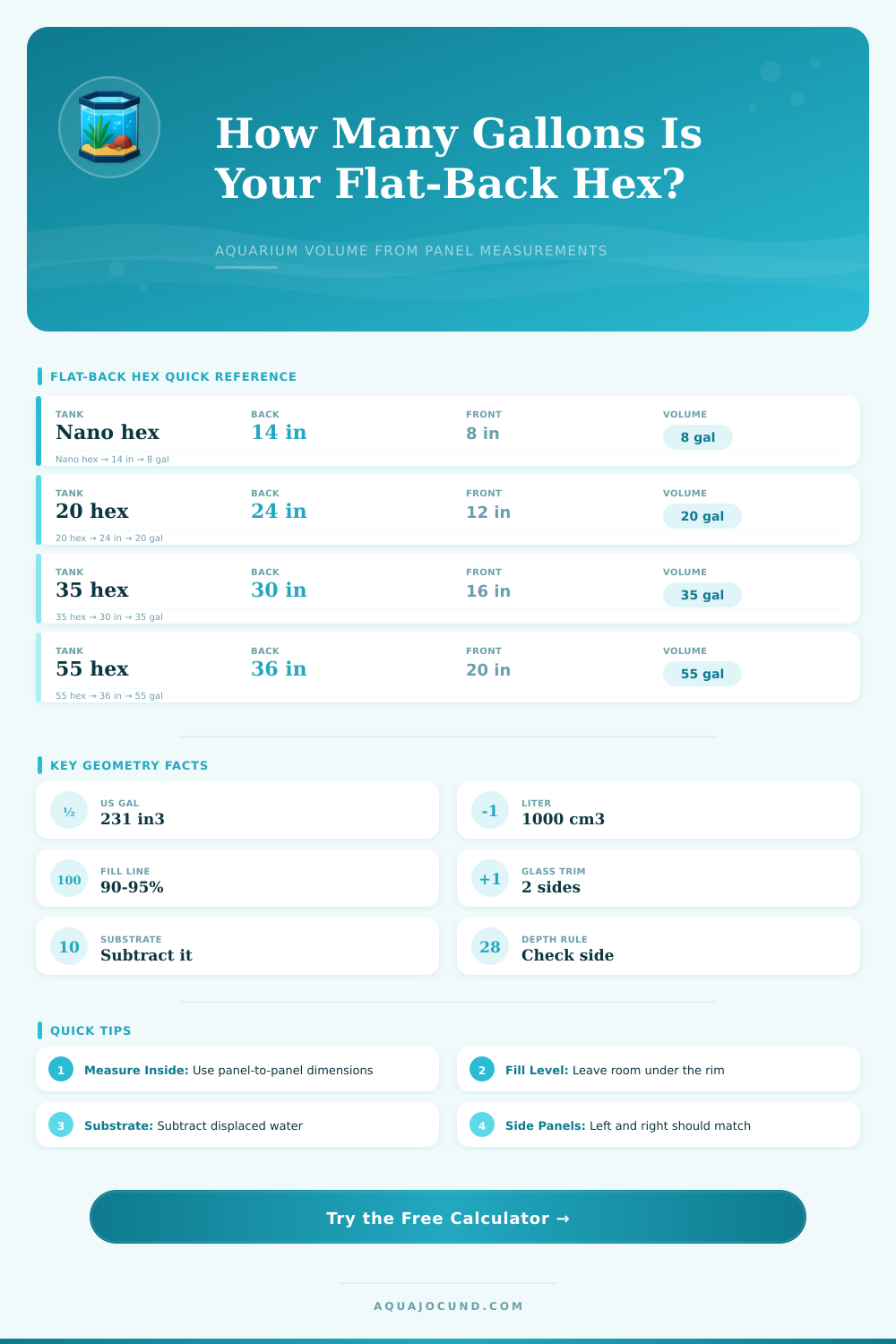
| Preset | Back Width | Front Width | Side Panel | Height | Typical Use |
|---|---|---|---|---|---|
| Nano Hex | 14 in / 35.6 cm | 8 in / 20.3 cm | 9 in / 22.9 cm | 14 in / 35.6 cm | Shrimp, betta, small planted tank |
| Desktop Hex | 18 in / 45.7 cm | 10 in / 25.4 cm | 12 in / 30.5 cm | 16 in / 40.6 cm | Nano community or display aquascape |
| 20 Gal Flat-Back | 24 in / 61.0 cm | 12 in / 30.5 cm | 15 in / 38.1 cm | 18 in / 45.7 cm | Planted community or pair tank |
| 29 Gal Planted | 27 in / 68.6 cm | 14 in / 35.6 cm | 17 in / 43.2 cm | 20 in / 50.8 cm | Plants, tetras, corydoras |
| 35 Gal Corner | 30 in / 76.2 cm | 16 in / 40.6 cm | 18 in / 45.7 cm | 21 in / 53.3 cm | Community fish or tall plants |
| 55 Gal Display | 36 in / 91.4 cm | 20 in / 50.8 cm | 23 in / 58.4 cm | 24 in / 61.0 cm | Angelfish, gourami, planted display |
| Step | Formula | Why It Matters |
|---|---|---|
| Glass allowance | Internal width = outside width - 2 x thickness | Water sits inside the panels, not around the outside glass box. |
| Side depth | Depth = sqrt(side^2 - half width difference^2) | Finds the front-to-back depth produced by the angled side panels. |
| Footprint area | Area = (back + front) / 2 x depth | Approximates the symmetric flat-back hex footprint as a tapered aquarium plan. |
| Water height | Fill height = internal height x fill percent | Accounts for the real water line below the rim or brace. |
| Net volume | Gross water - substrate displacement | Sand, rock, gravel, and decor reduce actual water volume. |
| Aquarium Range | Common Glass | Input in Imperial | Input in Metric |
|---|---|---|---|
| Nano and small tanks | 4-5 mm | 0.16-0.20 in | 4-5 mm |
| 20-40 gallon tanks | 6 mm | 0.24 in | 6 mm |
| 55-75 gallon tanks | 8-10 mm | 0.31-0.39 in | 8-10 mm |
| Large display tanks | 10-12 mm | 0.39-0.47 in | 10-12 mm |
| Tank Footprint | 1 in Sand | 2 in Gravel | Rocky Decor | Use This Input |
|---|---|---|---|---|
| Nano hex | 0.3-0.5 gal | 0.6-0.9 gal | 1-2 gal | Small planted setups |
| 20-29 gal hex | 0.8-1.2 gal | 1.6-2.5 gal | 2-4 gal | Community aquariums |
| 35-55 gal hex | 1.5-2.5 gal | 3-5 gal | 5-8 gal | Deep substrate or cichlid rock |
| 75-90 gal hex | 2.5-4 gal | 5-8 gal | 8-14 gal | Large displays and reefs |
For the best estimate, measure inside the tank after trim and silicone if possible. If you only have outside dimensions, keep glass thickness allowance turned on.
Use net water volume for dosing, stocking, filtration, and water changes. Manufacturer size often describes gross capacity before substrate and fill-line losses.
Calculating the volume of a flat back hexagon tank is an important task because the volume of a flat back hexagon tank determine the amount of water that the tank can hold. A flat-back hexagon tank dont have the shape of a rectangle. The flat-back hexagon tank has a more complicatedly shape than a rectangle because the sides of the tank angle inward.
The back panel of a flat-back hexagon tank is wider then the front panel of the flat-back hexagon tank. Additionally, the side panels of a flat-back hexagon tank connects the back and front panel of the flat-back hexagon tank at an angle. As a result, the flat-back hexagon tank have a footprint in the form of a trapezoid.
How to Find the Actual Water Volume of a Flat-Back Hexagon Tank
If you use the width of the back panel of the flat-back hexagon tank to calculate the volume of the flat-back hexagon tank, you will overestimate the volume of the flat-back hexagon tank. This is because the flat-back hexagon tank is narrower at the front panel than the back panel. Another factor that affect the volume of water in a flat-back hexagon tank is the thickness of the glass.
You may measure the thickness of the glass when you determine the dimensions of a flat-back hexagon tank. However, when you calculate the volume of the flat-back hexagon tank, you must take into account the thickness of the glass. The thickness of the glass will reduces the volume of the flat-back hexagon tank.
Depending upon the thickness of the glass, a flat-back hexagon tank may lose several gallon of the total volume of the flat-back hexagon tank. Additionally, another factor that will reduce the volume of water that can be contained in the flat-back hexagon tank is the substrate contained within the flat-back hexagon tank. The substrate take up the volume within the flat-back hexagon tank.
As a result, it displace some of the water within the flat-back hexagon tank. To calculate the actual volume of water in a flat-back hexagon tank, it is important to account for the substrate within the tank. The volume of water in a flat-back hexagon tank may be affected by the fill level of the flat-back hexagon tank.
It is unlikely that you will be filling the flat-back hexagon tank to the top of the flat-back hexagon tank to the rim. The maximum fill level of a flat-back hexagon tank is likely to be 90 to 95 percent of the total height of the flat-back hexagon tank. As such, when you calculate the volume of water in a flat-back hexagon tank, you should calculate it according to the fill level of the tank, not according to the total height of the flat-back hexagon tank.
Calculating the volume according to the actual fill level of the flat-back hexagon tank will allow you to accurately determine the net volume of the water in the flat-back hexagon tank. Knowing the net volume of the water in the flat-back hexagon tank will allow you to determine how much medication to add to the water in the flat-back hexagon tank. Additionally, knowing the net volume will allow you to determine how much water to change in the flat-back hexagon tank.
Many people may use the gallon rating that the manufacturer of the flat-back hexagon tank provides. The manufacturer of the flat-back hexagon tank likely provides a gallon rating that is the gross capacity of the flat-back hexagon tank. The gross capacity of the flat-back hexagon tank does not account for the substrate that is contain within the flat-back hexagon tank.
Additionally, the gross capacity of the flat-back hexagon tank does not account for the water that is lost due to the flat-back hexagon tank not being fill to the top of the tank to the rim. Thus, the gross capacity of the flat-back hexagon tank is likely to be higher than the actual volume of the water that can be contained within the flat-back hexagon tank. In order to avoid overstocking fish into the flat-back hexagon tank, you must use the net volume of the water in the flat-back hexagon tank.
If you use the gross capacity of the flat-back hexagon tank to determine how many fish to place into the flat-back hexagon tank, the bioload of the flat-back hexagon tank will likely be too high for the actual volume of the water in the flat-back hexagon tank. The geometry of the flat-back hexagon tank will also affect the way in which substrate within the flat-back hexagon tank displace water. Because the back panel of the flat-back hexagon tank is wider than the front panel of the flat-back hexagon tank, a deep layer of sand placed into the flat-back hexagon tank will displace more water at the back of the flat-back hexagon tank than it will at the front of the flat-back hexagon tank.
This is due to the difference in the surface area of the back and front panels of the flat-back hexagon tank. You can use a calculator to calculate the net volume of water in the flat-back hexagon tank by entering the dimension of the flat-back hexagon tank and the amount of substrate that is contained within the flat-back hexagon tank. Finally, knowing the net volume of the water in the flat-back hexagon tank will allow an aquarium to plan the filtration system for the flat-back hexagon tank and to determine the maintenance requirement for that flat-back hexagon tank.