Rimless Tank Glass Calculator
Estimate glass thickness, unsupported span risk, deflection, and silicone seam area for rimless aquarium panels.
⚙Quick presets
📏Tank dimensions and glass inputs
🔍Glass property reference
| Glass type | Design strength used | Best rimless use | Calculator note |
|---|---|---|---|
| Standard annealed float | 19 MPa reference | Common small and medium tanks | Needs excellent edge finishing |
| Low-iron aquarium glass | 18 MPa reference | Clear front and side panels | Slightly lower conservative rating |
| Laminated annealed glass | 16 MPa reference | Special custom panels | Interlayer changes stiffness behavior |
| Tempered safety glass | 45 MPa reference | Factory-cut fixed panels only | Cannot be drilled or trimmed after tempering |
📊Common rimless tank starting points
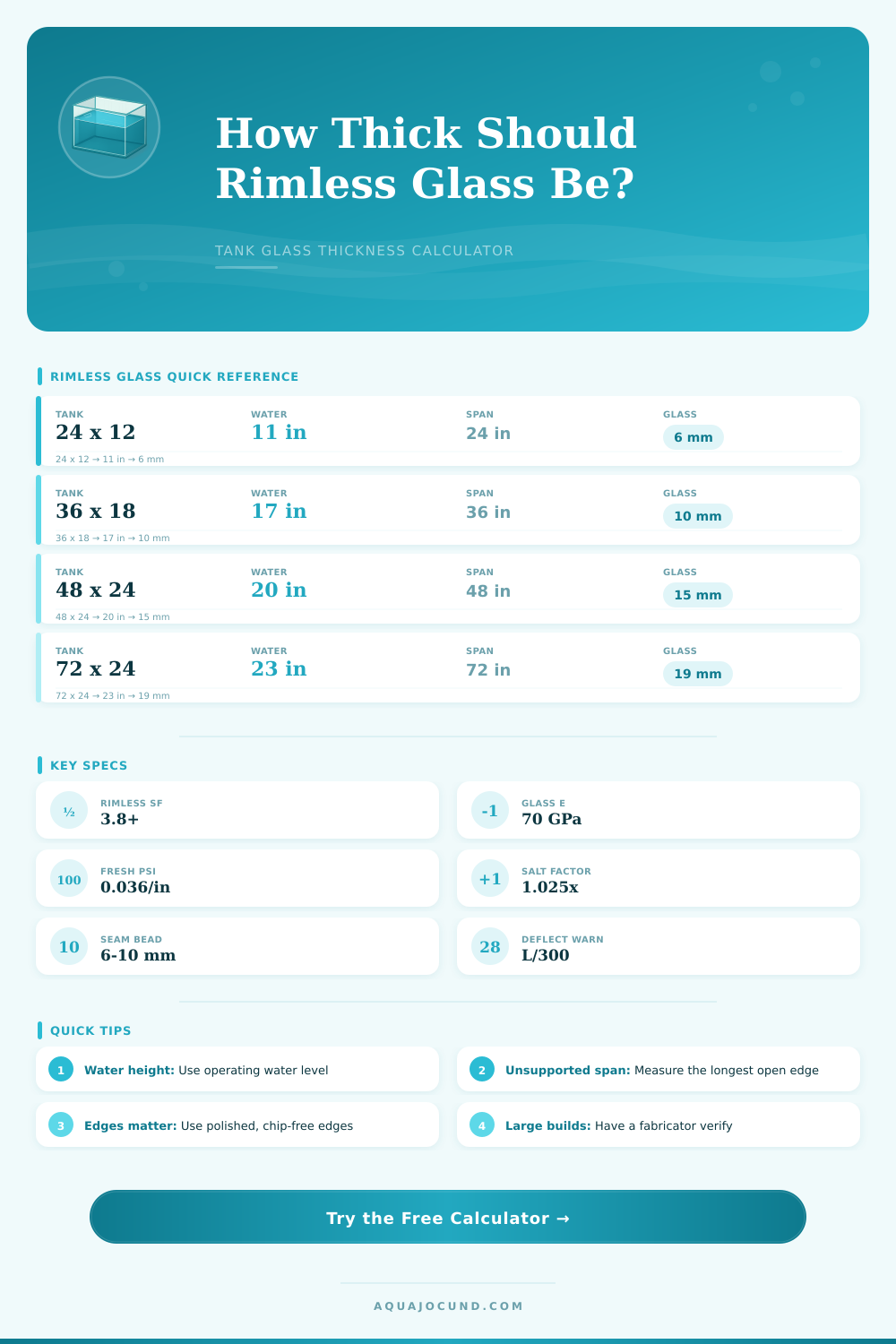
| Tank size | Typical dimensions | Water height | Conservative glass range |
|---|---|---|---|
| 10 gallon nano | 20 x 10 x 12 in / 51 x 25 x 30 cm | 10-11 in / 25-28 cm | 5-6 mm |
| 20 long rimless | 30 x 12 x 12 in / 76 x 30 x 30 cm | 10-11 in / 25-28 cm | 6-8 mm |
| 40 breeder rimless | 36 x 18 x 16 in / 91 x 46 x 41 cm | 14-15 in / 36-38 cm | 10-12 mm |
| 75 gallon display | 48 x 18 x 21 in / 122 x 46 x 53 cm | 19-20 in / 48-51 cm | 12-15 mm |
| 120 gallon peninsula | 48 x 24 x 24 in / 122 x 61 x 61 cm | 22-23 in / 56-58 cm | 15-19 mm |
| 180 gallon showcase | 72 x 24 x 24 in / 183 x 61 x 61 cm | 22-23 in / 56-58 cm | 19-25 mm |
🧪Silicone and deflection guide
| Check | Green range | Warning range | What to adjust |
|---|---|---|---|
| Panel safety factor | At or above target | Below target | Use thicker glass or reduce water height |
| Estimated bowing | Below 70% of L/300 | Near or above L/300 | Increase thickness or add bracing |
| Silicone bead width | About glass thickness or wider | Narrower than panel thickness | Increase bead/contact area |
| Unsupported span | Short, shallow panels | Long open top edges | Use thicker glass or redesign panel layout |
Building a rimless aquarium require the use of mathematics to determine the thickness of the glass that are required for the aquarium. Because a rimless aquarium does not use a top brace or a rim to provide structural support to the aquarium, each glass panel will be responsible for supporting the aquariums water on its own. A calculator can be use to determine the thickness of the required aquarium glass based off the dimensions of the aquarium, the height of the water in the aquarium, and the type of glass that is to be used in the aquarium.
The calculator will ask for the dimensions of the unsupported span of the aquarium. The unsupported span is the span of the aquarium that does not use a brace to provide structural support to that portion of the aquarium. The unsupported span is not always the same than the length of the aquarium; for instance, a peninsula aquarium has a different unsupported span than a shallow frag tank.
How to Choose Glass Thickness for a Rimless Aquarium
The calculator account for these different layouts, so that the calculator can provide an accurate reading of the parameters needed for that specific aquarium. The height of the water in the aquarium is another of the parameters that must be entered into the calculator. The height of the water creates the water pressure in the aquarium.
The height of the water is not necessarily the same as the height of the glass in the aquarium; in most cases, the aquarium will not be filled to the very top of the aquarium glass. Instead, there will be a small amount of empty space within the aquarium (known as the freeboard) that will accommodate for the expansion of the tanks water. For these reason, the height of the water (instead of the height of the tank) will be used in the calculation.
In addition to the height of the water, it is also possible to enter a factor that accounts for the safety of the aquarium; the higher the safety factor that is entered into the calculator, the more safer the aquarium will be. A higher safety factor can be used with rimless aquariums than braced aquariums. In addition to the dimensions of the aquarium and the height of the water, the type of glass that is to be used in the aquarium will impact the calculation of the thickness of the aquarium glass.
For instance, annealed float glass is the most common form of aquarium glass; however, low-iron glass is another type of glass that is available that provides better coloration of the aquariums inhabitant. Finally, tempered glass is a third type of available glass; however, you cant drill or cut tempered glass after it is tempered. Each of these types of glass have slightly different properties to the calculation; therefore, the calculator asks for the type of glass that will be used to calculate the appropriate thickness of that type of glass.
The deflection of the aquarium is another of the parameters of a rimless aquarium. The deflection is the amount that the aquarium will bow due to the pressure of the water. Even if the aquarium is not breaking, it may bow and exhibit ripples.
Additionally, the stress on the aquariums silicone seam may reach excess amounts if the aquarium bows noticeably; excess stress upon the silicone seams can lead to structural issue. The calculation will use an “L/300” warning line to alert the aquarium builder if the deflection is too high. If the deflection is too high in relation to the parameters of the rimless aquarium, then the thickness of the aquarium glass will have to be increased, or the builder will have to alter the unsupported span of the aquarium.
The width of the silicone bead that will be used in the aquarium is another of the construction parameters of a rimless aquarium. The silicone bead will be used to create a bonded area of the aquarium. That bonded area will allow for the load of the aquarium to be distributed from one panel of the aquarium to the next.
If the width of the silicone bead is too narrow relative to the thickness of the aquarium glass, the load will not be evenly distributed to the aquarium; instead, the corners of the aquarium will rely upon the adhesive property of the silicone. The calculation will calculate the bonded area and the exposed fillet of the aquarium; this allows for the determination of if the width of the silicone bead will be sufficient for the aquarium. Some of the sizes of aquariums and the thickness of the glass that is required for those aquarium size can be determined.
For instance, a 20 gallon long tank will require 6 to 8 millimeter thick glass if the height of the water is 11 inches. A 75 gallon display tank will require 12 to 15 millimeter thick glass due to the length of the unsupported span of that aquarium. Finally, peninsula tanks (aquariums where one or more of the panels are only partially braced on one side) can be of any size; however, they often require 19 millimeter thick glass or even thicker.
Note, though, that these measurements are only a planning number; the actual size and thickness of the aquarium will be determined by the fabricator of the aquarium. In addition to the calculations of the manufacturer, there are some additional factors that must be considered when determining the safety of the aquarium and the safety of it’s inhabitants. For instance, if the aquarium is to be a planted freshwater aquarium, the safety factor will be lower than that of a reef system; reef systems often have additional and heavy equipment within the aquarium, and the inhabitants of the aquarium may require that the aquarium be accessed and maintain.
Additionally, if the aquarium is difficult to access for its inhabitants, the glass will have to be thicker so that, in the case of an emergency, the aquarium will be more secure. These are additional factors beyond the calculations of the mathematician; however, in order to build a rimless aquarium that is both stable and safe. Thus, the rimless aquarium will remain stable if the thick of the aquarium is appropriate for the size and the silicone seams are of the correct size for the aquarium.