📏 Acrylic Aquarium Weight Calculator
Estimate acrylic panel weight, bracing, water, substrate, filled load, and handling team size.
| Panel Group | Estimated Dimensions | Area | Weight Share |
|---|---|---|---|
| Run calculator | -- | -- | -- |
| Material / Load | Typical Density | Calculator Use | Practical Note |
|---|---|---|---|
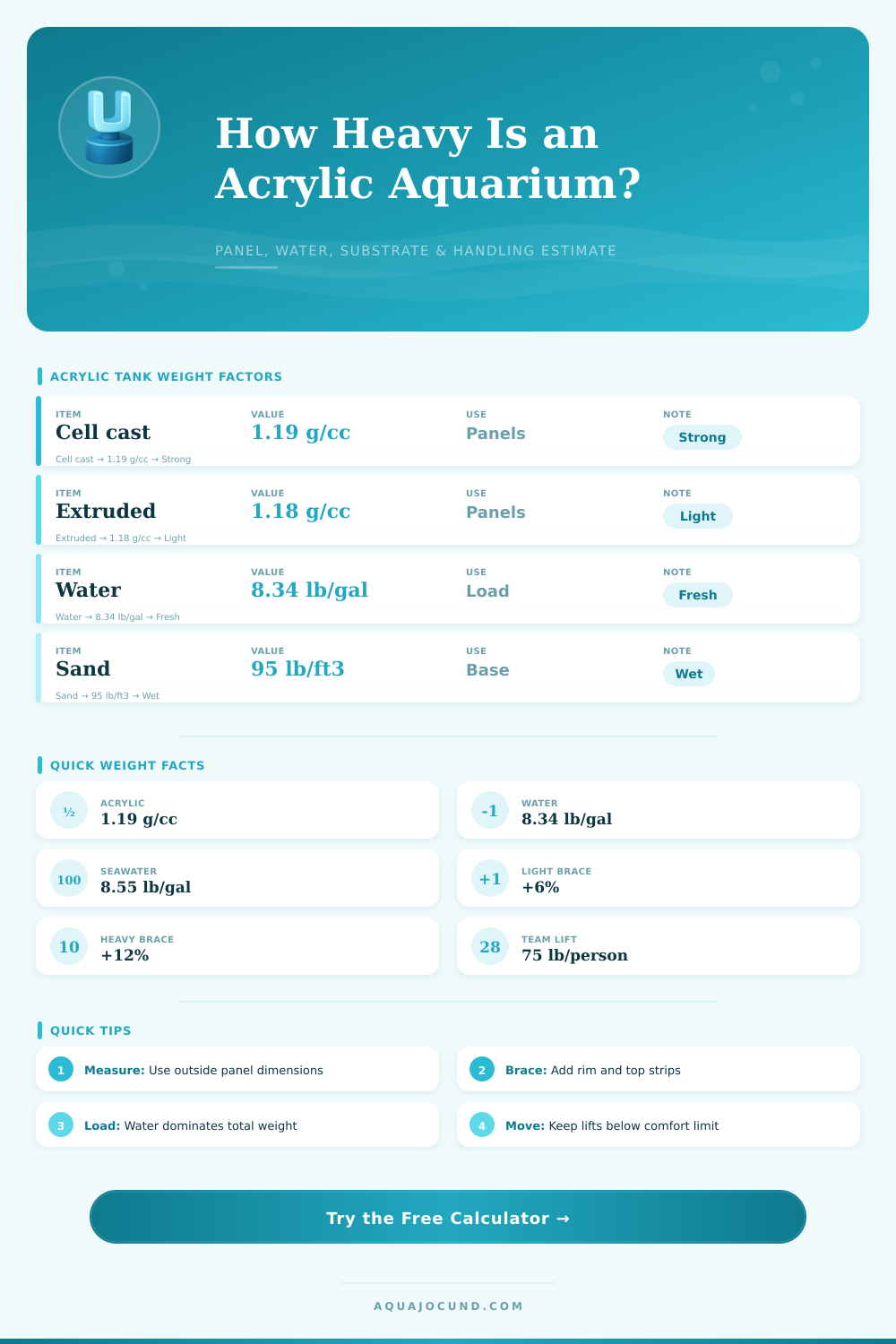
| Cell-cast acrylic | 1.19 g/cm3 | Panel weight | Common for premium custom tanks |
| Extruded acrylic | 1.18 g/cm3 | Panel weight | Slightly lighter sheet estimate |
| Freshwater | 8.345 lb/gal | Filled load | Use for planted and community tanks |
| Saltwater | 8.55 lb/gal | Filled load | Use for reef and marine systems |
| Aquarium sand | 95 lb/ft3 | Substrate load | Wet bulk estimate, varies by grain |
| Coarse gravel | 105 lb/ft3 | Substrate load | Heavier than many planted soils |
| Tank | Outside Dimensions | Common Thickness | Notes |
|---|---|---|---|
| 10 gallon | 20 x 10 x 12 in | 1/4 in | Small rimless or sump |
| 20 long | 30 x 12 x 12 in | 1/4 to 3/8 in | Long footprint, shallow height |
| 40 breeder | 36 x 18 x 16 in | 3/8 in | Popular reef footprint |
| 55 gallon | 48 x 13 x 21 in | 3/8 to 1/2 in | Tall front panels |
| 75 gallon | 48 x 18 x 21 in | 1/2 in | Often braced on top |
| 125 gallon | 72 x 18 x 22 in | 1/2 to 5/8 in | Plan for extra handlers |
| 180 gallon | 72 x 24 x 24 in | 5/8 to 3/4 in | Heavy empty lift |
| 300 gallon | 96 x 30 x 24 in | 3/4 to 1 in | Move with rigging plan |
| Calculated Lift | Suggested Handling | Risk Factor | Planning Note |
|---|---|---|---|
| Under 75 lb | 1-2 people | Low | Still protect seams and corners |
| 75-180 lb | 2-3 people | Moderate | Use suction cups or straps |
| 180-350 lb | 3-5 people | High | Dry run doorways and turns |
| 350 lb+ | Rigging advised | Very high | Consider dollies and lift equipment |
- Use outside dimensions: The estimate assumes the acrylic sheet area is based on full outside panel dimensions before seam overlap trimming.
- Add bracing weight: Eurobraces, perimeter rims, top strips, and lids can add more acrylic than the five main panels suggest.
- Thickness changes fast: Doubling acrylic thickness roughly doubles the empty tank weight, even when tank dimensions stay the same.
- Never move a filled tank: The filled load is for stand and floor planning, not for lifting an aquarium with water inside.
- Substrate varies: Wet sand, crushed coral, rock, and planted soils have different bulk densities, so treat substrate as an estimate.
- Plan the route: A light acrylic tank can still be awkward because long panels flex, scratch, and need balanced support.
Knowing teh weight of an acrylic aquarium is important because the weight of the aquarium will change with the addition of water, substrate, and other equipments. Consequently, the weight of the aquarium will impact the number of people that is needed to move the aquarium, as well as impact the type of stand that is required for the aquarium. In each of these instances, you can use the aquarium weight calculator to provide an estimate for the weight of the aquarium to avoid guesswork in determining the weight of the tank.
Acrylic panels are generaly lighter than the glass panels that are available for constructing aquariums. For these reasons, many aquarium builders will select acrylic panels for the aquarium that will be constructed. The density of cell cast acrylic is approximately 1.19 grams per cubic centimeter, which can be used to calculate the weight of the acrylic panels based off the thickness of the panels and the area of those panels.
How to Calculate the Weight of an Acrylic Aquarium
The builder must select the thickness of the acrylic panels; thicker panels will add to the weight of the aquarium, but will also provide more rigidity to the structure of that aquarium. In addition to the weight of the aquariums panels, the bracing that is constructed into the aquarium will add to the weight of the aquarium. Bracing panels, such as a simple rim brace, will add to the weight of the aquarium to a small degree; a full top frame will add more weight to the structure of the aquarium.
The use of bracing will help to prevent the aquarium’s panels from bowing due to the water pressure that will act upon the aquarium; while the addition of such bracing will add to the weight of the aquarium, the benefit of such bracing is considered to be an acceptable tradeoff. As such, the level of bracing can be selected with the weight calculator. The addition of water to the aquarium will add to the weight of the aquarium; one gallon of water weighs approximately eight pounds.
Thus, the more water that is added to the aquarium, the more the weight will increases. Saltwater is heavier than freshwater, so the inclusion of saltwater will increase the weight of the aquarium in comparison to the same amount of freshwater. You can use the weight calculator to adjust the amount of water that is contained within the aquarium, as is typical for most aquariums that are constructed with acrylic panels; the water level will impact the total weight of the aquarium.
Furthermore, the weight of the substrate that covers the floor of the aquarium will also contribute to the total weight of the tank. Substrates of sand and gravel has different weights; the weight of the substrate will vary according to the type of substrate that is used and the depth of the substrate. The depth of the substrate will impact the total volume of substrate that is placed within the aquarium; the footprint of the aquarium will determine the amount of substrate that is required to cover the tank.
Thus, the weight of the substrate is another contributing factor to the total weight of the aquarium. In addition to the substrate and water, other equipment and decorative rocks will add to the weight of the aquarium. Items like heaters, pumps, and even live rock will add to the weight of the aquarium; the calculator can account for the weight of the aquariums equipment.
Depending upon how the aquarium is to be managed, there will be options for the calculator to determine the weight of the empty aquarium, dry tank and substrate, or the weight of the filled tank with all components. Each of these options will provide an indication of the total weight of the aquarium and how many people is required to move that tank. In moving an aquarium constructed of acrylic panels, care must be taken to avoid placing stress upon the aquarium.
The aquarium should be supported along its longest dimension, and should be kept level during movement. While the calculator will provide the handling number for the aquarium, care must be taken to ensure the tank remains level during movement. The tables located within the reference information for this article describe the dimensions of and the thicknesses of the acrylic panels that are typically utilized within the industry for constructing aquariums of different sizes.
These tables are not rules for the thicknesses of aquarium panels, but they do indicate what is typically used in constructing tanks of specific sizes. For instance, tanks with a volume of 75 gallons may utilize half-inch thick panels for their construction; in contrast, tanks of 125 gallons may be made of five-eighths-inch thick panels or thicker. The aquarium weight calculator can be used to determine how various thicknesses and bracing options will impact the weight of the aquarium.
The weight of the filled aquarium will impact the loading that is placed upon the floor where the aquarium is standing; it is possible that the stand that can support the empty aquarium will not be able to support the filled tank. For these reasons, it is recommended that you never attempt to move the aquarium while it still contains water. The tables and breakdown of the weights of the different components of the aquarium will help to provide an understanding of the total weight of that aquarium.
For instance, the weight of the empty aquarium panels is typically very small in comparison to the weight of the water within the tank. Furthermore, small changes in the thickness of the aquarium panels will result in the addition of many pounds to the weight of the aquarium; thicker panels are stronger, but also add to the weight of the aquarium. The use of the aquarium weight calculator will help to determine the total weight of the aquarium, which will help to determine the type of stand that will be needed, as well as to plan for the movement of that aquarium.
Once the calculator has determined the total weight of the tank, it will be possible to plan the movement of that aquarium by determining the path that the aquarium will take and by gathering enough number of individuals to move the tank.