🌊 Starphire Glass Thickness Calculator
Estimate aquarium glass thickness, bowing deflection, and panel weight for low-iron builds.
| Glass Type | Visible Edge Tint | Relative Weight | Calculator Strength Factor | Common Aquarium Use |
|---|---|---|---|---|
| Starphire low-iron annealed | Very low green tint | Same as float | 1.00 | Front viewing panel, display tanks |
| Low-iron float glass | Low green tint | Same as float | 0.98 | Front and side viewing panels |
| Extra-clear low-iron glass | Minimal tint | Same as float | 0.98 | Rimless display aquariums |
| Standard soda-lime float | Green edge tint | Same as float | 1.00 | Back, bottom, utility panels |
| Low-iron laminated pair | Low tint, interlayer visible | Heavier | 0.92 | Special builds and impact margin |
| Tempered low-iron panel | Low tint | Same as float | 1.15 | Undrilled bottoms or covers only |
| Brace Mode | Top Support | Span Effect | Best Use |
|---|---|---|---|
| Rimless | Open top | Highest demand | Small to medium display tanks |
| Euro brace | Glass perimeter strips | About 18% reduction | Low profile display builds |
| Center / cross brace | One or more cross ties | About 25% reduction | Long tanks with open sections |
| Factory plastic rim | Perimeter rim | About 30% reduction | Standard manufactured tanks |
| Full perimeter frame | Rigid top and bottom frame | About 36% reduction | Large framed aquariums |
| Tank Size | Dimensions | Water Height | Typical Rimless | Typical Braced |
|---|---|---|---|---|
| 10 gallon | 20 × 10 × 12 in | 11 in | 6 mm | 5 mm |
| 20 long | 30 × 12 × 12 in | 11 in | 8 mm | 6 mm |
| 40 breeder | 36 × 18 × 16 in | 15 in | 10 mm | 8 mm |
| 55 gallon | 48 × 13 × 21 in | 20 in | 12 mm | 10 mm |
| 75 gallon | 48 × 18 × 21 in | 20 in | 12 mm | 10 mm |
| 90 gallon | 48 × 18 × 24 in | 23 in | 15 mm | 12 mm |
| 125 gallon | 72 × 18 × 22 in | 21 in | 19 mm | 15 mm |
| 180 gallon | 72 × 24 × 24 in | 23 in | 19 mm | 15 mm |
When considering the thickness of glass for an aquarium, there are a variety of variable that must be taken into consideration. Most people may believe that the total height of the aquarium is the most important measurement for determining aquarium thickness. However, the most important measurement of an aquarium isnt the total height of the tank, but instead the height of the water within the tank.
The height of the water within the aquarium will determine the amount of pressure that is placed onto the front glass panel of the aquarium. Tanks with higher heights of water will exert more pressure onto the front glass panels of the tank than tanks with lower heights of water. Thus, you must use the height of the water in the calculations for the thickness of the aquariums glass panels, rather than the total height of the aquariums panels.
How to Choose the Right Glass Thickness for an Aquarium
The type of water that will be contained within the aquarium will also impact the thickness of the aquariums glass. Because saltwater is more denser than freshwater, saltwater will exert more pressure against the side of the aquarium than freshwater would. Furthermore, the type of bracing that the builder utilizes for the aquarium will also impact the thickness of the aquarium.
For instance, aquariums without a bracing system at the rim of the tank will experience a more great degree of stress placed upon the aquariums glass panels. Thus, tanks without bracing at the rim will require thicker glass to prevent the tank from bowing. However, if euro braces or a center crossbar brace the aquarium, the stress placed upon the glass will be less, and thus, thinner glass can be used.
The material for the aquarium glass will impact the clarity of the aquarium, but will not impact the thickness of the aquarium. For instance, Starphire low-iron glass will produce a more clearer view of the aquarium than standard float glass. However, Starphire low-iron glass has the same density and structural property as standard float glass.
Thus, the thickness of the glass will be the same regardless of whether you chose Starphire low-iron glass or standard float glass for the aquarium. However, you can choose Starphire low-iron glass for the front panel of the aquarium only, instead of all four panels of a custom aquarium. Another factor to consider for the thickness of the aquarium is the deflection of the aquariums glass panels.
Even with the selection of the appropriate thickness for the aquarium, the panels may still experience some deflection caused by the water. While a small amount of deflection is normal for aquariums, large deflection can lead to the glass panels of the aquarium appearing curved. Thus, the field for comparing the thickness of the glass panels can be used to test the deflection that may result from various thickness of the aquariums glass panels.
There are some common mistake that can be made when calculating the thickness of the aquariums glass. For instance, one of the most common mistake is measuring the outer footprint of the tank rather than the actual length of the aquarium panels. Additionally, using the total height of the aquarium rather than the height of the water within the tank is another mistake that people often make.
Using these incorrect measurements will lead to the incorrect calculation of the thickness of the aquariums glass. Furthermore, any safety factor that can be applied to the thickness of small aquariums may not be applicable to larger aquariums. Because the longer the panel of glass for an aquarium, the more leverage the panel has; thus, the longer panel will require a thicker thickness of glass to ensure the same safety factor is provided for those long glass panels.
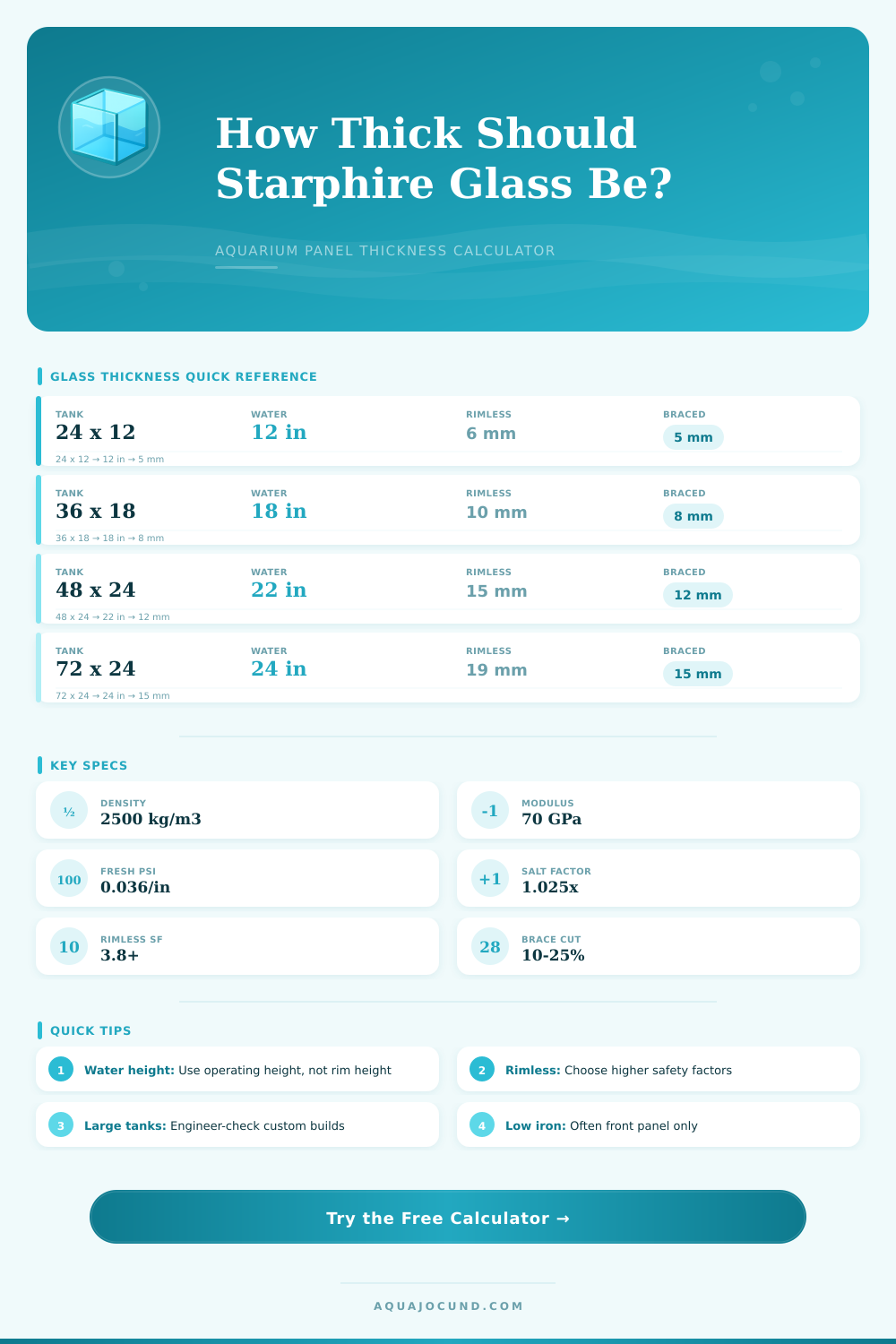
Another option for aquarists considering the thickness of their aquarium is to refer to the reference table provided for various size of tanks and the thickness of the glass that should be utilized for those tanks of the given sizes. Though this reference table can provide a helpful guide for different sizes of tanks and the thickness of the glass panels that should be utilized for those tanks, the reference table is not to be use as a replacement for the calculations for the custom aquarium. After determining the thickness of the aquariums glass panels, other factor for the aquarium must also be decided.
For instance, the remaining thickness of the aquarium will dictate the way in which the aquariums seams will be finished, as well as the way in which the aquarium will be braced for support. Thus, the thickness of the aquarium glass will also determine the method in which the aquarium will be finished. Additionally, the thickness of the aquarium glass panels should match the amount of water pressure in the aquarium, as well as the type of bracing for the aquarium; this will ensure the safety of the aquarium when the aquarist is to utilize it.