💧 Dosing Pump Calibration Calculator
Convert a measured pump test into flow rate, correction factor, split dosing, tube wear insight, and reservoir duration.
| Condition | Typical Flow Change | Calibration Action | Common Symptom |
|---|---|---|---|
| New tubing | 0% to +4% | Run a fresh baseline test | Higher than old setting |
| Light wear | -2% to -6% | Retest monthly | Small daily drift |
| Moderate wear | -7% to -12% | Correct controller and monitor | Alk or nutrient swings |
| Heavy wear | -13% to -25% | Replace tube soon | Slow or pulsed output |
| Roller slip | -25% or more | Service pump head | Air gaps in line |
| Solution Type | Viscosity Hint | Scheduling Style | Practical Note |
|---|---|---|---|
| Alkalinity / KH | Medium | Many small doses | Separate from calcium |
| Calcium | Medium | Split if large | Keep line clean |
| Magnesium | Medium-high | Few larger doses | Retest after mixing |
| Trace elements | Low | Small daily dose | Use accurate test volume |
| Plant fertilizer | Low-medium | Daily or weekly split | Shake reservoir if needed |
| Carbon source | Low | Very small splits | Avoid sudden increases |
| Kalkwasser | Settling risk | Slow frequent doses | Keep pickup above sediment |
| RO/DI water | Low | ATO-style dosing | Good calibration fluid |
| Test Duration | Best For | Accuracy Tradeoff | When to Repeat |
|---|---|---|---|
| 30 seconds | Fast high-flow check | More measuring error | After quick maintenance |
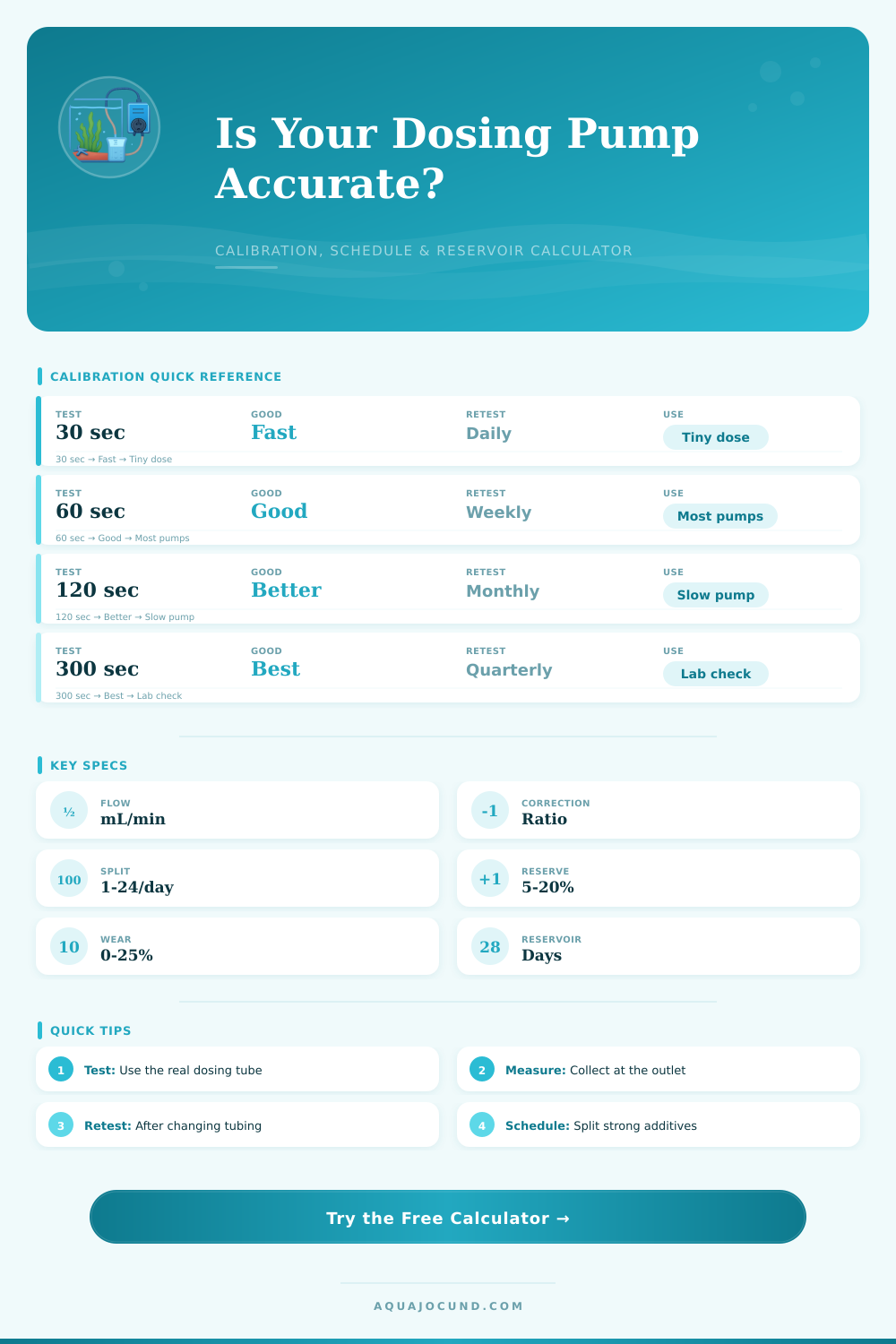
| 60 seconds | Standard pump check | Good for most dosing heads | Weekly or monthly |
| 120 seconds | Slow dosing heads | Better low-flow accuracy | After tube replacement |
| 300 seconds | Critical trace dosing | Best manual precision | Before fine corrections |
| Setup | Typical Daily Dose | Common Splits | Calibration Focus |
|---|---|---|---|
| 10 gal nano reef | 1-10 mL/day | 2-6 | Small-volume accuracy |
| 20 gal planted tank | 5-30 mL/day | 1-3 | Weekly consistency |
| 40 breeder reef | 20-80 mL/day | 4-12 | Alk stability |
| 75 gal reef | 40-160 mL/day | 6-24 | Line wear correction |
| 125 gal display | 80-300 mL/day | 12-48 | Reservoir planning |
Dosing pumps is used to deliver precise amount of liquid to various tanks and areas within the aquarium. Despite the precision dosing pumps are capable of during they’re operation, dosing pumps can drift from their expected parameter. Dosing pump drift can occur for a variety of reason, such as the tubing within the dosing pump can soften over time, the check valves within the dosing pump can increase in friction over time, or the viscosity of the liquid solution can change with changes in the temperature of that liquid.
Each of these factor can cause the amount of liquid that the dosing pump controller thinks is being delivered from the dosing pump to not match the amount of liquid that the dosing pump is actualy delivering to the tank. In order to understand at what rate the dosing pump is actually able to deliver its liquid, it is possible to perform a timed measurement of the dosing pump. In order to perform a timed measurement, you should run the dosing pump for a specific number of second, collect the liquid that the dosing pump delivers, and then compare that amount of liquid to the amount that the dosing pump controller has set as the amount that should be delivered.
How to Test and Adjust Your Aquarium Dosing Pump
By performing this type of measurement, it is possible to determine the true milliliter per minute of the dosing pump, as well as to calculate the correction factor that the dosing pump controller should apply to the target amount of liquid that is targeted daily by the dosing pump controller. The duration for which the dosing pump is to be timed can have an impact upon the accuracy of the measurement of the true delivery rate of the dosing pump. For instance, if the dosing pump is only timed for a period of thirty seconds, it is possible that the amount of liquid collected will be too small to provide accurate reading of the true delivery rate of the dosing pump.
In contrast, if the dosing pump is timed for a period of two minutes or five minutes, there will be more time for the liquid to be dispensed from the dosing pump at an even rate, and it will be easier to read the amount of liquid that was delivered from the tank. Thus, longer test will help to provide accurate measurements of the true delivery rate of dosing pumps that have slow delivery rates, or those that require small amounts of liquid to be dispensed into the tank. The tubing within the dosing pump can also impact the amount of liquid that the dosing pump delivers.
For instance, tubing that is new may allow for the dosing pump to deliver more liquid than those that are intended to be delivered. Yet, after three months of continuous use of the dosing pump, the tubing may have worn and flattened, which can reduce the amount of liquid that the pump can deliver. After six month of use, the flow rate of the dosing pump may have dropped to only 90% or 88% of the flow rate that was created by new tubing.
In order to account for this wear and tear, a wear selector can be used within the calculation tool that allows for the lost percentage of flow rate to be accounted for when manually calculating the correction factor for the dosing pump. The type of liquid solution that is to be dispensed from the dosing pump also has an impact upon the schedule for the dosing pump. For instance, dosing pumps that are used to deliver alkalinity and calcium solution may have their liquid split into many different dose of liquid.
This is to prevent the pH or the saturation of the water from changing too rapid within the tank. Carbon sources are also best dosed in small amounts and provided frequently to prevent shocking the bacterial population within the aquarium. Lastly, kalkwasser solution must also be dosed slowly and often to prevent the slurry from the kalkwasser from settling within the lines of the dosing pump.
It is also important to take into account the amount of liquid that will be contained within each of the liquid reservoir. By utilizing the calculation tool, it is possible to account for the amount of liquid that will not be usable within the dosing pump (due to the lines and the safety reserve), leaving only the usable volume of liquid. By dividing that amount by the amount of liquid that the dosing pump is to be delivered daily by the dosing pump, it is possible for the calculation tool to provide an amount in relation to the number of day that the current amount of liquid will last within each of the reservoirs.
Thus, it is possible to determine if the current container of the liquid will last for a certain period of time, or if additional liquid must be batched and prepared for the aquarium. The dosing schedule for the dosing pump can also impact the accuracy of the dosing pump. For instance, if each dose from the dosing pump is less than five second in length, it is possible for the dosing pump to not be consistent in the rate at which it delivers the liquid.
Therefore, splitting the dose into more event will improve the accuracy of the dosing pump. However, increasing the number of events will also impact the dosing pump in that it will need to start and stop more frequently. Therefore, the user can review the dosing schedule to ensure that it is compatible with the dosing pump that is to be utilize within the aquarium.
It is recommended to perform a timed measurement each time the tubing within the dosing pump is replaced. Each time the tubing is replaced with new tubing, the dosing pump may deliver more liquid than with the old tubing. Thus, the alkalinity level within the tank can rise.
By measuring the amount of liquid that the dosing pump will actually deliver with the new tubing after each replacement, it is possible to adjust the dosing pump controller to compensate for any difference in the rate of liquid delivery. Furthermore, by measuring the true delivery rate of the dosing pump each time the tubing is replaced, it is also possible to catch any drift that may be occurring with the dosing pump.