💧 ATO Reservoir Size Calculator
Size top off water for evaporation, room conditions, autonomy days, pump dead volume, and reservoir safety margin.
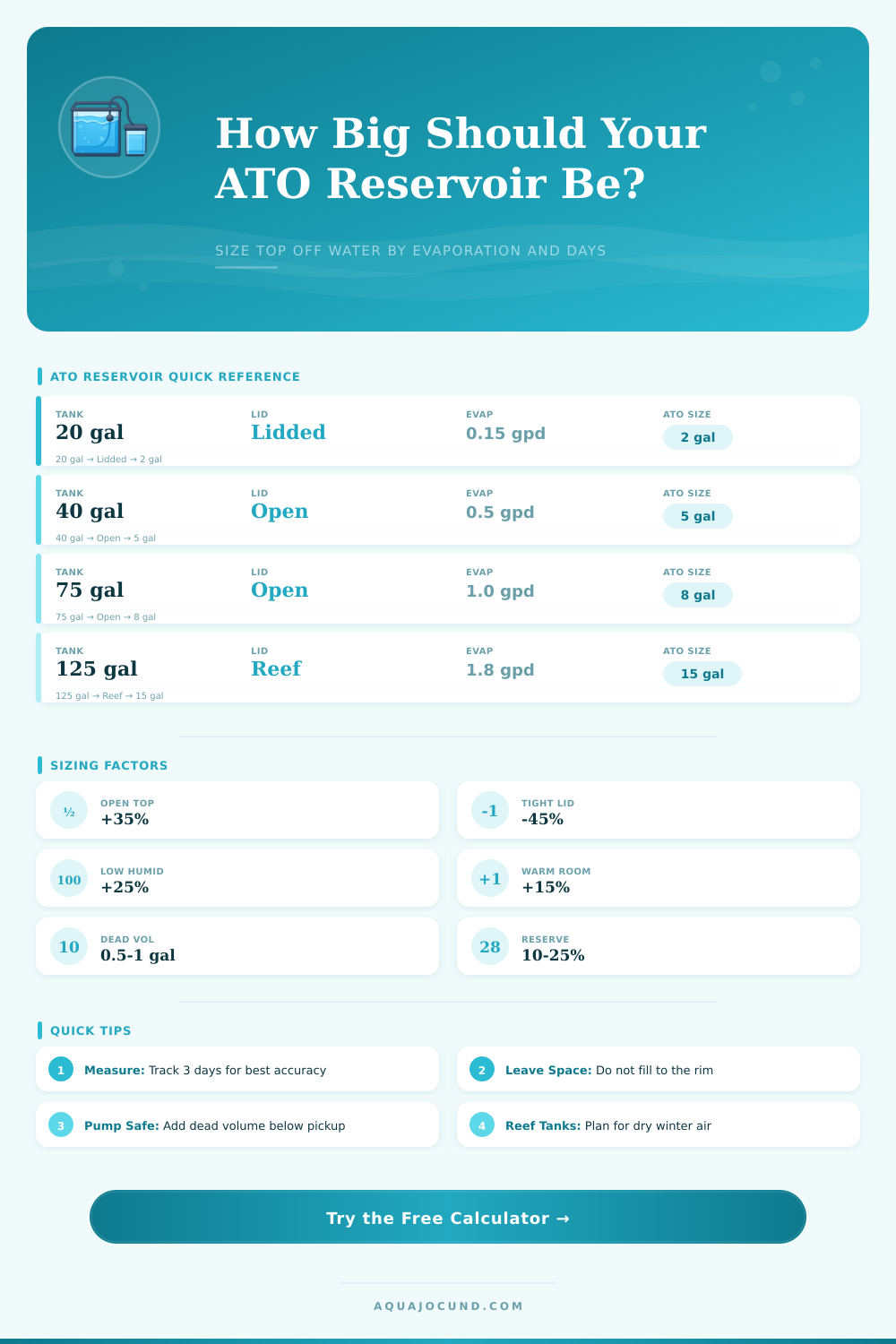
| System | Typical Evaporation | 5 Day Reservoir | 7 Day Reservoir | Notes |
|---|---|---|---|---|
| 10 gal lidded nano | 0.08-0.18 gal/day | 1-2 gal | 2 gal | Small pump dead volume matters |
| 20 long planted | 0.20-0.40 gal/day | 2-3 gal | 3-4 gal | Open tanks trend higher |
| 40 breeder reef | 0.45-0.85 gal/day | 4-6 gal | 5-8 gal | Fan cooling can double use |
| 75 gal reef with sump | 0.80-1.30 gal/day | 6-9 gal | 8-12 gal | Include sump surface area |
| 125 gal SPS reef | 1.40-2.40 gal/day | 9-15 gal | 12-20 gal | Dry rooms need more reserve |
| Factor | Low Evaporation | Moderate | High Evaporation |
|---|---|---|---|
| Lid / top | Tight glass lid | Mesh or partial lid | Open rimless top |
| Humidity | 65% or higher | 40-60% | Below 35% |
| Room temperature | 68-72°F | 73-78°F | 79°F or warmer |
| Water movement | Low freshwater flow | Planted or mixed reef | High flow or fan cooling |
| Container | Dimensions | Approx Capacity | Best Use |
|---|---|---|---|
| Cabinet jug | 10 x 10 x 12 in | 5 gal | Nano or 3 day reef |
| Slim bin | 16 x 10 x 14 in | 9.7 gal | Most 40-75 gal systems |
| Tall reservoir | 18 x 12 x 18 in | 16.8 gal | Week away reef use |
| Round bucket | 12 in diameter x 14 in | 6.9 gal | Compact freshwater ATO |
| Large storage bin | 24 x 16 x 18 in | 29.9 gal | Large reef or vacation |
Mark your sump water line, disable the ATO for a safe test window, and measure how much fresh water replaces evaporation over two or three normal days.
Do not size only to the exact daily loss. Add pump dead volume, leave headspace below the rim, and keep total reservoir volume below what your sump can safely accept during a failure.
An automatic top off system is a device that is use to replace the water that evaporates from aquarium tanks. An automatic top off system is important because if the water levels in the aquarium tank becomes to low, this can lead to the pump running dry or the chemistry of the water becoming imbalanced. In order for an automatic top off system to function proper, it is important to make sure that the system is the correct size to avoid the system from running empty.
The system’s size should account for the amount of water that evaporates from the tank each day, as well as the number of days that you want the system to be autonomous before needing to refill the tanks reservoir with water. Evaporation is the process in which water from the tank evaporate into the air. Because of this process, an automatic top off system is necessary.
Choose the right size for your automatic top off system
The rate at which water evaporates from the tank can change depending upon the environment of the tank. For instance, tanks that experience significant agitation of there water will lose water at a faster rate than tanks with a lid. Additionally, the tank that is located in a dry room will lose water at a faster rate than a tank in a humid room.
As such, you will need to enter each of these factors into the automatic top off system calculator in order to determine the correct size of the reservoir. To calculate the correct size for the automatic top off system reservoir, there are several different inputs that you must make into the calculator. The display and sump volumes of the aquarium must be entered into the calculator.
Additionally, you must enter the waters surface area, as well as the lid and system type, as well as the humidity and temperature of the room in which the aquarium is located. Additionally, if you have measured the amount of water that is lost from the tank each day, you can enter that value into the calculator instead of the estimated measurement. The autonomy days for an automatic top off system are the number of days that the automatic top off system will run before the reservoir become empty.
While many individuals may desire to set the system to a low number of autonomy days, it is actualy recommended to use a higher number of autonomy days, as this will allow for extra time in the case that the rooms temperature increase. Additionally, the pump dead volume should also be entered into the calculator. Dead volume is the amount of water that remains in the reservoir within the automatic top off system beneath the intake of the aquarium pump.
Including this value in the calculation will ensure that the automatic top off system does not become depleted of water prior to the float switch turn off the pump. The reference tables included in the tool provide examples of the different rates at which tank of each size can lose water based off the environment in which they are located. These tables are not rules, but they do provide a helpful starting point in the estimation of the amount of water that should be lost by the tank each day.
For instance, a 75 gallon reef tank may lose one gallon of water per day in one environment, but may lose two gallons per day in another environment. These scenarios can be test with the tool. Ensuring that the automatic top off system reservoir is the correct size for the aquarium can provide a variety of benefit for the aquarium owner.
For instance, if the reservoir is of the correct size, the automatic top off system does not need to be refilled each day. Additionally, the system will help to maintain the salinity of the tank, as well. Additionally, in the case that an individual should decide to change any part of the tank, such as adding a lid, the automatic top off system can be adjusted to account for this change.
The tool also include a section for the shape and dimensions of the automatic top off system. This is because different shapes of containers can hold different amounts of water. For instance, a round container of a certain size may hold a different amount of water than a rectangular container of the same dimensions.
This area of the tool ensure that the automatic top off system will fit into the designated spot under the tank stand. Additionally, if you know the dimensions of the container that is to be utilized for the automatic top off system, you can enter that information into the system using the “direct capacity entry” section of the tool. An automatic top off system acts as a buffer between the loss of water from the tank and the time that an owner can dedicate to performing maintenance on the tank.
By ensuring that the automatic top off system is of the correct size, the system will perform as it is intended to perform. An automatic top off system of the correct size will avoid the types of problems that an incorrectly sized automatic top off system may create.