🌊 Durso Standpipe Size Calculator
Estimate quiet gravity-drain capacity, air-hole starting size, overflow drop, noise risk, and emergency drain margin.
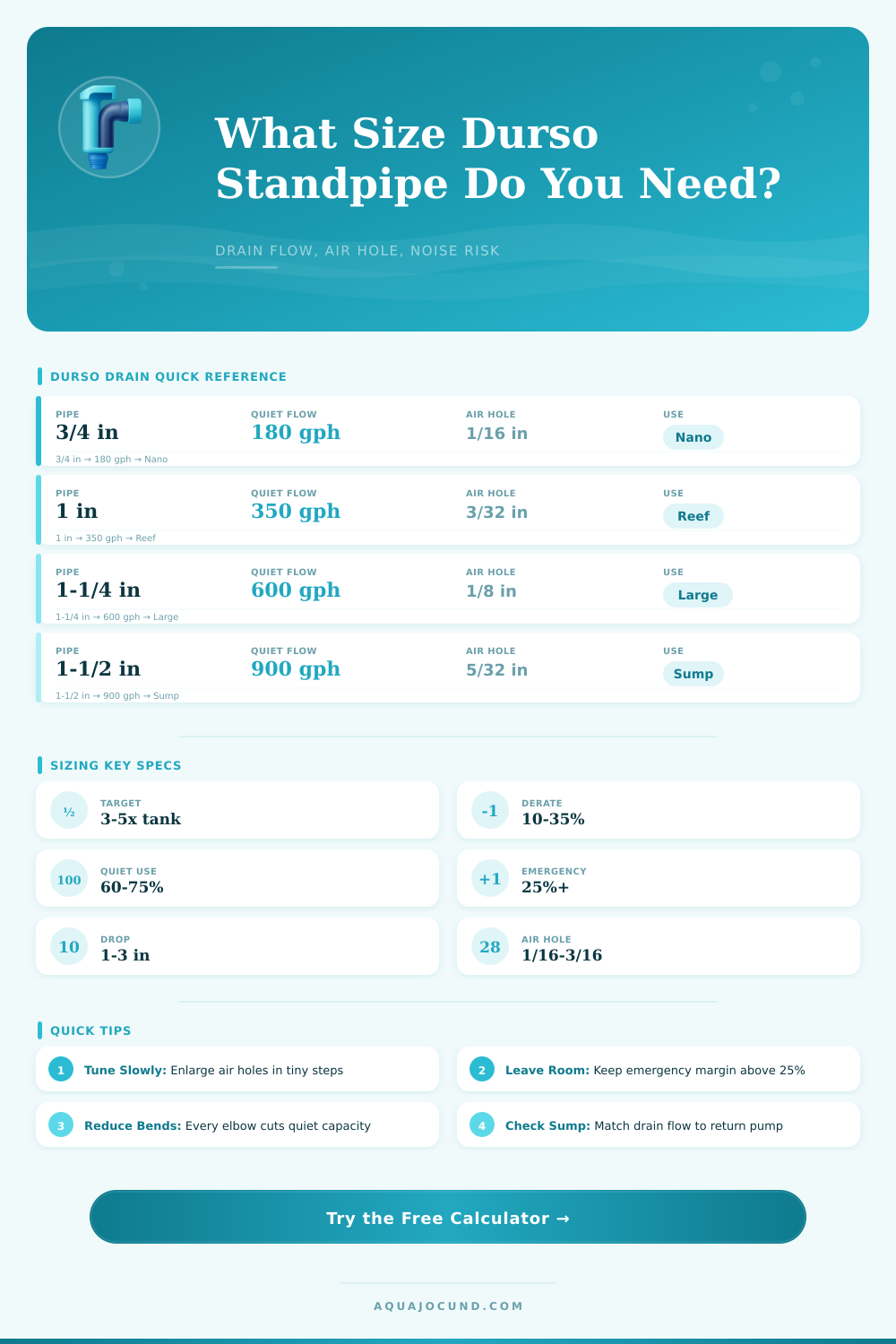
180-250 gph quiet
350-450 gph quiet
550-700 gph quiet
850-1050 gph quiet
| Pipe Size | Inside Dia. | Quiet Durso Flow | Upper Practical Flow | Typical Air Hole | Best Aquarium Use |
|---|---|---|---|---|---|
| 3/4 in | 0.824 in | 180-250 gph | 300 gph | 1/16-5/64 in | Nano, small sump |
| 1 in | 1.049 in | 350-450 gph | 600 gph | 3/32-1/8 in | Most reef-ready tanks |
| 1-1/4 in | 1.380 in | 550-700 gph | 900 gph | 1/8-5/32 in | Large reef overflows |
| 1-1/2 in | 1.610 in | 850-1050 gph | 1350 gph | 5/32-3/16 in | Large display drains |
| 2 in | 2.067 in | 1400-1800 gph | 2300 gph | 3/16 in+ | Very large systems |
| Tank Style | Sump Turnover | Example Tank | Target Drain Flow | Typical Durso Size |
|---|---|---|---|---|
| Quiet reef | 3x-4x display | 75 gal | 225-300 gph | 1 in |
| Mixed reef | 4x-6x display | 90 gal | 360-540 gph | 1-1/4 in |
| FOWLR | 5x-7x display | 125 gal | 625-875 gph | 1-1/2 in |
| Frag system | 4x-8x display | 60 gal | 240-480 gph | 1 in |
| High flow sump | 7x-10x display | 180 gal | 1260-1800 gph | Dual drains |
| Factor | Typical Effect | Calculator Treatment | Practical Note |
|---|---|---|---|
| Durso tee and elbow | 5%-12% loss | Count as fittings | Oversize if the cap must be silent |
| Each extra elbow | 3%-6% loss | Progressive derate | Sweeps are quieter than hard 90s |
| Valve or strainer | 4%-8% loss | Extra derate | Clogging quickly reduces margin |
| Short vertical run | Lower draw | Run bonus or penalty | Very short drains need extra margin |
| Overflow drop over 3 in | Splash noise | Noise risk increase | Raise standpipe or lower weir drop |
| Capacity above 80% | Slurping risk | Noise risk increase | Reduce return flow or upsize pipe |
Start small: Drill the Durso cap undersized, then enlarge one drill size at a time. Too little air makes a flushing siphon; too much air makes a hiss and lowers useful drain capacity.
Do not run a single drain at its limit: A snail, algae mat, or salt creep can reduce capacity fast. A separate emergency standpipe should comfortably exceed the return pump flow.
A standpipe is an component of a reef tank that manage the drainage of the tank. A Durso standpipe must be sized apropiately to ensure the draining of the water from the reef tank are quiet. A Durso standpipe allows for air to enter the standpipe in a control fashion.
The introduction of the air prevent the formation of a full siphon that could potentially create a loud hiss of water emerging from the bulkhead of the tank. The size of the standpipe, the height of the overflow tank, and the size of the air hole allow for control of the quietness of the standpipe. The calculator consider several different variable when determining the size of the standpipe that is necessary for the reef tank.
How to Size a Durso Standpipe for a Quiet Reef Tank
The target drain flow of the return pump is the amount of water that drains from the reef tank each cycle, and that is the amount that the standpipe must drain. The size of the pipe is the baseline for the amount of water that can pass through the standpipe. However, the number of elbows and valves that is contained within the standpipe will introduce friction into the system that reduce the amount of water that can move through the standpipe.
The length of the vertical portion of the standpipe can also have an impact upon the amount of water that is allowed to pass through the standpipe; the longer the vertical portion, the more momentum that the water gains that allows for more flow through the standpipe without surging. The height from which the water drops into the standpipe can also impact the noise created by the standpipe. The higher the overflow tank is set above the standpipe, the more splash that will occur as the water falls into the standpipe.
The height of the overflow is one of the variables that can be incorporated into the noise risk score of the standpipe. Additionally, the preference for the water level within the tank impact the derate percentage of the standpipe. Finally, you can compare the size of the air hole within the standpipe to the size of the existing air hole.
The size of the air hole should be adjusted until the water level within the tank is kept steady without the standpipe hiss. The emergency margin is the difference between the amount of water that drains from the reef tank and the amount of water that the return pump moves. It is recommended that standpipes is installed as a means of providing additional emergency margin in the case that the standpipe becomes clogged with algae or other particulate.
The emergency margin will shrink over time as the standpipe becomes clogged. By calculating this emergency margin, a person can avoid creating a situation where the clogging of the standpipe lead to water on the floor. The reference tables included in the article provide information regarding the quiet ranges for various standpipe size.
These tables allow individuals to easily understand if the size of the standpipe leaves enough headroom for the remaining number of elbows and valves to be install in the system. The real world is never the same as the ideal world that is represented by the calculator. The inside of the standpipe may become covered in salt creep and the bends in the standpipe (elbows) may become coated in micro bubbles that both reduce the amount of water that passes through the standpipe.
Additionally, the output of the return pump can change over time as the impellers within the pump wear. The change in output will impact the amount of water that passes through the standpipe. To account for these changes in the real world, a progressive derate is applied to the capacity of the standpipe.
This allowance for the standpipe to decrease to 80% of its capacity, for example, take into account that a standpipe that is running at 80% of its capacity will have a more different noise output than one that is running at 60%. In order to properly tune the standpipe, a person follows a process of trial and error. The suggested size for the air hole is initially set.
The system is started and the noise created by the standpipe is listened to. If the standpipe flushes in bursts, indicating a lack of quietness, you should enlarge the air hole by one drill size. If the standpipe creates hissing noise and the water level within the overflow tank drop too low, the air hole is shrunk slightly.
The goal is to create a steady trickle of bubbles that prevent the formation of a long water column that would result in a loud flush of water from the standpipe. Often, individuals realize that they have made an incorrect calculation of the size of the standpipe once the reef tank is running. However, the cost of replacing the standpipe is typically high due to the need to replace the bulkhead and the overflow box.
Thus, it is better to be conservative in the sizing calculations than to deal with the errors later on in the tanks operation. The calculator provides a way of understanding the difference between a standpipe that barely meets the target flow of the return pump and one that provides a comfortable margin of extra flow that is not needed for the reef tanks operation. In cases where livestock is added to the tank or the return pump is changed, it is again necessary to calculate the proper size of the standpipe.
The system may start with lower requirements for the standpipe than those that are created by the growth of the reef tanks inhabitant. In these cases, it is better to calculate the standpipe size prior to changing the return pump. The standpipe must be sized to allow for the movement of the water without creating noise, and it must have enough spare capacity for cases of partial blockage.
Thus, prior to cutting a hole in the reef tanks glass, these requirement should be considered.