🌊 Aquarium Plumbing Pipe Size Calculator
Size return and drain plumbing by flow, pipe diameter, velocity, fittings, head loss, and overflow safety margin.
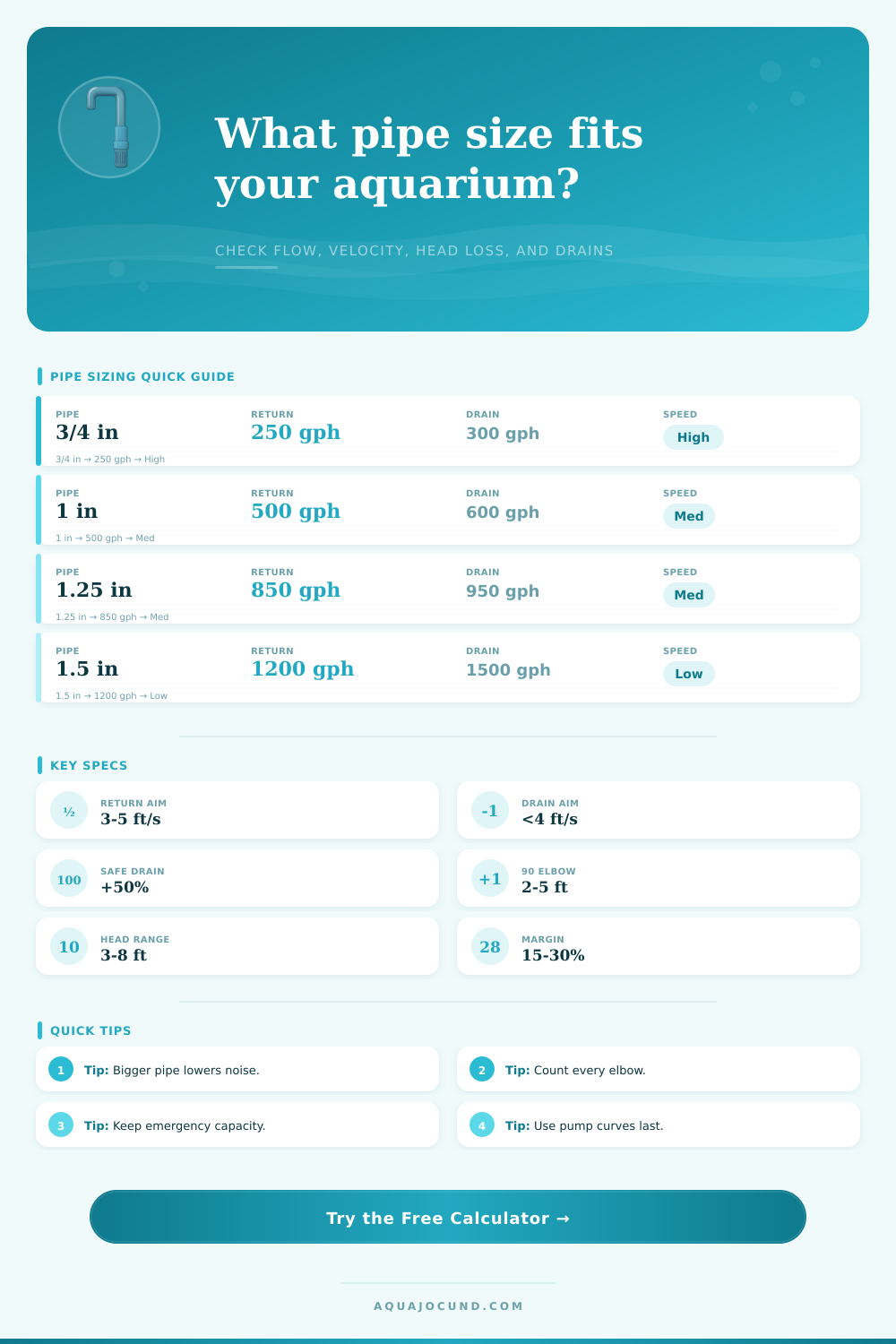
| Nominal Pipe | Internal Diameter | Quiet Return Range | Conservative Drain | Typical Aquarium Use |
|---|---|---|---|---|
| 1/2 in | 0.622 in / 15.8 mm | 80-180 GPH | 150 GPH | Nano return, reactor feed |
| 3/4 in | 0.824 in / 20.9 mm | 180-350 GPH | 300 GPH | Nano and small return |
| 1 in | 1.049 in / 26.6 mm | 300-600 GPH | 600 GPH | Common return or small drain |
| 1.25 in | 1.380 in / 35.1 mm | 550-950 GPH | 950 GPH | Quiet medium return |
| 1.5 in | 1.610 in / 40.9 mm | 800-1450 GPH | 1500 GPH | Reef drain, large return |
| 2 in | 2.067 in / 52.5 mm | 1400-2400 GPH | 2600 GPH | Large tank or manifold |
| Fitting | Small Pipe | Medium Pipe | Large Pipe | Calculator Use |
|---|---|---|---|---|
| 90° elbow | 4.5 ft | 3.2 ft | 2.6 ft | Highest common bend loss |
| 45° elbow | 2.2 ft | 1.6 ft | 1.2 ft | Gentler direction change |
| Ball valve | 5.5 ft | 4.2 ft | 3.0 ft | More loss if partly closed |
| Union | 1.2 ft | 0.9 ft | 0.7 ft | Small service allowance |
| Tee / outlet | 6.0 ft | 4.5 ft | 3.5 ft | Branch or return split |
| System | Tank Size | Desired Flow | Common Pipe | Safety Note |
|---|---|---|---|---|
| Nano reef return | 20 gal / 76 L | 150-220 GPH | 3/4 in | Keep velocity quiet |
| 40 breeder overflow | 40 gal / 151 L | 250-350 GPH | 1 in drain | Use emergency drain |
| 55 planted return | 55 gal / 208 L | 250-400 GPH | 3/4-1 in | Avoid plant blast |
| 75 mixed reef | 75 gal / 284 L | 500-700 GPH | 1 in return | Check pump curve |
| 120 SPS display | 120 gal / 454 L | 900-1200 GPH | 1.25-1.5 in | Plan extra headroom |
| 180 BeanAnimal | 180 gal / 681 L | 1200-1600 GPH | 1.5 in drains | Keep dry backup |
| Material / Mode | Friction Factor | Best Use | Watch Point |
|---|---|---|---|
| PVC Schedule 40 | Baseline | Most return and drain builds | Use sweep elbows when possible |
| Flexible PVC | +8% | Quiet long bends | Secure supports well |
| Vinyl tubing | +12% | Short cabinet returns | Kinks raise head quickly |
| ABS drain pipe | +4% | Gravity drains | Check bulkhead compatibility |
| Return mode | Uses static head | Pump-to-display sizing | Use manufacturer pump curves |
| Drain mode | Uses safety capacity | Overflow sizing | Always plan backup capacity |
Aquarium plumbing involve many variables. Pipe sizes is one of the variable to consider when designing aquarium plumbing. Pipe size affect the flow rate and a noise level of the aquarium plumbing.
The return and drain line of an aquarium have different sizing rule. The return line of an aquarium involve water under pressure. The velocity of the water in the return line impact how much resistance the aquarium pump have to overcome.
Choosing the Right Pipe Size for an Aquarium
Aquarium drain lines use gravity to empty the aquarium. The capacity of the drain line is dependent on the slope and an diameter of the drain line. Because return lines use pressure to move the water and drain lines use gravity to drain the aquarium, the pipe size should be more different for each line.
If you use the same pipe size for both lines, the aquarium plumbing may be too loud or the plumbing may be too restriction. Fittings is another major factor in aquarium plumbing. A 90-degree elbow are a fitting that create friction loss equivalent to several foot of straight pipe.
All the fittings, such as 90-degree elbows, valve, and tees, create friction loss in the plumbing system. The more friction loss in the system, the longer the aquarium plumbing system will be. Every fitting in the aquarium plumbing system must be accounted for as each one create resistance to the water movement in the system.
The material used in aquarium plumbing impact its performance. Smooth PVC are a plumbing material used in aquariums, and it offer a different level of resistance then flexible tubing or vinyl. Biofilm build up in aquarium plumbing systems.
This biofilm create more
Overflow safety are important for aquarium plumbing in that overflow safety prevent water from leaving the tank. A drain line sized to the target flow of the tank do not contain a safety margin for unexpected obstruction or valve adjustment. Should the drain line become partially clog or a valve become partially opened, the water will back up into the tank.
An emergency path should be included in the aquarium plumbing that drain into the tank, such as a second line or a larger backup line. This provide headroom for the water to not overflow from the tank into the stand. Velocity is also important in aquarium plumbing in that velocity determine whether the aquarium plumbing will be too loud or if the aquarium plumbing allow for solids to settle in the lines.
If the velocity in the return line are too fast, the return line will create excessive noise. If the velocity in the drain line are too slow, solids will settle in the drain line. Using the proper pipe diameter will allow for the proper velocity in the aquarium plumbing.
Many people makes mistakes in their aquarium plumbing design. One of the most common is to size the return line to the maximum flow rate of the pump. Another is to not count the fittings in the plumbing system in addition to the straight lengths of the pipe.
Finally, many people does not consider the emergency drain to be one of the component to consider in the design of the aquarium plumbing. You should use a calculator to determine the correct size of the pipes to be used in the aquarium plumbing system. The calculator allow the designer to enter the different variable of the plumbing system.
Using the calculator allow the designer to make more informed design decision based off calculation rather than rules of thumb. Choosing a larger pipe size for the aquarium plumbing system may increase the cost of the aquarium system. However, using a larger pipe size will allow the aquarium plumbing system to be quiet while also providing headroom in case you make adjustment in the future.