🌿 CO2 Cylinder Duration Calculator
Estimate planted aquarium CO2 run time from cylinder size, bubble rate, bubble volume, solenoid hours, pressure reserve, diffuser efficiency, and tank demand.
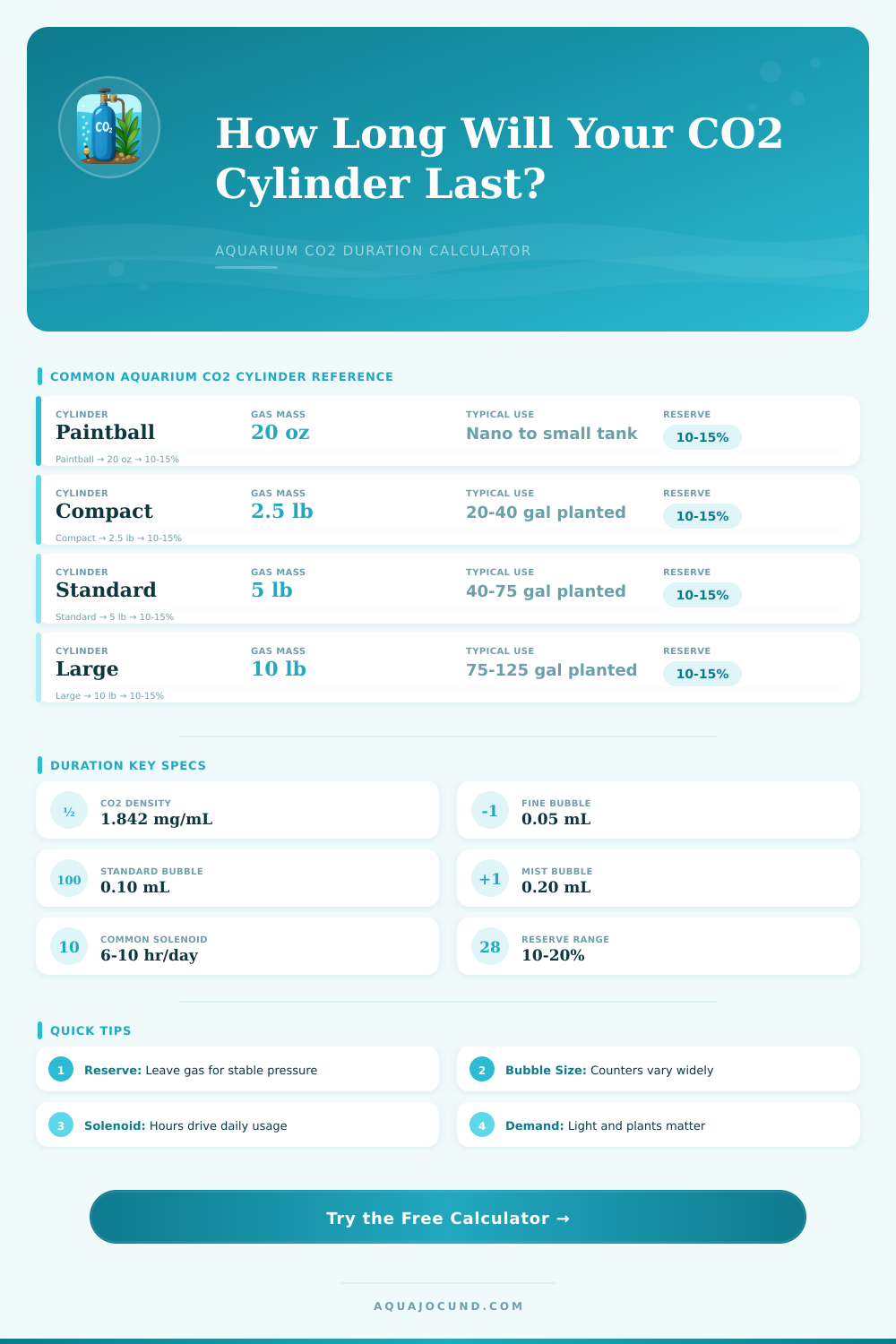
| Cylinder | Gas Mass | Metric Mass | Typical Aquarium Range | Common Reserve |
|---|---|---|---|---|
| 20 oz paintball | 1.25 lb | 567 g | 5-20 gal | 10-15% |
| 2.5 lb compact | 2.5 lb | 1.13 kg | 20-40 gal | 10-15% |
| 5 lb standard | 5 lb | 2.27 kg | 40-75 gal | 10-15% |
| 10 lb large | 10 lb | 4.54 kg | 75-125 gal | 10-20% |
| 15 lb high capacity | 15 lb | 6.80 kg | 125-180 gal | 10-20% |
| 20 lb bulk | 20 lb | 9.07 kg | Multi-tank rack | 10-20% |
| Bubble Style | Approx. Volume | Best Use | Duration Effect |
|---|---|---|---|
| Tiny mist bubble | 0.03-0.06 mL | Needle valve fine tuning | Longest estimate |
| Fine counter bubble | 0.07-0.10 mL | Most planted tanks | Balanced estimate |
| Large counter bubble | 0.12-0.18 mL | Wide bubble counters | Shorter estimate |
| Coarse bubble | 0.20-0.30 mL | Loose or high-flow counters | Shortest estimate |
| Tank | Dimensions | Cylinder | Typical Setting | Rough Duration |
|---|---|---|---|---|
| 10 gal nano | 20 x 10 x 12 in / 51 x 25 x 30 cm | 20 oz | 0.5 bps, 7 hr, fine bubble | 5-8 months |
| 20 gal long | 30 x 12 x 12 in / 76 x 30 x 30 cm | 2.5 lb | 1 bps, 8 hr, ceramic | 6-9 months |
| 40 breeder | 36 x 18 x 16 in / 91 x 46 x 41 cm | 5 lb | 2 bps, 8 hr, atomizer | 7-11 months |
| 55 gal | 48 x 13 x 21 in / 122 x 33 x 53 cm | 5 lb | 2.5 bps, 8 hr, ceramic | 5-8 months |
| 75 gal | 48 x 18 x 21 in / 122 x 46 x 53 cm | 10 lb | 4 bps, 8 hr, inline | 7-10 months |
| 120 gal | 48 x 24 x 24 in / 122 x 61 x 61 cm | 15 lb | 6 bps, 9 hr, reactor | 8-12 months |
A CO2 system for your aquarium can be difficulity to manage if the CO2 cylinder run out of gas. When the CO2 cylinder runs out of gas, your plants will not be able to recieve the CO2 that they requires in order to perform the processes necessary to produce the oxygen that the aquarium fish requires to survive. Additionally, when the CO2 level drop for the aquarium, the pH of the water can change and the algae in the tank can begin to grow at an increased rate.
Therefore, it may be helpful to provide some means of knowing when the aquarium will need the CO2 cylinder to be refilled. A calculator can help to determine how long the CO2 cylinder will last based off a few different parameter of the aquarium and the system. You must enter the size of the CO2 cylinder into the calculation.
How Long Will Your Aquarium CO2 Cylinder Last
The size indicates how much CO2 the cylinder can hold. Additionally, you must enter the bubble rate and volume of the bubbles into the calculation. These two parameter indicate how much CO2 leaves the regulator of the system.
The solenoid schedule indicates how many hour each day that the solenoid will be open to allow gas to exit the cylinder. The reserve percentage can be used to ensure that the aquarium does not run out of CO2 by providing a safety margin for the amount of CO2 that is expect to leave the tank. Diffuser efficiency account for the CO2 that exits the bubble counter but does not dissolve into the water.
Finally, tank demand account for the amount of CO2 that the aquarium’s plants use each day. These different parameter interact with each other to create an understanding of the length of time that the CO2 cylinder will last. For instance, a fine ceramic diffuser will have a high diffuser efficiency but a coarse airstone will have a low diffuser efficiency.
Thus, if the efficiency is low, the CO2 will run out of gas more quick. Additionally, if the aquarium contains a high amount of light and dense plant, then the tank demand will be high. High tank demand will deplete the CO2 more quick than if the tank contained little light and few plants.
Thus, by using this calculator, the user can determine these difference between tanks and aquariums without having to perform the calculations themselfs. The duration of time that the CO2 cylinder will last is calculated based upon a few different variable. Each of these variable has the potential to impact the actual length of time the CO2 cylinder will last.
For instance, changes in the water temperature can impact how much CO2 dissolves into the water. Additionally, if the water is agitated in any way, CO2 can leave the water before the plants can utilize it. Thus, while this calculator will help to indicate when the CO2 cylinder may need to be refilled, keeping record of the actual date upon which the CO2 cylinders are refilled can improve the exactness of the calculation.
Furthermore, bubble counters may not be the same among different setup for the same individual. For instance, one bubble counter may produce large bubble while another may produce small bubble. Thus, if the user measures one bubble counter and find it have different size bubbles than the other, the rate of bubble may be the same but the actual volume of CO2 released from the tank will be different.
Therefore, if the results from the CO2 system do not appear to be accurate, you can measure the volume of the bubbles with a syringe. Additionally, the efficiency of the diffuser may decrease over time as the small pore of the diffuser may get clogged. Thus, if the efficiency of the diffuser decreases, less CO2 will enter the aquarium.
This calculator allows users to compare the amount of CO2 that is being released from the system each day to the demand for CO2 by the aquarium’s tank. If the daily use of CO2 from the system is higher than the demand for CO2 in the tank, you can lower the bubble rate. However, if the daily use of CO2 from the system is less than the demand for CO2 in the tank, the bubble rate will need to be increased.
By providing a specific number for each tank setup, this calculator allows users to make adjustment to the aquarium system according to calculated data. Finally, the size of the CO2 cylinder must be chosen. Small CO2 cylinders tend to be the most convenient and inexpensive option to refill but do not last for as long as large CO2 cylinder.
However, large CO2 cylinders will last for longer period of time but are more costly and heavy for the room. Thus, the CO2 cylinder calculator allows users to understand the impact that each size option will have upon the CO2 system. Thus, by using this CO2 calculator, individual can plan for the time that the CO2 cylinder will last so that it does not run out of gas unexpectedley.