Titanium Heater Size Calculator
Estimate aquarium heating watts, titanium heater count, sump/display split, controller load, guard margin, and cold-room derate from real tank dimensions.
| Heater style | Typical use | Flow factor | Guard note |
|---|---|---|---|
| Bare titanium tube | Sump or protected chamber | 1.00x | Use a guard in display areas |
| Encased titanium rod | Display, sump, or refugium | 1.03x | Case adds slight heat transfer margin |
| Inline titanium module | Return manifold or canister loop | 0.96x | Requires steady flow past element |
| Dual-probe titanium kit | Controller-managed reef systems | 1.00x | Good for split heater layouts |
| Compact sump heater | Nano sump or tight chamber | 1.06x | Needs clearance around element |
| High-flow pro element | Large sump with strong turnover | 0.95x | Best with controller probe downstream |
| Vat or pond titanium | Large aquarium, vat, or pond | 0.98x | Check controller outlet rating carefully |
| Tank size | Dimensions | 10°F rise | Cold room sizing |
|---|---|---|---|
| 20 long | 30 × 12 × 12 in / 76 × 30 × 30 cm | 100 W | 150 W |
| 40 breeder | 36 × 18 × 16 in / 91 × 46 × 41 cm | 200 W | 300 W |
| 55 gallon | 48 × 13 × 21 in / 122 × 33 × 53 cm | 275 W | 400 W |
| 75 gallon | 48 × 18 × 21 in / 122 × 46 × 53 cm | 375 W | 500 W |
| 125 gallon | 72 × 18 × 21 in / 183 × 46 × 53 cm | 625 W | 900 W |
| 180 gallon | 72 × 24 × 24 in / 183 × 61 × 61 cm | 900 W | 1200 W |
| Planning item | Calculator treatment | Typical range | Reason it matters |
|---|---|---|---|
| Temperature rise | Target minus lowest room temp | 5-20°F / 3-11°C | Higher rise requires more continuous wattage |
| Sump volume | Added to display water volume | 0-40% of display | Total system water must be heated |
| Cold room derate | Multiplier after base watts | 1.00-1.45x | Open tops, fans, and basements lose heat faster |
| Controller margin | Usable rating equals rating minus margin | 10-25% | Relays and outlets should not run at their limit |
| Metal guard use | Small added heat-transfer allowance | 0-8% | Guards protect livestock but can slow local flow |
| Split placement | Allocates wattage to display and sump | 30/70 to 50/50 | Reduces cold spots if return flow stops |
Selecting an titanium heater for an aquarium requires you to consider many different factor. Ensuring that you select the correct titanium heater for your aquarium will ensure that your aquarium maintain a steady temperature. Factors to consider include the condition of the room in which the aquarium is located, the volume of the sump, and how many titanium heater you will be utilizing in your aquarium.
Every aquarium lose heat at a different rate due to the environmental conditions in which each aquarium exists. For instance, a covered 75-gallon aquarium located in a climate-controlled room will lose heat at a different rate then an aquarium that is located in a basement and does not have a cover. One factor that you will have to calculate is the temperature rise, which is the difference between the desired temperature of the water in the aquarium and the coldest temperature in the room where the aquarium is located.
How to Choose a Titanium Heater for Your Aquarium
Based off this temperature rise, you can calculate other factors regarding the aquariums requirement. Titanium heaters is useful in aquariums that contain water with high concentrations of salt because the titanium heater will not corrode in these environment. In addition, the titanium heaters tend to transfer heat to the water at a higher rate than other material.
To ensure that the titanium heater performs proper in the aquarium, it is essential to size the heater correctly. Using an undersized titanium heater will cause the heater to constant work to maintain the temperature in the aquarium. Additionally, if you use an oversized single heater for your aquarium, it may create hot spot around the heater.
To avoid this problem, you can select an N+1 redundancy strategy. Using an N+1 redundancy strategy will require you to purchase additional heater so that if one heater should fail, the other will be able to supply enough heat to the aquarium. In addition to calculating the wattage and the number of heaters that is required for your aquarium, you will also have to consider the placement of these heaters.
For many aquarium, it is beneficial to split the number of heaters between the display tank and the sump. This allow the system to automatically compensate for any failed pump within the sump. Other aquarium keepers may place all of the heater within the sump so that the livestock in the aquarium is not exposed to hot surface.
Using the percentage calculator, you can determine how much of the total wattage will be allocated to each tank. This is important if you are planning to split the heaters as the split in wattage may impact the operation of your sump if it should fail during maintenance. Another factor to consider is the capacity of the controller into which you will incorporate your titanium heaters.
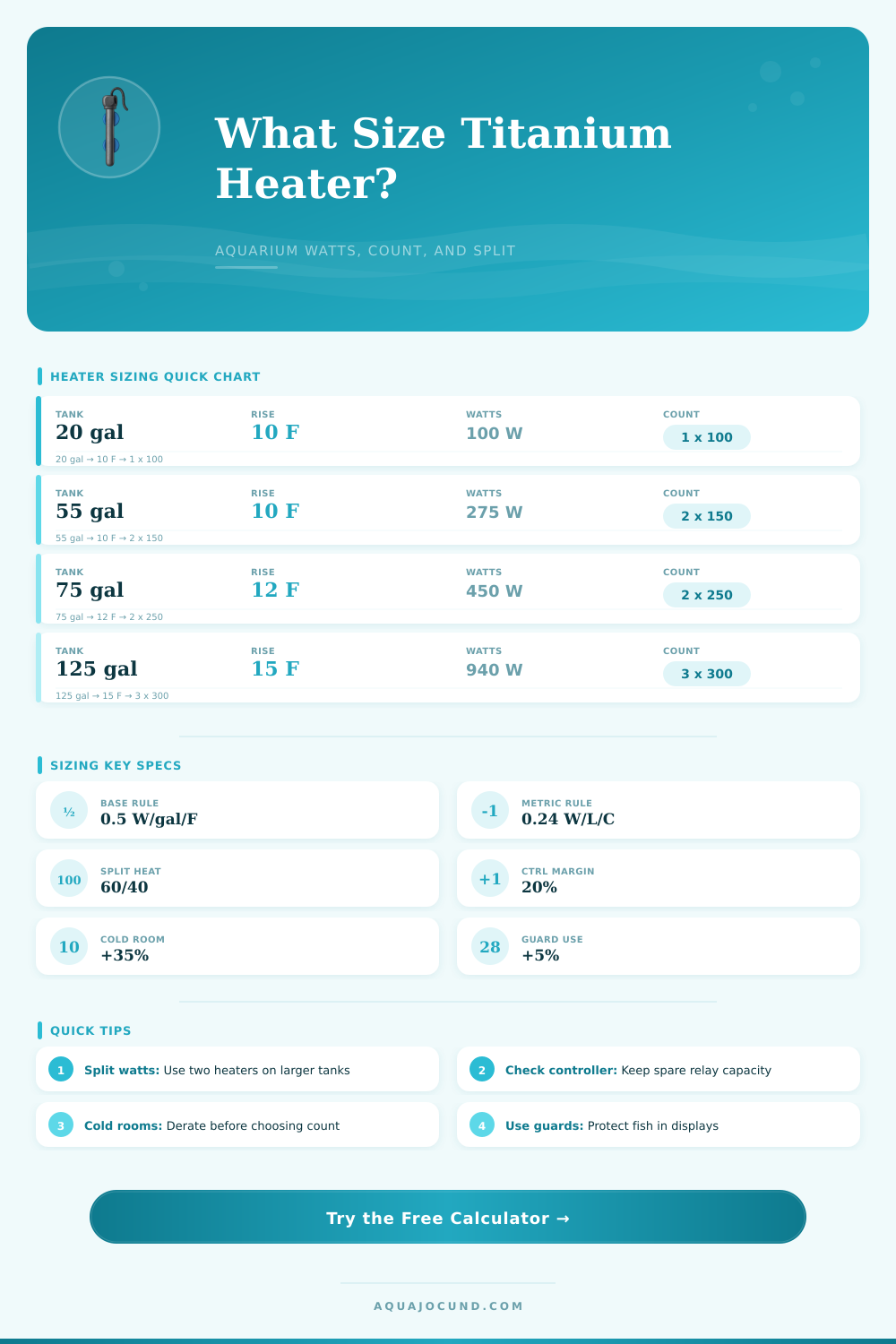
If the controller should fail, the aquarium will lose heat from each of the heaters. You will have to leave some headroom in the controller. The heater system should never reach 95 percent of the capacity of the controller.
At this rate, the relay switch will fail. You must allow for 15 to 20 percent of headroom within the controller so that the relay switch has time to breathe and for you to be able to add more equipment to the aquarium in the future. Another factor to consider is the condition of the room in which your aquarium is located.
If the aquarium is located in a room that reaches cold temperature, more heat will be lost from the aquarium. This is one of the factor that will impact your requirement for the titanium heaters. Aquariums in basements or garages will lose more heat than those in climate-controlled room.
You can use the setting in the calculator to adjust for open tops, fans, or rooms that have low ambient (air) temperatures. This will prevent you from purchasing titanium heaters that can handle ideal room conditions yet experience significant change to the water temperature in the aquarium when it is cold outside. The guards for the heaters, while not as crucial to consider as the other factors, are still another factor that can impact the aquarium.
Guards can be metal or plastic and are used to prevent the fish from damaging the titanium heater. However, the guards will impact the movement of the water around the heater. You can enter this into the calculator so that you can determine how long it will take for the water in the aquarium to reach the desired temperature if it is guarded.
The type of livestock in the aquarium and their feeding habit can impact the margin for the heaters. If the aquarium contains a heavier bioload or if the fish are often fed, there will be an increase in the heat that is released from the water. Use the extra margin field to allow for this increase bioload.
Ultimately, there is no way to know the exact number and wattage of each of the titanium heaters that are required for the aquarium without entering the parameter of your aquarium into the calculator. A 125-gallon aquarium located in a cool room may require three 300-watt heater, but an aquarium of the same size in a warm room may only require two heater. The difference in the number of heaters required can be attributed to the different input that you enter into the calculator.
Using these heaters will ensure that the aquarium maintains a steady temperature, has a system redundancy in case one heater fails, and that there is a safe loading of the controller with the heaters.