Hang-on-Back Filter Size Calculator
Estimate the HOB filter rating your aquarium needs from tank volume, stocking bioload, turnover goal, media capacity, waterfall spread, head loss, noise settings, and backup filtration.
The backup filter's actual flow is subtracted from the required total, then the calculator sizes the primary HOB for the remaining load.
Filter sizing breakdown
| Media profile | Typical chamber mix | Base media target | Best use |
|---|---|---|---|
| Basic cartridge | Floss pad plus small carbon insert | 14 ml per gallon | Lightly stocked tanks where convenience matters most |
| Bio basket | Coarse sponge plus ceramic rings | 22 ml per gallon | Most freshwater community tanks |
| Planted polish | Floss, sponge, and small chemical pouch | 18 ml per gallon | Planted tanks that already have biological surface area |
| Cichlid media | Coarse sponge and high-biomedia basket | 28 ml per gallon | Cichlids, territorial fish, and heavier feeding |
| Goldfish media | Prefilter sponge, coarse pads, extra biomedia | 34 ml per gallon | Goldfish and other large waste producers |
| Reef HOB | Floss, carbon, small biomedia, optional phosphate media | 20 ml per gallon | Small reef or saltwater support filtration |
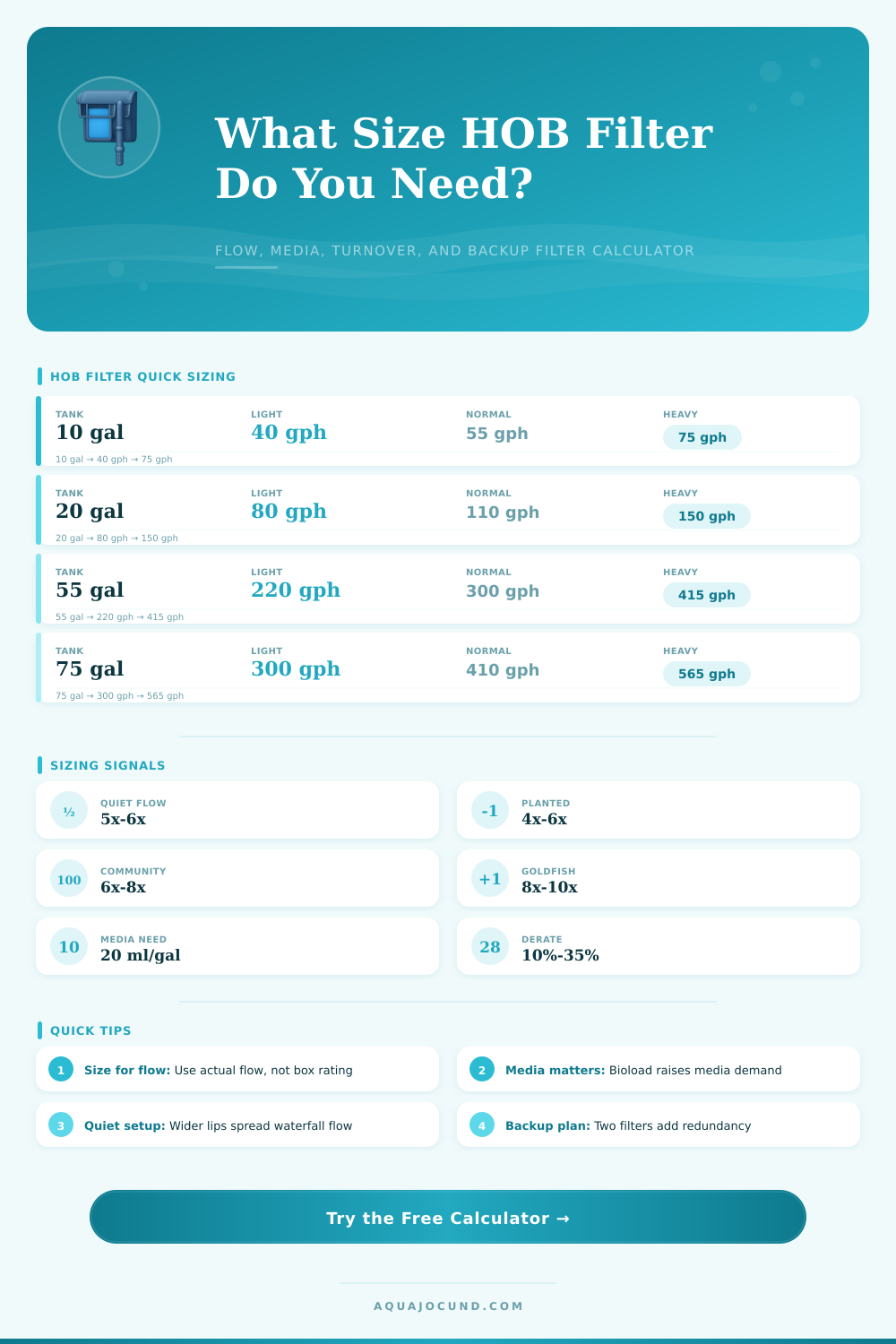
| Tank size | Common dimensions | 6x actual flow | Typical HOB choice after 22% derate |
|---|---|---|---|
| 5 gallon | 16 x 8 x 10 in | 30 gph actual | 40 gph rated, often throttled for quiet fish |
| 10 gallon | 20 x 10 x 12 in | 60 gph actual | 75 to 90 gph rated HOB |
| 20 long | 30 x 12 x 12 in | 120 gph actual | 150 to 170 gph rated HOB |
| 29 gallon | 30 x 12 x 18 in | 174 gph actual | 220 to 250 gph rated HOB |
| 40 breeder | 36 x 18 x 16 in | 240 gph actual | 300 to 330 gph rated HOB |
| 55 gallon | 48 x 13 x 21 in | 330 gph actual | 425 to 450 gph rated or two smaller HOBs |
| 75 gallon | 48 x 18 x 21 in | 450 gph actual | 575 to 600 gph rated, usually split between filters |
| 125 gallon | 72 x 18 x 21 in | 750 gph actual | Dual HOBs or HOB plus canister backup |
| Factor | Why it matters | Typical adjustment | Planning note |
|---|---|---|---|
| Clean media | Box ratings are usually measured with minimal restrictions | 10% loss | Best-case flow shortly after cleaning |
| Normal cartridge | Floss, carbon, intake height, and bio media slow the pump | 20% to 25% loss | A practical default for most HOB sizing |
| Quiet throttle | Reduced flow and low waterline soften sound but lower turnover | 30% loss | Common for bedrooms, bettas, and nano tanks |
| Dirty media | Clogged pads restrict flow and can bypass media | 40% loss | Clean or replace mechanical media before relying on capacity |
| Waterfall lip | Narrow lips push more gph through each inch | Under 25 gph/in is quiet | Use wider outflows or raise waterline to reduce splash |
Choosing a hang-on-back filter is an important decision when establishing an aquarium, as the hang-on-back filter will have an effect at the way in which the aquarium functions each day. If the hang-on-back filter does not provide enough movement of the water through the aquarium, the water within the tank may become murkily. If the hang-on-back filter provides too much movement of the water in the aquarium, the fish in the aquarium will have to swim against strong current.
You should match the hang-on-back filter to the aquarium that it will be used in, and you should consider the performance of the hang-on-back filter rather than just the rating for the filter indicated on the manufacturer’s box. Hang-on-back filters is popular for aquariums for a variety of reasons. For instance, hang-on-back filters are typically easy to set up and easy to service.
How to Choose a Hang-On-Back Filter
Because you place hang-on-back filters outside of the aquarium itself, they tend to keep heat from entering the water in the tank, and you can access the filter media for clean. The flow of a hang-on-back filter, however, is typically less than the flow indicated by the specification on the box. For instance, the height of the intake for the filter, the resistance of the filter media, the waterline of the aquarium, and the amount of media that is placed into the hang-on-back filter may reduce the flow.
For these reasons, the flow may be less than the specification listed on the manufacturer’s box; for instance, a flow specification of 200 gallons per hour may only provide 150 gallons per hour when the hang-on-back filter is installed in the aquarium. Therefore, the parameter of the aquarium should be established based off the actual performance of the hang-on-back filter, rather than the specification indicated on the filter’s box. The calculator includes elements that allow you to calculate the appropriate size of hang-on-back filter to purchase for your aquarium.
For instance, you will need to enter the dimensions of your aquarium, the stocking level for your aquarium, and the target turnover rate of your aquarium. The calculator will consider these parameters in part because different stocking levels in the aquarium lead to different amounts of waste that must be filtered. For instance, a tank with only a betta fish will require less media than a tank that contains numerous goldfish; goldfish produce more waste, and more media is required to break down that waste.
The calculator also allows you to model the inclusion of a backup filter; backup filters are helpful for aquariums of 50 gallon or more because the backup filter can help in the case of one hang-on-back filter motor fail. Another of the factors that you must consider when deciding the size and type of hang-on-back filter to purchase is the media capacity of that hang-on-back filter. While the hang-on-back filter may be able to move a great deal of water through the aquarium, if the media basket that the filter uses is too small to contain the necessary amount of filter media to clear the water of suspended particle, then the hang-on-back filter will not be able to effectively clean the water.
The calculator accounts for this by calculating the volume of media that is already installed in the hang-on-back filter, and comparing that volume to the amount of media that is required to effectively clean the water in the aquarium. If the volume of media in the installed hang-on-back filter is less than the volume of media that is required to effectively perform its filtration function, the calculator will recommend the purchase and installation of another chamber into the hang-on-back filter, the purchase and installation of a hang-on-back filter with deeper filter basket, or even the purchase of two hang-on-back filters altogether. The design of the waterfall in the aquarium can also have an impact upon the aquarium’s function and the noise level of that aquarium.
For instance, waterfalls with narrow lips and drops into the tank will create loud splashes that may be loud for the inhabitants of the tank or be stressful for those species of fish that are known to become stressed by loud noises. Waterfalls with wider outlets of water that spread into the tank as sheets of water will be quieter and will not move the substrate at the bottom of the aquarium. The calculator determines the gallons per inch of the lip of the waterfall, allowing you to view how loud the splash will be when the filter is installed in the aquarium.
Aquariums change over time. For instance, the filter media naturaly accumulates the waste from the aquarium’s fish and becomes clogged over time. Additionally, the waterline of the aquarium may drop due to water changes, and the intake for the hang-on-back filter may become clogged with the substrate from the aquarium.
These changes may reduce the efficiency of the hang-on-back filter. For these reasons, a safety margin for the efficiency of the hang-on-back filter is recommended. For instance, if the filter is calculated to have 200 gallons per hour efficiency when new, the aquarium owner may only wish to install the hang-on-back filter if it can provide 150 gallons of water per hour in the aquarium; this safety margin will ensure that the filter will still function at an acceptable rate even after the media begins to become clog.
Many customers also ask the question of whether a hang-on-back filter that is one large size is better then two smaller filters of the same total size. For aquariums that are larger than 50 gallons, two smaller hang-on-back filters are typically better than one large size of the same total capacity. For instance, using two hang-on-back filters will allow for redundancy of the filtration system; should one hang-on-back filter become disabled, the second will provide for the filtration of the aquarium.
Additionally, using two hang-on-back filters will provide agitation of the water in the aquarium; this agitation is beneficial for the health of the fish. The calculator allows modeling of the installation of a backup hang-on-back filter. Thus, if only one of the two hang-on-back filters is to be purchased, the subtraction of the gallons per hour of the backup hang-on-back filter can determine the size of that hang-on-back filter.
The shape and size of the aquarium also matter when installing a hang-on-back filter. For instance, water will move in different ways in a long, shallow tank than in a tall, cube-shaped aquarium of the same size in relation to the total volume of water in the tank. For these reasons, the calculator also allows you to enter the dimensions of your aquarium, ensuring that the rate of turnover of the aquarium is calculated based on how the water will actually move in the aquarium that you wish to install the hang-on-back filter into.
Ultimately, the goal of any aquarium owner is to keep the water in the tank as clear as possible, to ensure that the fish feel comfortable in there environment, and to minimize the amount of maintenance that is required of that aquarium. Each of these goals can be best accomplished by selecting a hang-on-back filter that is slightly oversized for the flow requirements of the aquarium but appropriately sized according to the amount of media that will be used to clean the water. Thus, by using the calculator, the owner of the aquarium can test each of these possibilities to determine which option will best enable the hang-on-back filter to both fit the aquarium that already exist, and to provide the benefits that is desired from incorporating such a hang-on-back filter into the aquarium.