🧪 Vodka Dosing Calculator Reef Tank
Estimate a cautious carbon dosing start, ramp, maintenance target, and daily safety cap for a reef aquarium.
Enter your reef parameters and calculate.
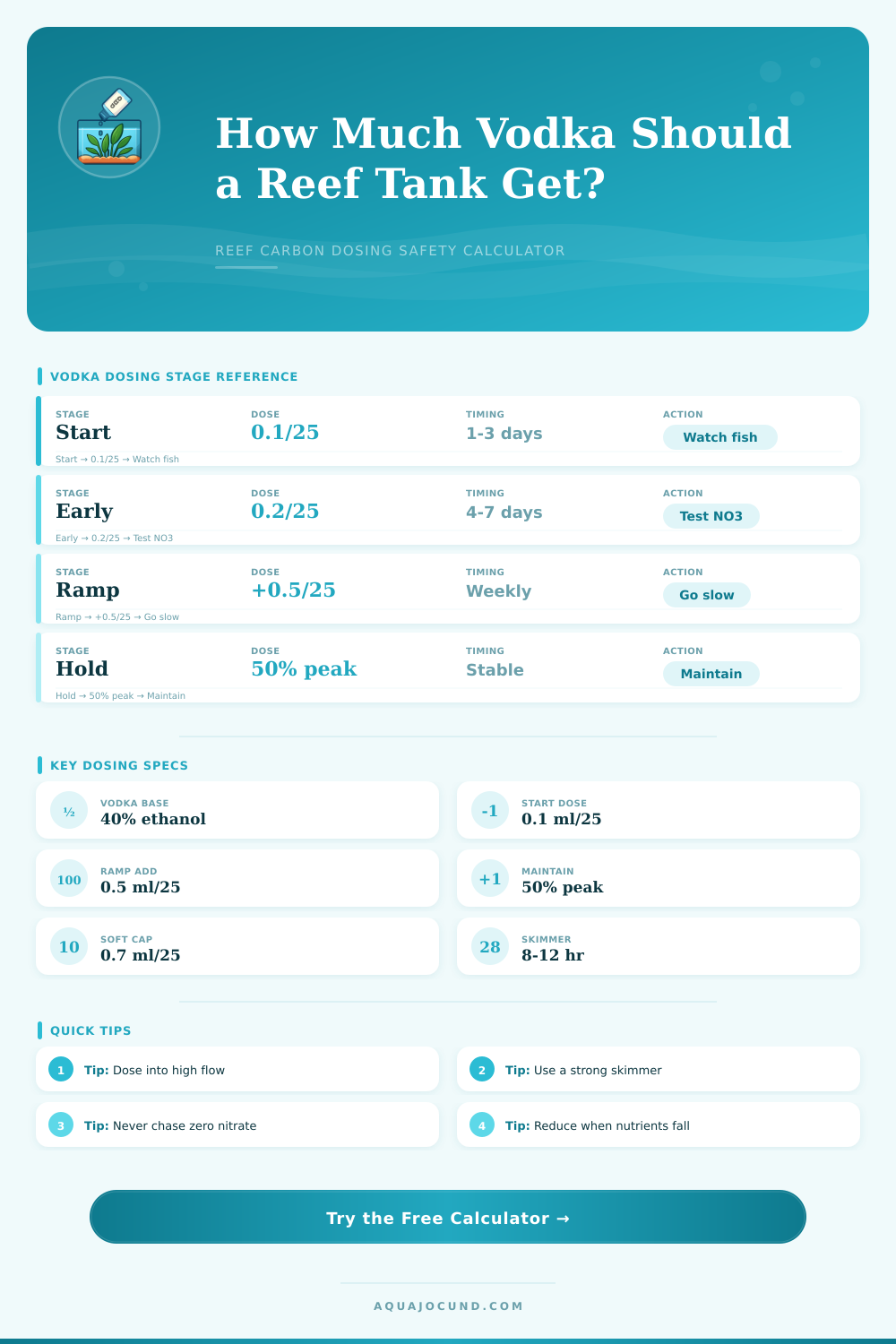
| Stage | Timing | 40% Vodka Reference | What to Watch | Adjustment Rule |
|---|---|---|---|---|
| Start | Days 1-3 | 0.1 ml per 25 gal daily | Fish breathing, water clarity, skimmer behavior | Hold dose; do not chase test movement yet |
| Early | Days 4-7 | 0.2 ml per 25 gal daily | Bacterial film, cloudy water, cyano patches | Stop or reduce if water turns hazy |
| Ramp | Week 2 onward | Add 0.25-0.75 ml per 25 gal weekly | Nitrate trend, phosphate trend, coral color | Increase only if nutrients remain above target |
| Hold | After decline starts | Keep the effective dose steady | Target range stability over several tests | Reduce to maintenance once stable |
| Maintain | Stable nutrients | About 40-60% of peak effective dose | Bottoming nitrate or phosphate | Cut dose before nutrients hit zero |
| Skimmer Setup | Cap Factor | Safe Use | Risk Signal |
|---|---|---|---|
| No skimmer or weak aeration | 25% | Avoid vodka dosing or use only expert supervision | Low oxygen risk is high |
| Undersized skimmer | 55% | Very slow ramp with strong surface agitation | Skimmer cannot export bacterial biomass quickly |
| Rated for volume | 80% | Good baseline if it pulls consistent skimmate | Watch for overflow after dose changes |
| Oversized and stable | 100% | Best candidate for careful carbon dosing | Still reduce dose when nutrients fall |
| Reef System | Typical Gross Volume | Common Net Volume | Start Dose at 80 Proof | Soft Cap at 80 Proof |
|---|---|---|---|---|
| 20 gal nano reef | 20 gal / 76 L | 16-18 gal | 0.07 ml/day | 0.45-0.50 ml/day |
| 40 breeder mixed reef | 40 gal / 151 L | 32-36 gal | 0.13 ml/day | 0.90-1.00 ml/day |
| 55 gal reef | 55 gal / 208 L | 44-50 gal | 0.18 ml/day | 1.20-1.40 ml/day |
| 75 gal reef with sump | 90 gal / 341 L | 70-80 gal | 0.30 ml/day | 2.00-2.25 ml/day |
| 120 gal mixed reef | 140 gal / 530 L | 110-125 gal | 0.48 ml/day | 3.10-3.50 ml/day |
| 180 gal display | 210 gal / 795 L | 165-190 gal | 0.72 ml/day | 4.60-5.30 ml/day |
| Nitrate NO3 | Phosphate PO4 | Carbon Dosing Posture | Safety Action |
|---|---|---|---|
| 0-2 ppm | 0-0.03 ppm | Avoid | Do not push vodka; feed or reduce export first |
| 2-10 ppm | 0.03-0.08 ppm | Maintain | Use a low maintenance dose only if needed |
| 10-25 ppm | 0.08-0.20 ppm | Cautious ramp | Increase weekly only after repeat testing |
| 25+ ppm | 0.20+ ppm | Slow reduction | Pair dosing with water changes and detritus export |
- Start below the cap: The calculator caps the suggested dose using skimmer strength, oxygen caution, and ethanol percentage.
- Split larger doses: If a dose climbs above 1 ml/day, many reef keepers split it into morning and evening additions in high flow.
- Hold when nutrients move: Once nitrate and phosphate begin falling, stop increasing and allow the system to respond for several tests.
- Cut before zero: Pale corals, cyano, cloudy water, or very low nutrients are signs to reduce or stop dosing.
The maintenance estimate is not a target to rush toward. It is a likely holding range after the reef has found its effective dose. Keep testing, adjust slowly, and allow the skimmer to prove it can remove the extra bacterial biomass.
Vodka dosing is used to manage the nitrate and phosphate level in a reef tank. Vodka dosing works because the ethanol in the vodka help feed the beneficial bacteria in the water. These beneficial bacteria consume the nitrate and phosphate levels in the tank, and the bacteria grow in number because they is consuming these nutrients.
You must use a measured amount of vodka to a tank. Using too much vodka can cause a crash in the water parameter in the tank. Additionally, if you use too much vodka, the trace nutrients they require to thrive will be starved from the coral in the tank.
How to Add Vodka to Your Reef Tank Safely
If you use too little vodka, the nitrate and phosphate levels will continue to rise in the water. To calculate the amount of vodka to add to the tank per week, the calculator requires several input that are required for the calculator. First, you must provide information regarding the volume of the tank.
However, this is not the volume of the tank labeled on the tank. The water volume of the tank is less than the labeled tank volume due to the amount of space taken up by the sand and rock in the aquarium. Thus, you must calculate and account for the displacement of these rocks and sand in the tank.
Second, you must provide information regarding the current nitrate and phosphate level in the tank. These nutrient level will dictate how much vodka you will need to add to the tank. Third, the calculator will also require information about your skimmer and the oxygen level in the tank.
This is because the beneficial bacteria will grow from the vodka you add to the tank. Thus, your skimmer will have to remove these beneficial bacteria from the tank at a rate that will not lower the oxygen levels of the water in the aquarium. If the oxygen levels drop too low, your reef tank livestock will be harmed.
Additionally, the vodka will contain alcohol, and not all vodkas contains 40% alcohol. The calculator will base the vodka dose calculated by the calculator on 40% alcohol. Thus, you must also provide information about the alcohol percentage of the vodka you will use in your reef tank.
Your skimmer will export the beneficial bacteria from your tank. To increase the amount of beneficial bacteria, you will have to increase the amount of vodka you add to the tank. However, you will have to decide how quickly you would like to increase the vodka dose.
Depending on the sensitivity of your tank to blooms of beneficial bacteria, you may want to ramp up the amount of vodka quickly or slow. Vodka dosing consists of four stages. During the start stage of vodka dosing, you will add a relatively small amount of vodka to the tank.
This stage allows time to observe how your fish are responding to the vodka and how the water clarity is change. After establishing that the tank can tolerate the initial dose of vodka, the early stage begin. During the ramp stage, you can increase the amount of vodka you add to your tank.
However, this stage should only be used if your nutrient test show that the nitrate and phosphate levels are still above the target levels that you wish to achieve in your reef tank. The maintenance stage of vodka dosing is not a set amount of vodka. Rather, the maintenance stage is the amount of vodka that will help maintain your target nitrate and phosphate levels in your tank.
The amount of livestock in your tank will impact the amount of vodka that you can add. Tanks with many fish will have lower levels of dissolved oxygen during the night. Thus, more livestock mean a lower limit on the amount of vodka that you will add to the tank.
Additionally, the stronger the surface movement of the water in your tank, the more vodka you can add. This is because more movement means more dissolved oxygen is circulated throughout the tank. If you have a larger skimmer, you can export more beneficial bacteria from the tank than with a smaller skimmer.
Prior to increasing the amount of vodka that you add to your tank, you must always test the water. You must allow time for a second or third test to confirm the general trend of the nitrate and phosphate levels. Only then should you decide to increase the amount of vodka that is added to the tank.
The calculator will provide the maintenance levels for nitrate and phosphate. However, the maintenance levels are not a set amount, and you should only approach these levels rather than rush to reach such concentration of these nutrients. If the corals begin to pale in color or if cyano forms in the tank, you must reduce the amount of vodka that you are adding to the tank.
You must monitor the biological signal of your tank; the calculator does not account for these. For example, if the water in the tank becomes cloudy after you add vodka, this means that the beneficial bacteria grew at a rate that the skimmer could not keep up with. Additionally, if the fish in the tank begin to breathe harder at the surface of the tank, this means that the oxygen levels in the tank are too low.
Thus, monitoring both the fish and the water in the tank will allow you to ensure that the vodka dosing is the right amount of vodka for your reef tank.