🧪 Acid Buffer Dosing Calculator
Estimate aquarium acid buffer dose from tank volume, pH, KH, daily limits, livestock sensitivity, and water change dilution.
| Profile | Typical Strength | Best Use | Adjustment Style |
|---|---|---|---|
| Botanical Extract | 1.0 g / 10 gal / dKH | Very small KH nudges | Slow and repeatable |
| Mild Powder Buffer | 1.5 g / 10 gal / dKH | Community tanks | Controlled daily dosing |
| Standard Powder Buffer | 2.0 g / 10 gal / dKH | Most KH reduction plans | Balanced estimate |
| Concentrated Buffer | 2.5 g / 10 gal / dKH | High KH source water | Smaller measured doses |
| Strong Dry Acid | 3.0 g / 10 gal / dKH | Large water volumes | Use conservative margins |
| Custom Strength | User supplied | Known label directions | Match your product label |
| Livestock Group | Max pH Change | Max KH Drop | Typical Schedule |
|---|---|---|---|
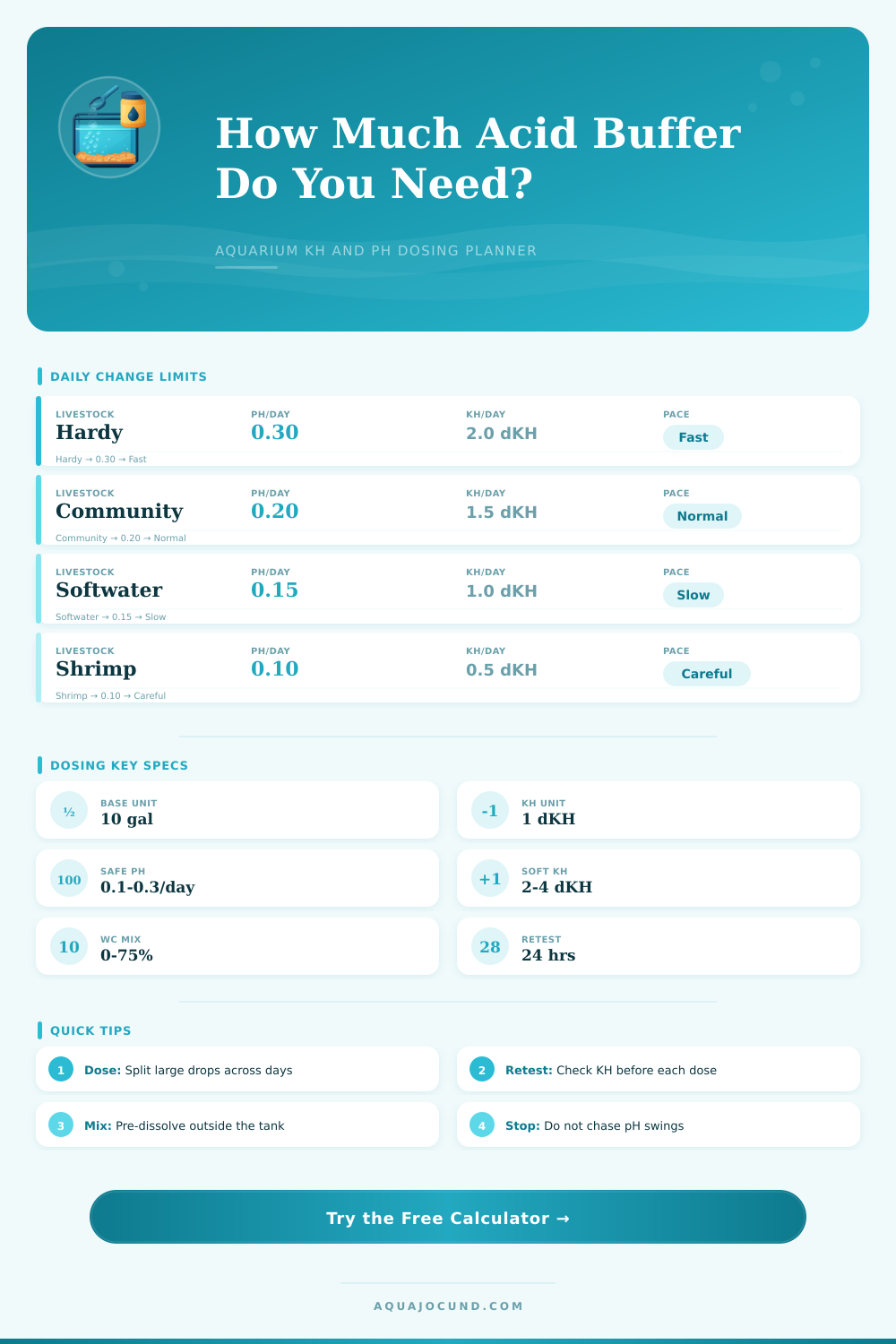
| Hardy Fish | 0.30 pH / day | 2.0 dKH / day | Fastest acceptable pace |
| Mixed Community | 0.20 pH / day | 1.5 dKH / day | Default general limit |
| Softwater Fish | 0.15 pH / day | 1.0 dKH / day | Slow adjustment |
| Shrimp / Wild Fish | 0.10 pH / day | 0.5 dKH / day | Very gradual adjustment |
| Tank Size | Dimensions | 1 dKH Dose at 2g | Softwater Use |
|---|---|---|---|
| 5 Gallon | 16 x 8 x 10 in | 1.0 g | Nano only |
| 10 Gallon | 20 x 10 x 12 in | 2.0 g | Betta, shrimp |
| 20 Long | 30 x 12 x 12 in | 4.0 g | Planted, apisto |
| 29 Gallon | 30 x 12 x 18 in | 5.8 g | Community |
| 40 Breeder | 36 x 18 x 17 in | 8.0 g | Rams, planted |
| 55 Gallon | 48 x 13 x 21 in | 11.0 g | Discus grow-out |
| 75 Gallon | 48 x 18 x 21 in | 15.0 g | Amazon display |
| 125 Gallon | 72 x 18 x 22 in | 25.0 g | Blackwater display |
| Input | Formula Used | Example | Result Meaning |
|---|---|---|---|
| Post-change KH | Tank KH x old water + source KH x new water | 8 dKH, 25%, source 2 | 6.5 dKH start |
| KH reduction | Post-change KH - target KH | 6.5 to 4.0 | 2.5 dKH drop |
| Total dose | Volume / 10 x KH drop x strength | 29 gal, 2.5, 2g | 14.5 g dose |
| Schedule days | Largest limit from pH or KH | 0.8 pH at 0.2/day | 4 days minimum |
To achieve the correct water chemistry for the aquarium it is not the number that is important but instead the concept of a living system has its own momentum. Buffer are tools that can change the direction of the water chemistry. The goal is to reach a target pH level by lowering the carbonate hardness of the water.
The target pH level should be one that are apropriate for the livestock in the tank and one that does not have major swing in the pH level. To begin to lower the carbonate hardness and to establish the correct pH level for the tank you will need to test the carbonate hardness and the pH level of the water in the tank. Based off these initial tests you will decide how much you would like to change the carbonate hardness and the pH level.
How to Safely Change Aquarium pH and Carbonate Hardness
The water change that you perform will change the carbonate hardness and the pH level of the water that is in the aquarium. The new water that you add to the aquarium have its own carbonate hardness and pH level. The water in the tank will no longer have the same level of carbonate hardness and pH as it did prior to the water change.
Therefore, you must account for this new starting point in your tank when you dose your acid buffer. While determining how much acid buffer is needed is important, it is even more important to ensure that you add the acid buffer at the proper rate to accomplish the desired change in the water chemistry. Each species of animal that live in the tank has different sensitivity to changes in the tank water chemistry.
The rate of change of the carbonate hardness that is required for shrimp is not the same then the rate of change that is required for a community tank of fish. A drop in the carbonate hardness of the water might seem small, but it can strip the protective layer of the shrimp or cause a soft water fish to experience water chemistry issue. The daily limits for changing the chemistry of the water are established to allow for one change to be broken into several smaller change, which are better for the livestock to handle.
The calculator can mathematically determine the amount of acid buffer that is required for adjusting the water chemistry of your tank. The factor that will be required to adjust the amount of acid buffer include the volume of the tank, the current chemistry of the water in the tank, the chemistry that you would like to achieve, and the sensitivity of the livestock. Furthermore, the calculator will also allow you to adjust for the dilution of the water changes and the strength of the acid buffer.
By entering each of these factor you will have a specific amount of acid buffer that is required. Using this specific amount of acid buffer is better than attempting to guess the amount of acid buffer that will achieve the specific change in carbonate hardness that is required for your aquarium. The table that are published on the page contain the information regarding the typical strength of the acid buffer and the limits of the different type of livestock.
The calculator cannot factor in how the tank will behave each day. Some of the substrate and materials that are in the tank may continuously leach mineral into the water for several weeks. The lighting, the amount of plant that are in the tank, and the filter media can also change the chemistry of the water in the tank.
These factor may be best dealt with by retesting the water prior to each addition of acid buffer to the aquarium. Furthermore, the way that you mix and measure the acid buffer can also have an impact upon the rate at which the carbonate hardness is lowered. Dry acid buffer have different densities and solubilities.
To even mix the acid buffer prior to adding it to the aquarium will even allow for better division of the dosage. Adding the mixture near a powerhead or filter outlet will also reduce any spike in the pH level of the water. While focusing upon the target pH of the tank is important, the carbonate hardness value of the water is actualy performing more of a function within the aquarium.
The carbonate hardness of the water act as a buffer for the water chemistry and prevents the pH from moving rapid. Therefore, if the carbonate hardness is too low it will remove some of this protective measure against rapid changes in the pH. For instance, a tank with a carbonate hardness of 1 dKH may exhibit stability during the day, but the pH level may swing widely overnight.
The calculator establishes limit for both the carbonate hardness changes and the pH changes in the water to ensure that one does not change at a faster rate than the other. Although the number may indicate the change of the chemistry of the water in the aquarium more quickly than what is expected of the livestock in the aquarium, it is always better to move the chemistry of the water gradually over several day. Gradually changing the chemistry will produce more repeatable result than attempting to achieve the tank chemistry in one step.
By adding the acid buffer to the tank at each stage you should retest the chemistry of the water. By retesting you will have fresh data that you can use to make each decision for the tank. Additionally, should the chemistry of the water from your source water change, your parameter will need to be updated and your plan adjusted to protect the livestock in the tank.