💧 RO/DI Water Remineralization Calculator
Calculate exact mineral doses to achieve target GH, KH & TDS for your aquarium
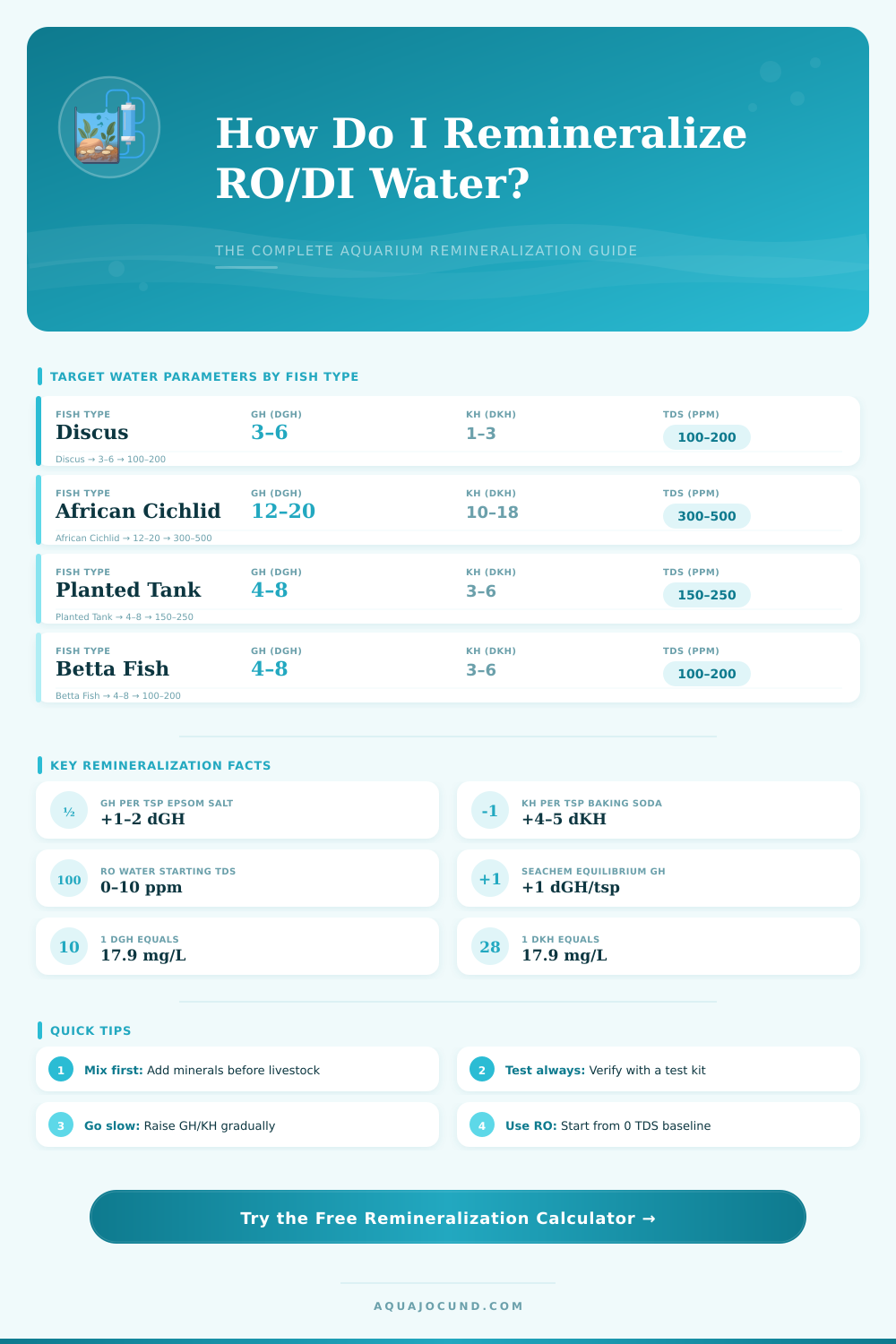
| Fish / Setup Type | Target GH (dGH) | Target KH (dKH) | Target TDS (ppm) | pH Range |
|---|---|---|---|---|
| Discus | 3–6 | 1–3 | 100–200 | 6.0–7.0 |
| African Cichlids (Malawi) | 12–20 | 10–18 | 300–500 | 7.8–8.5 |
| Planted Tank (general) | 4–8 | 3–6 | 150–250 | 6.5–7.4 |
| Betta Fish | 4–8 | 3–6 | 100–200 | 6.5–7.5 |
| Neocaridina Shrimp | 6–8 | 2–5 | 150–250 | 7.0–7.8 |
| Caridina Shrimp (Crystal) | 4–6 | 0–2 | 100–150 | 5.8–6.8 |
| Reef / Marine | 8–12 | 8–12 | 32–35 ppt salinity | 8.1–8.4 |
| Goldfish | 8–12 | 6–10 | 200–400 | 7.0–8.0 |
| Guppies / Livebearers | 8–12 | 6–10 | 200–350 | 7.2–8.2 |
| Rainbowfish | 8–12 | 5–8 | 150–300 | 7.0–8.0 |
| Product | GH Raise per tsp | GH Raise per gram | Notes |
|---|---|---|---|
| Seachem Equilibrium | +1 dGH / 20 gal | +0.14 dGH / 10 L | Ca, Mg, K blend; no sodium |
| Salty Shrimp GH+ | +1 dGH / ~3.3 gal | +0.30 dGH / 10 L | Ideal for shrimp; Ca, Mg, K, Na |
| Salty Shrimp GH/KH+ | Raises both GH & KH | +0.25 dGH+KH / 10 L | Best for Neocaridina |
| Epsom Salt (MgSO4) | +2 dGH / 10 gal | +0.12 dGH / 10 L | Mg only; pair with CaCl2 |
| Calcium Chloride | +1.5 dGH / 10 gal | +0.11 dGH / 10 L | Ca only; raises TDS quickly |
| Magnesium Chloride | +1.2 dGH / 10 gal | +0.09 dGH / 10 L | Mg only; less TDS than MgSO4 |
| Reef Salt Mix | Varies by brand | ~35 g/L for full marine | Full ionic profile for reef |
| Cichlid Buffer (Seachem) | +1 dGH+KH / 40 L | +0.25 dGH / 10 L | Raises both GH & KH; high pH |
| Product | KH Raise per tsp | KH Raise per gram | Notes |
|---|---|---|---|
| Baking Soda (NaHCO3) | +4 dKH / 10 gal | +0.60 dKH / 10 L | Cheap; adds sodium; use carefully |
| Potassium Bicarbonate | +4.5 dKH / 10 gal | +0.67 dKH / 10 L | No sodium; preferred for planted |
| Seachem Alkalinity Buffer | +1 dKH / 20 gal | +0.14 dKH / 10 L | Stable; potassium bicarbonate base |
| Crushed Coral / Calcite | Passive / slow release | Ongoing KH stabilizer | Add to filter; dissolves slowly |
| Seachem Malawi Buffer | Raises KH & pH | +0.25 dKH / 10 L | Targets high pH for Rift cichlids |
| Tank Size (gal) | Volume (liters) | Actual Water (gal) | Actual Water (L) |
|---|---|---|---|
| 5 gal | 18.9 L | ~4 gal | ~15 L |
| 10 gal | 37.9 L | ~8 gal | ~30 L |
| 20 gal | 75.7 L | ~17 gal | ~63 L |
| 29 gal | 109.8 L | ~25 gal | ~95 L |
| 40 gal | 151.4 L | ~34 gal | ~130 L |
| 55 gal | 208.2 L | ~48 gal | ~180 L |
| 75 gal | 283.9 L | ~65 gal | ~245 L |
| 125 gal | 473.2 L | ~110 gal | ~415 L |
Adding minerals to RO/DI water require understanding the concept of remineralization and why RO/DI water must have mineral added. RO/DI water is stripped of minerals during its creation. RO/DI water must have minerals added to provide an environment in which fish and plant can remain healthy.
To add minerals to RO/DI water, a person must add enough mineral to ensure that the health of the fish and plants is maintain. However, adding too much minerals to RO/DI water can lead to water chemistry that is unstable for the fish and plants. To prepare RO/DI water for an aquarium, a person must understand the measurement of General Hardness (GH) and Carbonate Hardness (KH).
How to Add Minerals to RO/DI Water for Your Fish and Plants
General Hardness (GH) is a measure of amount of calcium and magnesium in RO/DI water. Carbonate hardness (KH) is another measurement of RO/DI water that indicates the buffering capacity of the water, and it keep the pH of the water stable. These measurements are independent of one another.
A person can balance the GH without KH levels being balanced, or vice versa. Depending on the type of fish and plants to be kept in the aquarium, one or both of these parameter may need to be balance to an ideal level. If the parameters are not balanced correctly, the fish or plants will experience negative impact on there health.
A person must decide on the ideal levels of General Hardness (GH) and Carbonate Hardness (KH) according to the animals that will live in the aquarium. For instance, Discus, shrimp, and other type of fish require low level of both GH and KH, while African cichlid and goldfish require more higher levels of both GH and KH parameters. Based on these ideal parameters, a person can calculate how much mineral product is necesary to add to RO/DI water.
If the person calculates the amount of mineral product to be added incorrectly, the RO/DI water may be under-mineralized or contain too many mineral for the needs of the fish and plants in the aquarium. By entering the size of the aquarium tank, the desired level of GH and KH, and the type of mineral products that will be added to the RO/DI water, a calculator can determine the amount of mineral product to be added. The calculator also takes into consideration the percentage of the tank that will be fill with RO/DI water.
Another feature of the calculator is an estimate of the Total Dissolved Solids (TDS) of the RO/DI water. The reference table to the product list the typical parameter of different types of aquariums. A person can use these tables to select the best type of mineral product to add to RO/DI water.
A calculator will not be able to track the change in the aquarium over time. For instance, the GH and KH of RO/DI water will change due to evaporation of water from the tank and through the uptake of mineral by the plants in the aquarium. Regular water testing will allow a person to maintain the ideal levels of GH and KH for there fish and plants.
Depending on the tests that are performed, it may be necesary to change the amount of mineral product that a person adds to RO/DI water with each water change. By following the specific order in which the mineral products are to be added to RO/DI water, the health of the fish and shrimp can be maintained. GH-raising products should be added first, and then KH-raising products should be added.
RO/DI water should be mixed between the addition of GH and KH products. By mixing the RO/DI water and mineral products together, there is less chance of creating a high concentration of minerals in the RO/DI water that can potentially irritate the eyes and gills of the fish and shrimp. It is also best to add the mineral products to a container of RO/DI water before adding that container of water to the aquarium.
Additionally, the minerals should be slowly added to the RO/DI water rather than rapid adding the products. This allows the livestock to adjust to the change in chemistry of the RO/DI water rather than rapidly changing the chemistry of the water. Beyond the GH and KH parameters of RO/DI water, there are other factors that will impact the chemistry of the water in the aquarium.
For instance, the temperature of the water will impact how rapid the minerals will dissolve in the RO/DI water. Other factor affecting the chemistry of RO/DI water are the pH of the water. The calculator is only a starting point for adding minerals to RO/DI water.
Regardless of the effort that is put into adding the minerals correctly to RO/DI water, maintaining ideal levels of GH and KH in RO/DI water over time will require regular water testing. When correctly prepared, RO/DI water will lead to healthy fish and plants over the life of the aquarium. Fish that live in water with the proper chemistry for there species will have better color and exhibit breeding behaviors.
Plants will be able to adequately develop and root in the tanks water when prepare with the correct minerals. To prepare RO/DI water correctly, an understanding of the concepts of GH and KH are required. Additionally, a person can follow and repeat a method of adding the minerals to RO/DI water to achieve the target parameters for GH and KH in the RO/DI water.
By using the calculator to calculate the amount of mineral products to be added to RO/DI water, and through regular testing of the RO/DI water with the aquarium tests, a person can make the addition of minerals to RO/DI water a routine task for the maintenance of the aquarium.