🧪 Reef Trace Element Dosing Calculator
Convert ICP gaps, tank volume, water-change reset and supplement strength into a capped reef dosing plan.
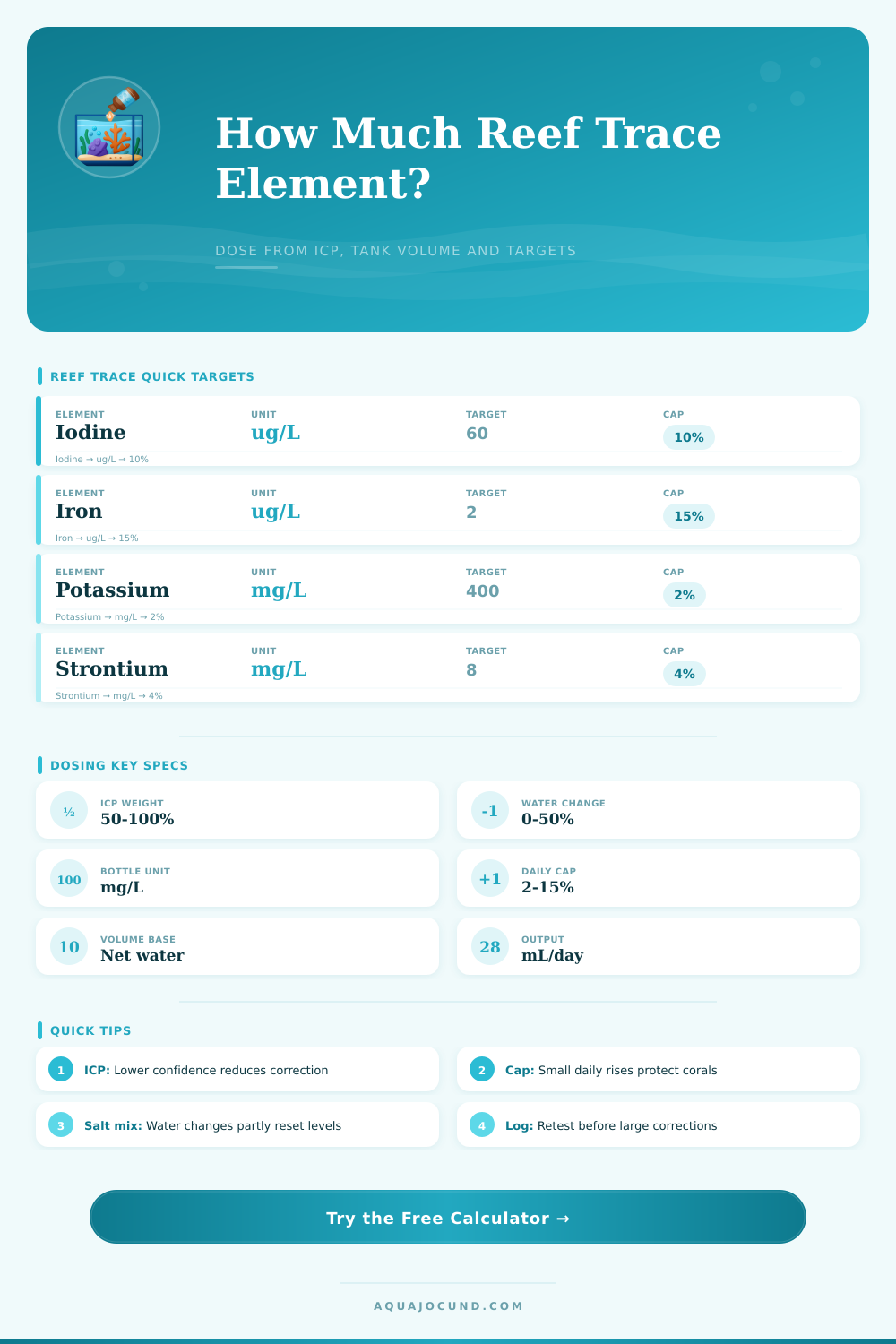
| Element profile | Common reef target | Default bottle strength | Default daily cap | Best dosing style |
|---|---|---|---|---|
| Iodine (I) | 60 ug/L | 1000 mg/L | 10% of target | Small daily correction |
| Iron (Fe) | 2 ug/L | 100 mg/L | 15% of target | Very small pulses |
| Potassium (K) | 400 mg/L | 50000 mg/L | 2% of target | Split large changes |
| Strontium (Sr) | 8 mg/L | 10000 mg/L | 4% of target | Correct over several days |
| Boron (B) | 4.5 mg/L | 5000 mg/L | 3% of target | Slow correction |
| Manganese (Mn) | 1 ug/L | 50 mg/L | 15% of target | Trace micro dosing |
| Molybdenum (Mo) | 12 ug/L | 500 mg/L | 10% of target | ICP-guided only |
| Vanadium (V) | 2 ug/L | 100 mg/L | 10% of target | ICP-guided only |
| Zinc (Zn) | 4 ug/L | 100 mg/L | 10% of target | Avoid overshoot |
| Reef size | Typical dimensions | Net water estimate | Iodine 25 ug/L gap at 1000 mg/L |
|---|---|---|---|
| 20 long nano | 30 x 12 x 12 in / 76 x 30 x 30 cm | 17 gal / 64 L | 1.6 mL total |
| 32 AIO cube | 24 x 20 x 19 in / 61 x 51 x 48 cm | 28 gal / 106 L | 2.6 mL total |
| 40 breeder reef | 36 x 18 x 17 in / 91 x 46 x 43 cm | 34 gal / 129 L | 3.2 mL total |
| 75 mixed reef | 48 x 18 x 21 in / 122 x 46 x 53 cm | 66 gal / 250 L | 6.3 mL total |
| 125 SPS system | 72 x 18 x 22 in / 183 x 46 x 56 cm | 110 gal / 416 L | 10.4 mL total |
| 180 display reef | 72 x 24 x 24 in / 183 x 61 x 61 cm | 158 gal / 598 L | 14.9 mL total |
| Input | How the calculator uses it | Example | Dosing effect |
|---|---|---|---|
| Water change reset | Blends current level with salt mix level | 10% change | Reduces or raises the gap before dosing |
| ICP confidence | Scales the corrective catch-up dose | 65% confidence | Doses 65% of the calculated correction |
| Consumption rate | Adds replacement dose for the coverage window | 7 days | Supports daily maintenance |
| Daily safety cap | Limits the allowed level rise per day | 10% target | Extends the correction schedule |
Trace elements is nutrients that exist within a specific range of concentration within the reef tank. Trace elements are not a category of macronutrients and are not the main focus of most reef tank dosing schedules. A shortage of trace elements can change the growths of corals, change the color of those corals, and even lead to instability of the entire reef tank.
Most people only notice a shortage of trace elements when the levels of those trace elements have moved away from the target levels within the reef tank. Based off the ICP report, the owner must translate the numbers for each trace element into a dosing plan for the reef tank, as a dosing plan is required to both respect the tank and the animals that lives within it. The calculator is used to translate the numbers from the ICP report into the amount of each supplement in milliliters.
How to Use the Trace Element Calculator
The numbers from the ICP report are not automatically translated into the amount of milliliters of supplement that must be added to the reef tank. Variables that must be accounted for include the total volume of the reef tank, the amount of water that is displaced by the rocks and sand within the reef tank, the chemistry of the water changes, and the rate at which the reef tank consumes the trace elements each day. For instance, the amount of iodine deficiency in a 75-gallon tank is more different than the amount of deficiency in a 20-gallon tank.
The calculator accounts for the age of the ICP sample, as the ICP sample can become old and the concentrations of the trace elements can change over time. Additionally, the test kits that may have been used to determine the initial trace element concentrations may not be as precise as an ICP test, so the calculator also accounts for this potential inaccuracy in the measurement of the initial levels of trace elements. Water changes can impact the levels of trace elements within the reef tank.
The concentration of trace elements within the water changes can change the levels within the reef tank, as the salt mixes does not always contain the same trace elements as the water within the reef tank. If an aquarium undergoes a 10 percent or 15 percent water change, it can reduce the deficiency of the trace elements within the reef tank. However, it is also possible that the water change can lead to a widening of the gap in relation to the trace elements within the tank.
The calculator performs the calculation that accounts for the water change. The reason that the water change is included in the calculator is to account for the fact that the dosing cycle should not be performed for a trace element deficit that has already been correct by performing a water change. Safety caps are included within the calculator in order to prevent the addition of too much of a trace element to the reef tank at once.
Trace elements such as iodine, iron, and manganese exist within a narrow range within the reef tank; adding too much of these trace elements can be harmful to the tank and its inhabitants. The calculator includes a daily cap on the amount of each trace element that is dosed to the reef tank, expressed as a percentage of the target level for that element. By using this percentage for daily dosing, the user doses the trace element slowly over several day rather than being dosed all at once.
This dosing schedule ensures that the trace element levels remains within the range that the corals of the reef tank can tolerate. Additionally, this dosing schedule ensures that the levels of the trace elements are able to be corrected within the tank over time. While the reference table that is included with the calculator provides the default safety caps for each trace element, the owner of the reef tank must adjust the amount of each trace element according to the need of their system.
The rate at which the reef tank consumes the trace elements must be accounted for within the calculator. Different populations of coral and algae requires different amounts of trace elements within the water each day. These requirements exist in addition to the requirements of the existing deficit of trace elements that may already be existing within the reef tank.
The calculator accounts for both the initial correction to the deficit of trace elements and the amount of trace element that is consumed by the reef tank each day. By separating these two dosing amounts, the reef owner is prevented from mistaking the requirement of the initial correction for the trace element needs of the reef tank each day. Should such a mistake be made, it is possible that the reef owner may overdose the reef tank with trace elements, which can have a negative impact upon the tank and its inhabitants.
The presets that are included in the calculator are used to assist the reef owner in beginning to perform their calculations. A reef owner can use the preset settings for a 32-gallon reef tank that is low in iron or a 125-gallon reef tank that is low in strontium, for instance. These preset settings fill in the fields within the calculator with suggested, realistic number.
These fields must then be adjusted according to the ICP report for the reef tank, according to the number of percent of water changes that are to be performed each month, and according to the amount of each trace element that is to be dosed into the reef tank daily. Trace elements must be continually retested within the reef tank, as the trace elements tend to move at a faster rate than macronutrients. A single cycle of adding trace elements to the reef tank can create change in the levels of those trace elements.
Therefore, another ICP test can be performed to determine the effect of the most recent dosing schedule for the tank. The calculator is provided as a plan for the reef owner based upon their current data regarding their reef tank. However, no dosing schedule is provided as a permanent schedule for the reef tank.
Each ICP report that is performed is a measurement of the tank at a specific moment in time. Finally, the calculator removes the need for manual arithmetic calculation within the reef tank. While the reef owner must still decide the level of aggressiveness of the trace element correction that will be performed, the amount of trust that they place in the trace element test kit, and when the reef tank will be retested for trace elements, the calculator ensures that the reef owner is not required to manually calculate the trace elements from the ICP test report.
Youll find that this makes the process much more comfortabley. It is actualy a lot easier to use than doing it by hand, and you should of used it sooner.