🧪 Aquarium Iodine Dosing Calculator
Plan reef iodine, iodide, and iodate dosing around test results, water changes, and sensitive livestock.
| Supplement type | Typical strength | Iodide | Iodate | Best calculation use |
|---|---|---|---|---|
| Balanced iodide-iodate trace | 0.100 mg/mL | 50% | 50% | Routine correction after ICP or kit test |
| Potassium iodide solution | 0.500 mg/mL | 95% | 5% | Mostly iodide deficit correction |
| Lugol iodine and iodide blend | 0.800 mg/mL | 70% | 0% | Small, carefully capped additions |
| Dilute nano reef iodine | 0.020 mg/mL | 80% | 20% | Small tanks needing easier measuring |
| Sodium iodate correction | 0.250 mg/mL | 0% | 100% | Iodate-heavy target corrections |
| Weekly broad trace iodine | 0.050 mg/mL | 60% | 40% | Gentle maintenance style dosing |
| Tank name | Dimensions | Display volume | 5 ug/L raise at 0.1 mg/mL |
|---|---|---|---|
| 13.5 gal nano | 22 x 12 x 15 in / 56 x 30 x 38 cm | 13.5 gal / 51 L | 2.6 mL before displacement |
| 20 long | 30 x 12 x 12 in / 76 x 30 x 30 cm | 20 gal / 76 L | 3.8 mL before displacement |
| 40 breeder | 36 x 18 x 16 in / 91 x 46 x 41 cm | 40 gal / 151 L | 7.6 mL before displacement |
| 75 gal reef | 48 x 18 x 21 in / 122 x 46 x 53 cm | 75 gal / 284 L | 14.2 mL before displacement |
| 120 gal reef | 48 x 24 x 24 in / 122 x 61 x 61 cm | 120 gal / 454 L | 22.7 mL before displacement |
| 180 gal system | 72 x 24 x 24 in / 183 x 61 x 61 cm | 180 gal / 681 L | 34.1 mL before displacement |
| Reef profile | Total iodine target | Starting cap | Testing interval | Sensitivity setting |
|---|---|---|---|---|
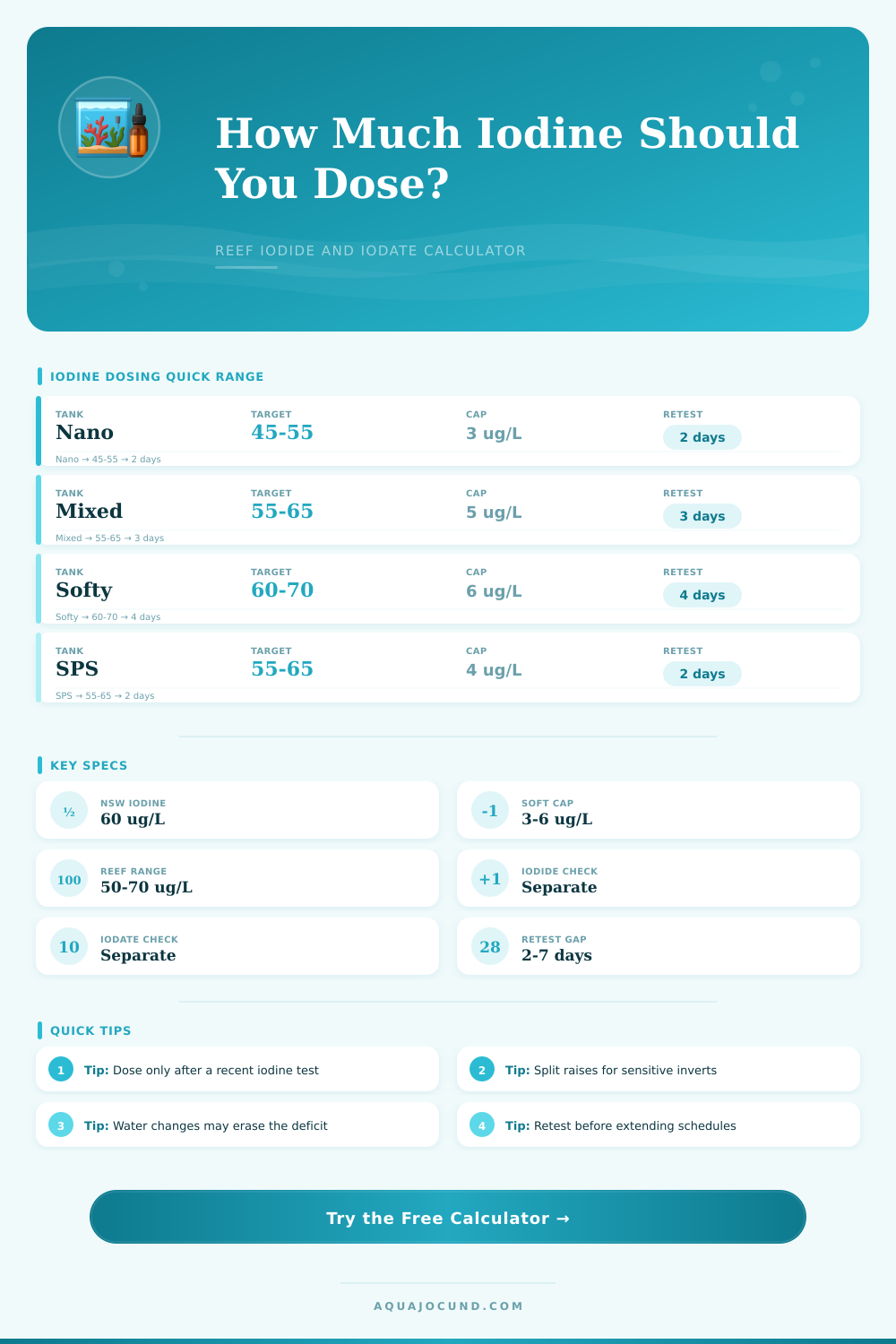
| Shrimp or clam nano | 45 to 55 ug/L | 3 ug/L/day | 2 days | High sensitivity |
| Mixed reef with LPS | 55 to 65 ug/L | 5 ug/L/day | 3 days | Moderate sensitivity |
| Soft coral dominant | 60 to 70 ug/L | 6 ug/L/day | 4 days | Lower sensitivity |
| SPS dominant system | 55 to 65 ug/L | 4 ug/L/day | 2 days | High or moderate sensitivity |
| After large water change | Match salt mix result | 3 to 5 ug/L/day | 2 to 3 days | Based on livestock |
Iodine is an trace element that exists in the reef tanks in two different forms: iodide and iodate. Both of these compounds is utilized by the livestock in the reef tank. However, the different types of livestock in the reef tank use iodide and iodate at different rates.
For example, soft corals and anemones requires more iodide than stony corals and clams require of iodate. The levels of iodide and iodate will change in the tank due to two reasons: first, the livestock utilizes this element, and second, the protein skimmer, carbon, and water changes removes this element from the system. Changes in the levels of iodide and iodate wont be noticed until the livestock begins to show signs of stress, such as loss of color from the corals or clam shells failing to open.
How to Test and Add Iodine to Your Reef Tank
You can use the calculator to determine how much iodine to add to the reef tank. The first value to enter into the calculator is the volume of reef tank. However, you must subtract the volume that the rocks and sand in the tank take up.
The calculator requires the volume of water in the tank to calculate the level of iodine appropriate. After obtaining the volume of water in the tank, test the iodine levels. The test will reveal the total amount of iodine in the water, as well as the split of iodide and iodate in the water.
Use these measurements in the calculator to determine the target levels of iodide and iodate in the water to suit the requirements of the livestock in the tank. Water changes will impact the amount of iodine in the tank. Each time the water change is performed, the volume of new saltwater is added to the tank.
The amount of iodine in the new saltwater in the replacement water depend on the brand and batch of the saltwater replacement product that is added to the system. Because the amount of iodine in the replacement water impacts the amount of iodine in the tank, it is necessary to use the iodine calculator to account for this addition of iodine in order to avoid overdosing the tank. When adding iodine supplements to the tank, it is necessary to use a supplement that contain the correct form of iodine.
Some iodine supplements contain mostly iodide, other supplements contain mostly iodate, and other supplements contain a split of both forms of iodine. The supplement bottles will display the concentration in mg/ml of iodine that the supplement contains. You must enter this concentration value into the calculator in order to recieve the amount in ml of supplement that is required to add to the tank.
Additionally, it is necessary to establish a daily cap for the amount of iodine that is dosed into the tank. Establishing a cap for daily doses limits the amount of stress that the tanks livestock will experience due to drastic changes in iodine levels. By utilizing different livestock in the tank, the rate of stress that the animals will experience from changes in iodine levels will be different; the calculator allows for the adjustment of the daily cap to account for these differences in livestock sensitivity to iodine levels.
Testing the levels of iodine in the tank is necessary to maintain appropriate levels for the tanks livestock. The levels of iodine will change over time in the tank. This is due to the removal of iodine by the protein skimmer, carbon, and water changes.
Therefore, using the iodine calculator to determine the frequency of testing of the iodine levels will help to maintain the appropriate levels of iodine in the tank. Testing iodine levels every two to four days is one method for maintaining stable iodine levels in the tank. In order to ensure the accuracy of the test results for iodine levels, it is necessary to ensure the consistency of the methods for testing the water.
There are testing kits that measure the total amount of iodine in the tank, while other testing kits measure the amount of iodide and iodate separately. If the user performs these different tests in the tank, the results may change due to the different methods of measuring the levels of iodine. The same rule applies to testing the iodine levels with ICP laboratories; different laboratories will test for iodine in different ways.
To ensure consistency of results, you should use the same ICP laboratory to test the iodine levels. The age of the bottle of iodine supplement should also be considered when adding iodine to the reef tank. The iodide in the supplement may have oxidized since the supplement was manufactured.
Iodide and iodate are present in the supplement in specific ratio that meet the needs of the livestock. If the ratio of iodide to iodate changes due to oxidation, the supplement may not meet the needs of the livestock. To avoid this situation, the supplement should be stored in a cool, dark place that will minimize oxidation of the iodine in the supplement.
Additionally, if the supplement is stored in a cool, dark place, yet the iodine levels in the tank dont reach the target levels, it is possible that the supplement is becoming ineffective. To avoid adding ineffective iodine to the tank, ensure that the supplement is added according to the instructions on the bottle. Consistently measuring and dosing the amount of iodine to the tank will help maintain the correct levels of iodine for the livestock in the tank.