🪨 Aquascape Rock Weight Calculator
Estimate hardscape rock weight from tank footprint, coverage, rock density, porosity, height zones, water displacement, and bottom-load safety.
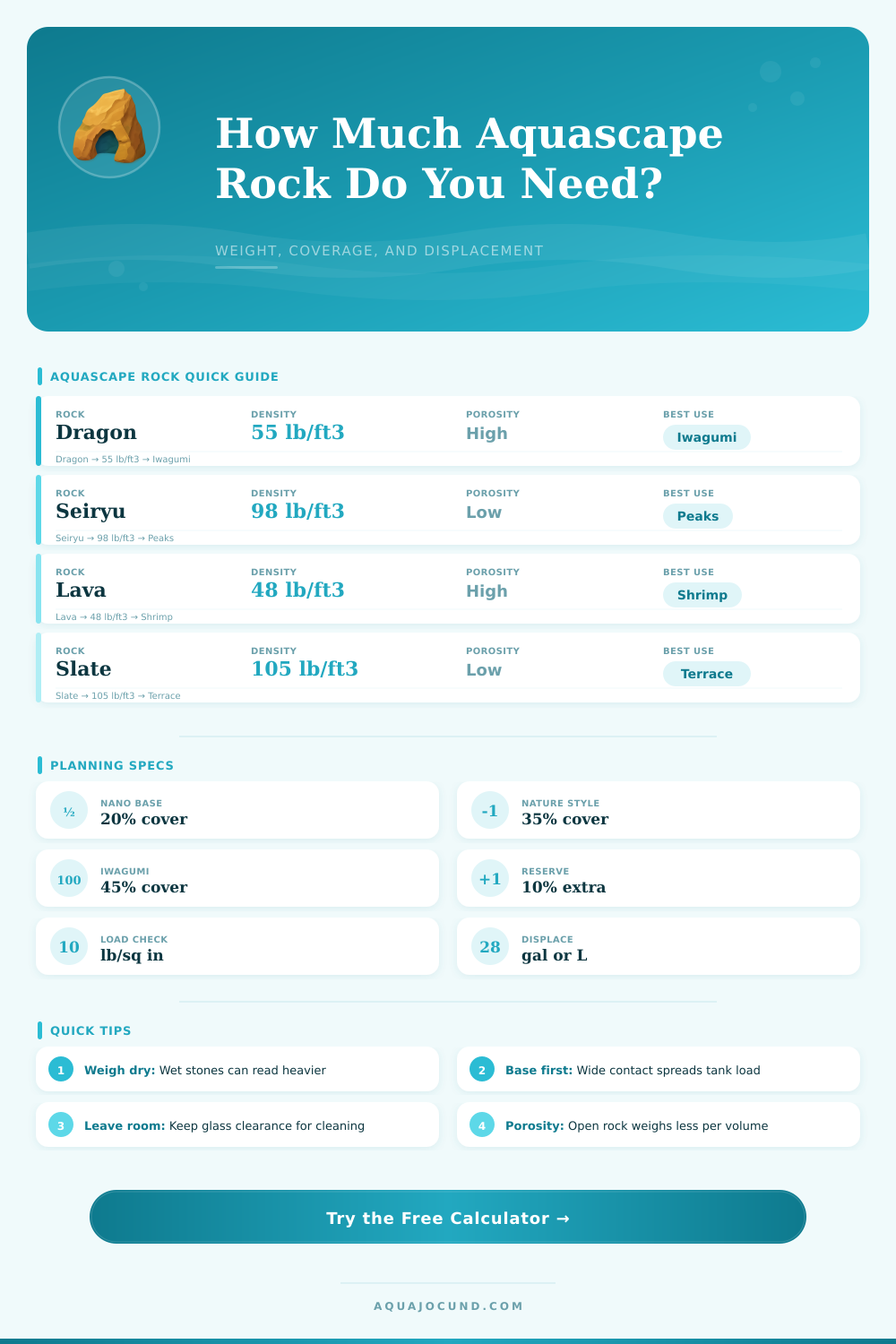
| Rock type | Approx density | Porosity | Typical use |
|---|---|---|---|
| Dragon stone / Ohko | 55 lb/ft³ (881 kg/m³) | High | Light iwagumi layouts, planted tanks, shrimp displays |
| Seiryu stone | 98 lb/ft³ (1570 kg/m³) | Low | Sharp mountain lines, focal stones, high-contrast scapes |
| Lava rock | 48 lb/ft³ (769 kg/m³) | Very high | Shrimp grazing, filter-media style mounds, lightweight support |
| Slate | 105 lb/ft³ (1682 kg/m³) | Low | Terraces, ledges, cave roofs, layered hardscape |
| Granite | 103 lb/ft³ (1650 kg/m³) | Low | Durable boulder bases and river-style features |
| River stone | 96 lb/ft³ (1538 kg/m³) | Low-med | Rounded streambeds and natural community tanks |
| Petrified wood rock | 88 lb/ft³ (1410 kg/m³) | Medium | Vertical ridges and desert-style planted aquascapes |
| Dry reef base rock | 42 lb/ft³ (673 kg/m³) | High | Marine-style arches, porous base, lightweight volume |
| Tank | Footprint | Moderate stone | Heavy stone |
|---|---|---|---|
| 10 gallon | 20 x 10 in (51 x 25 cm) | 8-14 lb (4-6 kg) | 16-24 lb (7-11 kg) |
| 20 long | 30 x 12 in (76 x 30 cm) | 16-26 lb (7-12 kg) | 30-45 lb (14-20 kg) |
| 29 gallon | 30 x 12 in (76 x 30 cm) | 18-30 lb (8-14 kg) | 35-55 lb (16-25 kg) |
| 40 breeder | 36 x 18 in (91 x 46 cm) | 30-50 lb (14-23 kg) | 55-85 lb (25-39 kg) |
| 55 gallon | 48 x 13 in (122 x 33 cm) | 32-55 lb (15-25 kg) | 60-95 lb (27-43 kg) |
| 75 gallon | 48 x 18 in (122 x 46 cm) | 45-75 lb (20-34 kg) | 85-130 lb (39-59 kg) |
| 90 gallon | 48 x 18 in (122 x 46 cm) | 50-85 lb (23-39 kg) | 95-145 lb (43-66 kg) |
| 125 gallon | 72 x 18 in (183 x 46 cm) | 70-115 lb (32-52 kg) | 130-200 lb (59-91 kg) |
| Zone | Coverage target | Height target | Design note |
|---|---|---|---|
| Base zone | 20-45% of footprint | 1-4 in (3-10 cm) | Spreads weight and creates stable contact points. |
| Mid zone | 10-25% of footprint | 3-8 in (8-20 cm) | Builds depth without filling the whole bottom. |
| Peak zone | 3-12% of footprint | 6-16 in (15-41 cm) | Creates focal height; keep clearance below rim and lights. |
| Open swim lane | 30-60% clear | Full water column | Leaves flow paths, cleaning access, and fish room. |
| Checkpoint | Green range | Caution range | What to adjust |
|---|---|---|---|
| Bottom pressure | Under 0.35 lb/sq in | 0.35-0.75 lb/sq in | Increase contact area or reduce tall stacks. |
| Stand margin | 25%+ reserve | 10-25% reserve | Check stand rating and total filled tank load. |
| Displacement | Under 10% volume | 10-18% volume | Recheck heater, dosing, and swimming space. |
| Glass clearance | 2+ in from panels | Under 2 in | Leave room for cleaning tools and vibration safety. |
When you plan your aquascape, you must consider the weight of the rock and the weight capacity of your aquarium. The weight of the rock affect the weight of the glass of the aquarium and the stand that hold the aquarium. If the weight of the rock are too high for the aquarium, the bottom pane of the aquarium glass may crack.
Similarly, if the weight of the rock is too high, the stand may sag under the weight of the rock over time. Many people focus on the color and the shape of the rock when choosing products for there aquarium. However, some people might find that the amount of rock they choose will either fail to cover the floor of there aquarium or will add more much weight to the aquarium.
How to Plan Rock Weight and Keep Your Aquarium Safe
The type of rock you choose for your aquarium are important. The density and porosity of the rock will determine the amount of rock you need to achieve your desired visual effect. Dragon stone is a porous rock and will feel light when you hold the rock.
However, the holes in the rock will eventually get filled with water. Seiryu stone and slate rocks is dense and will generally add more weight to your aquarium than dragon stone rocks of the same size. Because dense rocks are heavier than porous rocks like dragon stone, you can use less dense rock to achieve the same height as an aquascape with only dense rock.
However, the dense rocks will add more pressure to the bottom of the aquarium. The calculator include the porosity of the rock so that you can determine the accurate weight of the rocks you want to use in your aquarium. However, you must also consider if the visual look of the rock you choose for your aquarium justifies the weight that the rocks will add to your aquarium.
The coverage zone for your aquarium are important. These determine the placement of the weight of the rock in your aquarium. For example, placing the rock along the back wall will distribute the weight differently than placing the rock across the whole footprint of the aquarium.
The base zone for the rock have two functions within your aquarium. First, it will help to even distribute the weight of the rock across your aquarium glass. Additionally, it can act as a platform on which you can place other rocks.
If the base zone is too narrow or too tall, it will increase the pressure against the aquarium glass. The zones in the middle and on the peak of your aquascape will add the height to your aquarium. However, these zones will sit on top of the base zone of the rocks.
The calculator will allow you to track each of these zone separately. Water displacement by the rocks is a factor that many people will likely forget when planning their aquascapes. However, the fact that rock will displace water in your aquarium is important to know because you will have to dose fertilizers and medications into the water.
The dense rocks will displace more water than porous rocks of the same weight. This means that if you have two aquariums of the same size that contain the same weight of rock, one may contain more water than the other. The calculator will show you the effective volume of water in your aquarium so that you can plan your maintenance routine before you place fish into your aquarium.
Load safety is important for your aquarium. The contact percentage for your rocks will tell you how much of the rock is in contact with the bottom of your aquarium and how much of the rock are stacked on top of itself. A wider contact patch will distribute the weight of the rock more even across the glass of your aquarium.
This will lower the pressure against any one point of the aquarium glass. The calculator will compare the pressure that the rock will create in your aquarium to the estimated weight capacity of your aquarium stand. If there is no margin for error between the two value, you will need to either widen the base of the rock or reduce the total weight of the rock in your aquarium.
Finally, you must also consider the type of substrate that you will use in your aquarium. Different substrate will add to the weight of your aquarium. For example, substrates can be sand, soil, or cichlid sand.
Each substrate will have a different weight. In the calculator, you can either include the weight of the substrate or you can ignore the weight of the substrate. Aquarists that utilize planted tanks must take into consideration the weight of the substrate in their aquarium.
In this case, the weight of the substrate is a measurable quantity. The calculator will allow you to determine the combined system load for your aquarium. This value include the weight of both the rock and the substrate in your aquarium.
You should run these calculations before you go into the store to purchase your aquarium rock. By calculating the weight of the rock you want to use in your aquarium, you can ensure that the quantity of rock you purchase will fit the weight capacity of your aquarium. If you choose the correct weight of rock for your aquarium, your aquascape will function correct in the long term.