Iron Dosing Calculator
Calculate planted aquarium Fe dosing from target ppm, tank volume, chelate type, product strength, and stock solution settings.
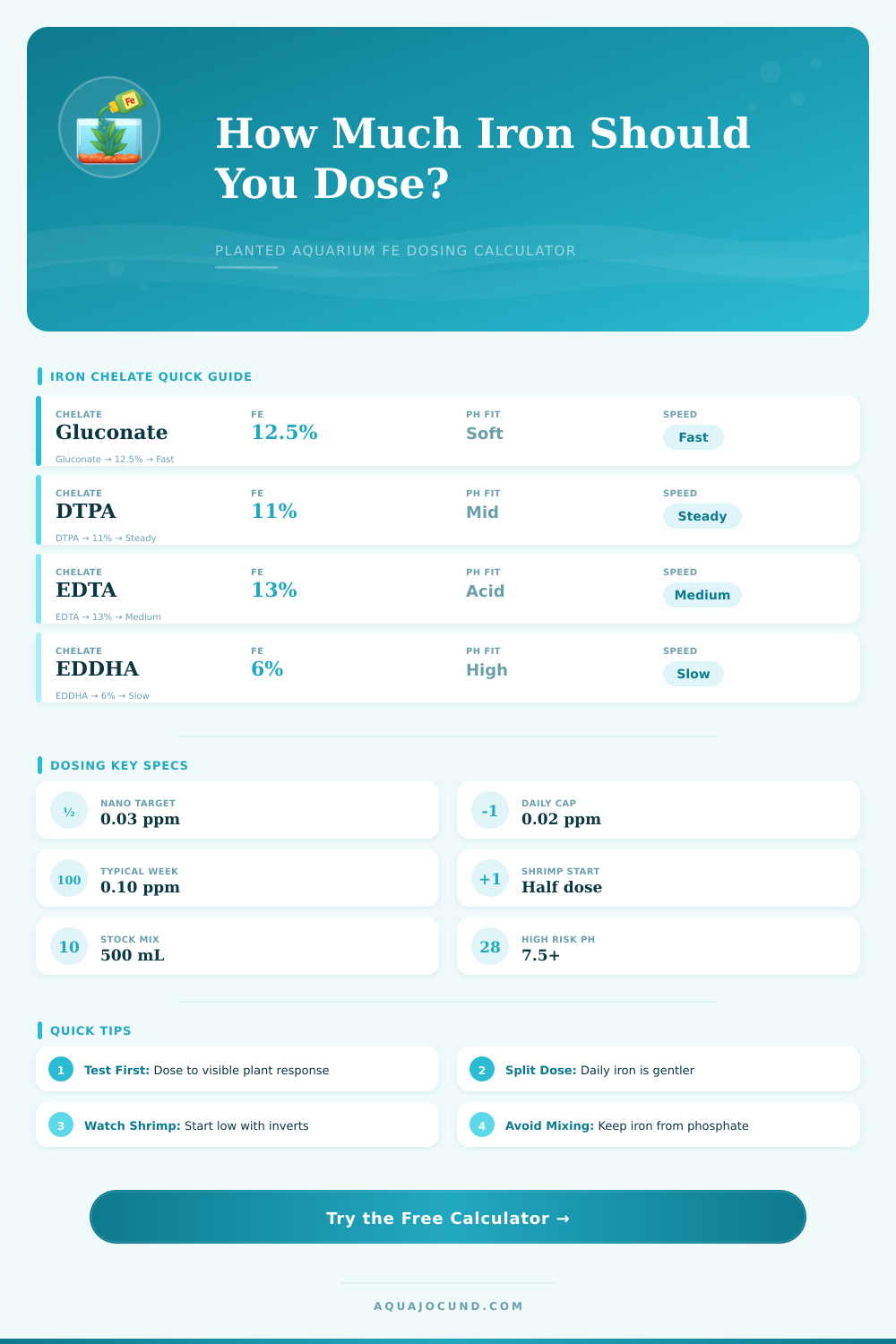
| Iron source | Typical Fe strength | Best water profile | Dosing note |
|---|---|---|---|
| Ferrous gluconate | About 12.5% Fe | Soft, acidic to neutral | Use small frequent doses; oxidizes quickly. |
| Fe DTPA | About 11% Fe | Low to moderate KH | Good all-around planted aquarium option. |
| Fe EDTA | About 13% Fe | Lower pH systems | Less reliable as pH rises above neutral. |
| Fe EDDHA | About 6% Fe | Harder, higher pH tanks | Stable but red tint can affect appearance. |
| Ferrous sulfate | About 20% Fe | Acidic stock solutions | Higher precipitation risk in display water. |
| CSM+B trace mix | About 7% Fe | General trace dosing | Includes other traces, not iron only. |
| Tank size | Dimensions | Effective volume | Fe for 0.10 ppm |
|---|---|---|---|
| 5.5 gallon nano | 16 x 8 x 10 in / 41 x 20 x 25 cm | About 18 L after displacement | 1.8 mg Fe |
| 10 gallon standard | 20 x 10 x 12 in / 51 x 25 x 30 cm | About 33 L after displacement | 3.3 mg Fe |
| 20 gallon long | 30 x 12 x 12 in / 76 x 30 x 30 cm | About 66 L after displacement | 6.6 mg Fe |
| 40 breeder | 36 x 18 x 16 in / 91 x 46 x 41 cm | About 132 L after displacement | 13.2 mg Fe |
| 75 gallon | 48 x 18 x 21 in / 122 x 46 x 53 cm | About 250 L after displacement | 25.0 mg Fe |
| 125 gallon | 72 x 18 x 22 in / 183 x 46 x 56 cm | About 416 L after displacement | 41.6 mg Fe |
| Condition | Why it matters | Calculator effect | Practical response |
|---|---|---|---|
| High pH | Some chelates release iron faster | Raises precipitation risk | Use DTPA or EDDHA, split smaller doses. |
| High KH | Carbonates reduce iron availability | Adds risk points above 6 dKH | Favor stable chelates and avoid large pulses. |
| High phosphate | Iron phosphate can form insoluble particles | Adds risk above 2 ppm PO4 | Dose iron away from phosphate macros. |
| Shrimp colony | Inverts dislike abrupt trace swings | Flags high single-dose Fe | Start at half strength and observe molts. |
Iron is a nutrient that plants require for growth in an aquarium, but it is also a nutrient that cause confusion for many aquarium owners. If you’re aquarium’s plants are exhibiting symptoms of iron deficiency, such as yellowing of the new leaves or stunted growth of the plant stems, then the problem may be that iron is missing from the aquarium water. Furthermore, the amount of iron that should be added to the aquarium isnt a fixed number, but rather one that can change according to the conditions within the aquarium.
The goal with iron supplementation is to establish the iron level in the aquarium to the target level that the plants will need, while at the same time ensuring that the iron level does not pose a problem for the remaining inhabitants of the aquarium. This target iron level can change based off the aquarium’s lighting cycles and the amount of plant masses that lives within the aquarium. For instance, an aquarium with very low lighting cycles and plants that grow slow will require less iron than an high-tech aquarium that utilizes high levels of lighting and carbon dioxide for the plants.
How to Add Iron to Aquarium Plants Safely
A calculator can help determine the amount of iron that should be dosed into the aquarium each week, utilizing information about the aquarium dimensions, the current iron levels in the water, and the aquarium’s required maintenance plan. The type of chelate to which you add the iron can impact the length of time that the iron remains active in the water. For example, DTPA is a chelate that is frequently added to aquariums because it work well within a variety of pH levels in the water.
Gluconate chelates work quickly to introduce iron into the water, but will become inactive within hours of being added to the aquarium. Furthermore, EDDHA chelates work well even within alkaline pH levels, but can tint the water a red color if too much iron is added using this chelate. Finally, EDTA works in the middle of the range for each of these chelates, but can lose effectiveness if the pH of the aquarium increases beyond neutral levels.
The calculator can ask for the type of chelate that will be used to supplement the iron in the water, allowing it to calculate the proper dosage for that specific chelate. The volume of water within the aquarium can impact the amount of iron that should be dosed into the water. For example, the substrate and hardscape elements within the aquarium can displace some of the water within the aquarium.
An aquarium that has a gross volume of 20 gallon may contain only 17 or 18 gallons of water. Therefore, the amount of iron should also be dosed according to the actual amount of water within the aquarium. Thus, the calculator will ask for the percentage of the aquarium’s volume that the substrate and landscape elements within the aquarium displace.
Aquarium shrimp are particularly sensitive to changes in the trace elements of the aquarium water. For instance, adding iron to the water may stress these shrimp, even if the total amount of iron added to the aquarium each week is an amount that would be considered adequately for the aquarium’s plants. Therefore, you should account for the sensitivity settings of the aquarium in the dosage calculations.
For example, it may be beneficial to start by adding half of the amount of iron that the calculator calculates, allowing the shrimp to become used to the change in trace elements before increasing the iron dosage. One of the risks of adding iron to the aquarium is the potential development of precipitation. Precipitation occurs when iron and phosphate combines in the water to create particles that do not dissolve in the water.
Because precipitation can form when iron and phosphate are added to the aquarium at the same time, especially if the pH of the water is high, it is essential to account for the risk of precipitation. The calculator can calculate the risk of precipitation based upon the levels of phosphate, carbonate hardness, and pH in the aquarium. Stock solutions of iron supplements may have variables introduced by the way that the solution is mix.
For example, if the iron is mixed from dry powder, you will have to weigh the dry powder and measure the amount of water to ensure that the iron is present at the appropriate concentration within the stock solution. The calculator can determine the amount of iron in the stock solution in milligrams per milliliter, allowing for the dose of iron to be measured with a syringe. Alternatively, liquid supplements will have a set concentration of iron per amount of liquid, making it easier to dose iron supplements into the aquarium, but locking the aquarist into a specific amount of iron that will be added to the water.
Many people make mistakes in dosing iron into the aquarium. For instance, people often increase the iron dose when the plants begin to stall in their growth, but the plant growth may stall for a different reason then the lack of iron. Furthermore, adding iron at the same time as the macro nutrients can lead to cloudy water.
Therefore, it is better for the iron dose to be lower than the total amount of iron that should be dosed into the aquarium each week, but provided in smaller portions over several day. Instead of adding iron according to the recommendations from the test kits, the plants will be a guide to the proper levels of iron in the water, and the calculations performed by the calculator will be a reference for the iron levels in the aquarium. As with any other aspect of aquarium maintenance, over time you will become more familiar with your aquarium and its requirements.
For instance, some aquariums may require more iron to be added each day than others. Therefore, while the calculator provides a method for calculating the amount of iron that should be added to the aquarium each week, the actual amount of iron that is dosed may change over time with the establishment of the requirements of that specific aquarium. Furthermore, the plants will help to indicate the proper level of iron in the water, and the calculations will provide a reference for those levels.