RO Membrane GPD to LPH Converter
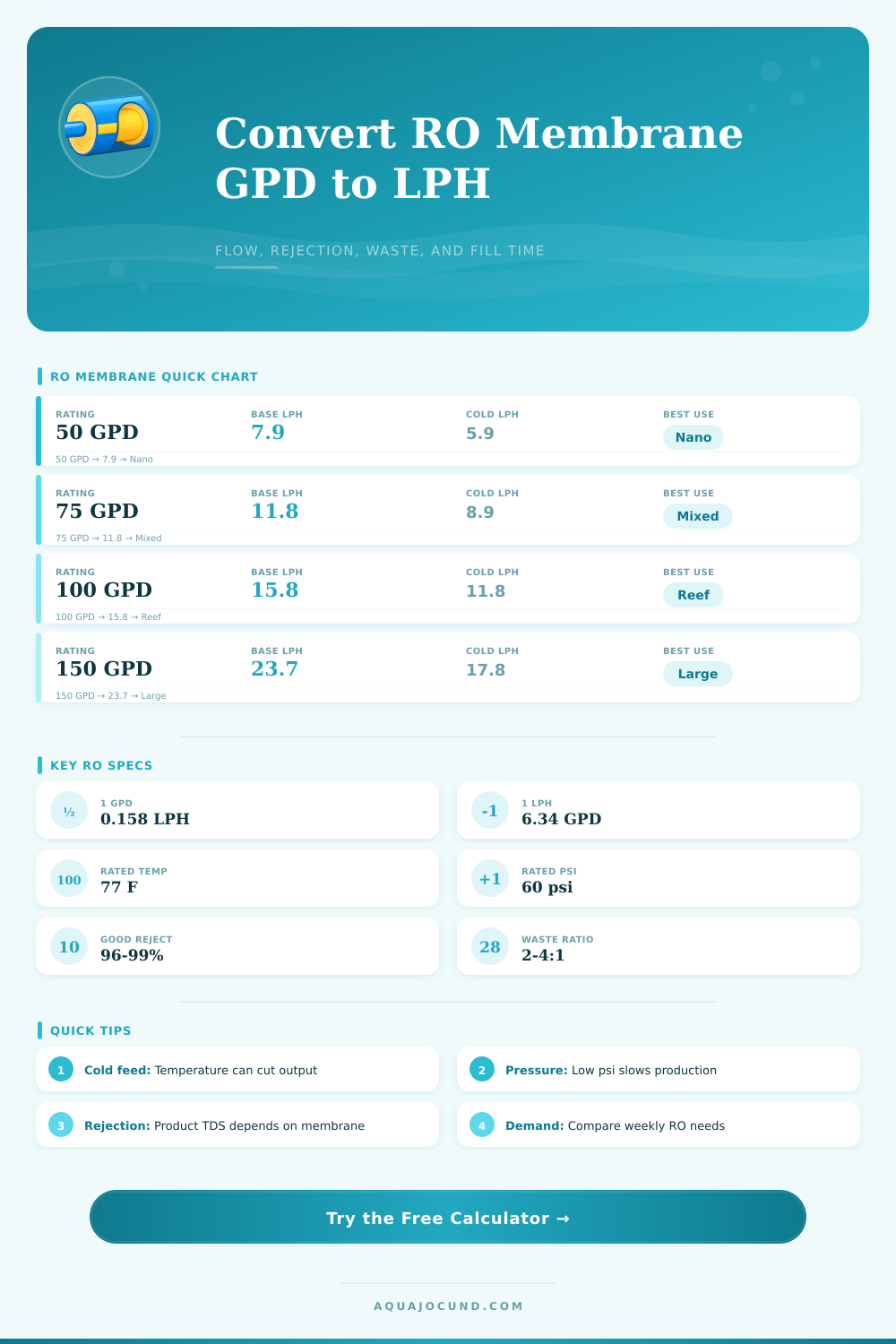
Convert membrane rating into corrected RO output, waste water, rejection TDS, reservoir fill time, and aquarium water-change coverage.
| Membrane profile | Typical rejection | Pressure behavior | Aquarium use |
|---|---|---|---|
| Standard thin-film composite | 95-98% | Rated output near 60 psi and 77°F | General RO and RO/DI production |
| High rejection reef membrane | 97-99% | Best with stable pressure and good carbon prefiltering | Lower DI resin load for reef tanks |
| High flow low restriction membrane | 94-97% | Prioritizes output over maximum rejection | Large water-change batches |
| Low pressure residential membrane | 94-98% | More forgiving below 50 psi | Homes without booster pumps |
| Dual membrane saver setup | 95-98% | Can improve recovery but needs enough feed pressure | Reducing waste water volume |
| Aged membrane estimate | 90-95% | Lower output and higher product TDS are common | Troubleshooting old membranes |
| Rated membrane | Base LPH | Base gal/hour | 20 gal fill at rating |
|---|---|---|---|
| 50 GPD | 7.9 LPH | 2.08 gal/hr | 9.6 hours |
| 75 GPD | 11.8 LPH | 3.13 gal/hr | 6.4 hours |
| 100 GPD | 15.8 LPH | 4.17 gal/hr | 4.8 hours |
| 150 GPD | 23.7 LPH | 6.25 gal/hr | 3.2 hours |
| 200 GPD | 31.5 LPH | 8.33 gal/hr | 2.4 hours |
| System | Weekly change | Daily top-off | Weekly RO demand |
|---|---|---|---|
| 20 gal nano reef | 15% | 0.2 gal/day | 4.4 gal/week |
| 55 gal planted tank | 30% | 0.2 gal/day | 17.9 gal/week |
| 75 gal mixed reef | 15% | 0.5 gal/day | 14.8 gal/week |
| 125 gal display | 20% | 1.0 gal/day | 32.0 gal/week |
When a person is establishing a reverse osmosis system in both an aquarium and a water station, the person typically begins by looking at the number that is printed on the membrane. The number represent the rating of the membrane, which is typicaly measured in gallons per day. The laboratory establishes the number under specific conditions, however, those conditions are not typicaly the same as the conditions in the home where the membrane will be used.
Conditions in the home can include the temperature of the water, the pressure of the water, and the quality of the water. Each of these factors can potentially change the output of the membrane relative to the rating of that membrane. The gallons per day rating can be easily converted into liters per hour, but that measurement can be adjusted according to the environmental conditions of the location where the membrane is to be used.
How to Find the Real Water Output from an RO Membrane
Factors that can alter the output of the system include the temperature of the water, the pressure of the water in the system, and the age of the membrane. For instance, the membrane that is rated to produce seventy-five gallons of water per day may produce less water if the water temperature is sixty degrees instead of the standard seventy-seven degrees. Additionally, if the water pressure in the home is higher than the pressure at which the membrane was tested, the membrane may produce more water than the rating indicates for that membrane.
Each of these variables can alter the rate at which the storage tank fills with water. In order to produce an accurate estimation of the performance of the membrane, a person must consider the actual environment in which the system will be established, rather than the conditions at which the manufacturer tested the membrane. Factors to consider include the feed pressure, the water temperature, the viscosity of the water, the rejection percentage, and the waste ratio.
Each of these factors can help to indicate the performance of the membrane. For instance, the feed pressure is the force that pushes the water against the membrane; higher water temperatures will alter the viscosity of the water which alters the movement of the water through the membrane pores; the rejection percentage indicates the amount of dissolved solids that pass through the membrane; the waste ratio indicates how much water is lost down the drain relative to the amount of water that is dispensed from the system, with higher ratios indicating that more water is lost than gained. By adjusting the initial output of the membrane for these various factors, a person can use that number to establish a schedule for the establishment of the reverse osmosis system.
For instance, using the adjusted number of gallons of water that the membrane will produce per day, a person can calculate how long it will take to fill a twenty-gallon storage tank. Additionally, that number can help a person to understand if the membrane can keep up with the requirements of the aquarium for water changes. The corrected flow rate will tell a person if the reservoir will be large enough to supply the demands of the system during the production runs.
These calculations help to transform the membrane rating to a figure that helps in the planning of the system. Aquarium keepers often find that the actual output of the membrane is less than the rating of the membrane. Reef systems, for instance, may require a smaller unit to supply the demands of the reef.
The smaller reef, however, still requires enough water to account for both the evaporation of the water from the system as well as the water changes that is required weekly. Thus, the person must calculate the corrected production rate to ensure that the rate of the production is equal to the demands of the system of water. Another factor in considering the membrane of RO/DI systems is the impact that the membrane will have upon the workload of the deionization resin.
Membranes with a higher percentage of rejection will require the deionization resin to perform less work. Thus, there will be less need to change the deionization resin. Membranes with a lower percentage of rejection will move the same amount of water through the system, but will leave more dissolved solids behind.
Thus, these membranes will increase the cost of the consumables for those keeping the aquariums. Temperature and pressure interact with each other in a way that can have a significant impact upon the membrane. For example, the membrane may perform well at sixty psi and seventy degrees, but if the pressure and the temperature of the water decrease at the same time, the membrane may slow in its movements.
In this case, the person can use a booster pump to increase the pressure of the water, especially if the water is cold. If there is a ten percent decrease in the pressure as a result of the temperature of the water and a fifteen percent decrease in the rate at which the water passes through the system as a result of the pressure, the total daily output will be less than if only one of these factors was considered. One more factor that needs to be considered is the amount of waste water that the RO system will produce.
This factor will become visible on the utility bill for the system. The person who sets up the system can set the waste ratio, based off the behavior of the membrane as well as the amount of water that the individual is prepared to waste. Some individuals will set the system to waste more water to increase the rate of the production of the water, while others may prefer to set the ratio of the waste water to the amount of water that is produced by the RO system to a lower ratio to save water.
Those who are familiar with the corrected production rate of the system can make these decisions more easily. In setting up the system and determining the specifications of the RO system, the person should of calculate the correction calculation for the flow rate using the actual conditions within the room in which the system will operate. This calculation will provide the person with an understanding of whether or not the membrane will be able to supply the demands of the system, whether the reservoir is of the appropriate size, and whether the amount of waste water that will be produced is acceptable.
Furthermore, if the person is familiar with these calculations, they will also be able to anticipate any changes in the temperature or the pressure of the water that passes through the system. While the membrane rating will remain the same, this adjusted number will be the number that governs the operation of the RO system each day.