🧪 Kalkwasser Dosing Calculator
Estimate a safe limewater dose from evaporation, reef demand, pH ceiling, drip duration, and ATO capacity.
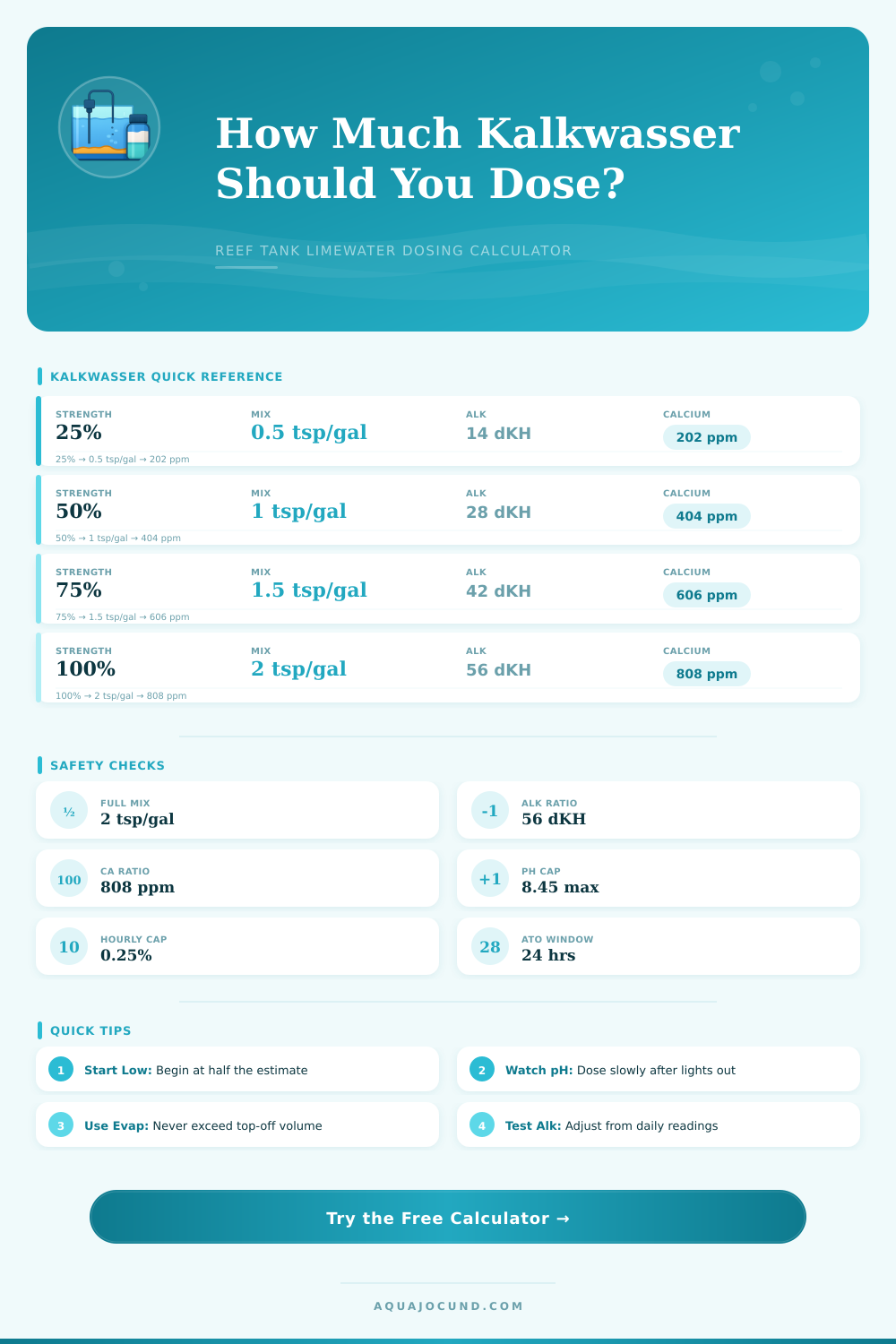
| Mix strength | Approx dry kalk | Alk in solution | Calcium in solution | Best use |
|---|---|---|---|---|
| 25% | 0.5 tsp/gal | 14 dKH | 202 ppm | New kalk users |
| 50% | 1 tsp/gal | 28 dKH | 404 ppm | Low demand reefs |
| 75% | 1.5 tsp/gal | 42 dKH | 606 ppm | Mixed reefs |
| 100% | 2 tsp/gal | 56 dKH | 808 ppm | High demand tanks |
| Tank | Typical volume | Evap/day | Common demand | Kalk note |
|---|---|---|---|---|
| 20 gal nano | 76 L | 0.2-0.5 gal | 0.2-0.6 dKH | Use weak mix |
| 40 breeder | 151 L | 0.5-0.9 gal | 0.4-0.9 dKH | Drip slowly |
| 75 gal reef | 284 L | 0.8-1.5 gal | 0.7-1.5 dKH | Often evap-limited |
| 125 gal reef | 473 L | 1.5-2.8 gal | 1.0-2.0 dKH | ATO friendly |
| Limiter | What it means | Typical fix | Status cue |
|---|---|---|---|
| Demand | Kalk meets the selected alk or calcium target | Hold dose and test daily | Good |
| Evaporation | Required kalk is above top-off volume | Use two-part or calcium reactor | Limited |
| pH cap | Dose may raise pH too quickly | Lower strength or extend drip time | Caution |
| Hourly ATO | ATO pump adds water too fast | Spread dosing across more hours | Slow down |
- Start below the calculator result: Begin at 50% of the safe dose, test alkalinity for several days, then raise gradually.
- Do not chase calcium with kalk alone: Kalkwasser adds alkalinity and calcium in a fixed ratio, so use alkalinity stability as the main control point.
- Keep slurry out of the tank: Dose only clear settled limewater, not the white solids from the bottom of the reservoir.
- Respect evaporation limits: Kalkwasser replaces evaporated water; dosing more than daily evaporation can drop salinity.
- Use the longest practical drip window: Longer duration lowers the estimated pH spike and makes ATO delivery gentler.
- Stop if pH climbs too high: If pH approaches your cap, pause kalk and use plain RO/DI for top-off until the tank settles.
Kalkwasser dosing take into account the evaporation rate for your reef tank. The goal of adding kalkwasser to your reef tank is to replace the water that evaporates from your tank with water that contains the same amount of calcium and alkalinity as the evaporated water. In addition to provide calcium and alkalinity to the water, kalkwasser dosing also must take into account preventing the pH of your water from rising to dangerous level.
Should you miscalculate the dosing of kalkwasser to your reef tank, those dosing error will accumulate over the weeks. Furthermore, miscalculated dosing of kalkwasser can lead to uncontrollable swing in the pH of your water. Therefore, you must have an understanding of the dosing of kalkwasser to your reef tank; the amount of kalkwasser that you dose to your tank will determine whether or not your corals recieve the supplementation that they requires, or whether you must use two-part additive to your tank.
How to Add Kalkwasser to Your Reef Tank
The evaporation of the water in your reef tank is one of the factors that will limit the amount of kalkwasser that you can dose into your tank. If the evaporation of water from your tank is slow, then the amount of kalkwasser that you dose is also limited. A calculator allows you to determine the amount of kalkwasser that you should dose to your reef tank by inputting the dimension of your tank and the amount of water that you change daily for your tank.
The calculator will provide for you an indication of whether evaporation rates are the limiting factor for your dosing of kalkwasser, or whether your pH will be the limiting factor in dosing kalkwasser to your reef tank. The strength of the kalkwasser solution that you dose into your tank is another variable in perform the dosing of kalkwasser. A saturated kalkwasser solution (two teaspoons per gallon) contains the highest level of calcium and alkalinity, but causes the steepest rise in the pH of your water.
Should you use a weaker solution, the rise in the pH of your water will be less, but you will have to dose more of the weaker solution into your tank. Many reef keeper use a half-saturated kalkwasser solution so that there is some margin for error with the pH of the water, and so that the keepers can learn how their tanks react to adding kalkwasser. The length of time that you dose the kalkwasser into your tank also play a role in performing the dosing of kalkwasser.
If you dose the kalkwasser quickly and concentrated into a certain area of the tank, the pH will rise to a higher level in that area. However, if you dose the same amount of kalkwasser over a longer period of time, the concentration of the kalkwasser in that area will be lower. Therefore, dosing kalkwasser slowly is the best way to ensure that your tank is not exposed to extreme level of kalkwasser, but the slow dosing of kalkwasser will require a longer amount of time to dose the amount of kalkwasser required to supplement the calcium and alkalinity in your tank.
The pH level of the water in your tank is another major factor in dosing kalkwasser to your tank. For instance, if the pH of your tank is 8.2 in the morning, the pH may rise by half a point or more if you dose the total amount of kalkwasser while the lights are on your tank. This is due to the fact that photosynthesis does not occur while the lights are off.
Therefore, you may have to adjust the dosing of kalkwasser to the late evening or the early morning, when the natural fluctuation in the pH of your water will mask any additional rise in the pH caused by the addition of kalkwasser. In addition to the factor discussed above, the dosing pump for your tank is also a factor in kalkwasser dosing. Automatic top-off (ATO) pumps, while helpful for maintaining the water level in your tank, are often not precise enough for dosing kalkwasser.
For instance, an ATO system may have to deliver the entire daily amount of kalkwasser in only forty minute of running the ATO system. If you dose the kalkwasser at such a rapid rate, the concentration of kalkwasser at the return will become extreme and may be dangerous for the reef tank. Therefore, you must ensure that the percentage of kalkwasser dosed per hour that you use in the dosing calculator also respects the limits of your ATO system.
Some of the variables in your reef tank may differ from the calculation performed by the dosing calculator. For instance, kalkwasser may creep on the rim of the tank, increasing the evaporation of water from your tank. Furthermore, protein skimmer may remove some of the alkalinity from the water in your tank.
Additionally, when you perform water change, both calcium and alkalinity levels in your water are reset. These changes may not occur on the same time schedule as your kalkwasser dosing schedule. Therefore, the calculations will provide an upper limit to the dosing of kalkwasser to your tank.
Begin with dosing only half the amount of kalkwasser suggested by the dosing calculator. After a week, determine if the alkalinity level of your tank began to drop, indicating that the dosage of kalkwasser should be increased. While kalkwasser can be one of the tool that you use to supplement your reef tank with the calcium and alkalinity that it requires for the health of its corals, kalkwasser is not always the solution for those requirement.
If the demand for calcium and alkalinity in your tank is higher than the evaporation rate of your tank, then you should not use kalkwasser to meet those demand. Instead, you should use a calcium reactor or a two-part additive for your reef tank. Kalkwasser is relatively inexpensive and has the additional benefit of acting as a buffer for the pH of the water in your tank; however, kalkwasser will work best for your reef tank if you understand the limits of kalkwasser dosing.
The dosing calculator is useful in that it consider all of the factors discussed above and provides you with a number that represents the amount of kalkwasser that you should dose to your tank. This number is merely a guide for you, however. You must monitor the pH, alkalinity, and evaporation rates in your tank to ensure that the dosage of kalkwasser that you provide is within a level that will ensure the stability of the water in your reef tank.