💧 Aquarium Drip Acclimation Time Calculator
Estimate drip time from bag volume, water differences, drip rate, dilution target, species sensitivity, and your maximum session limit.
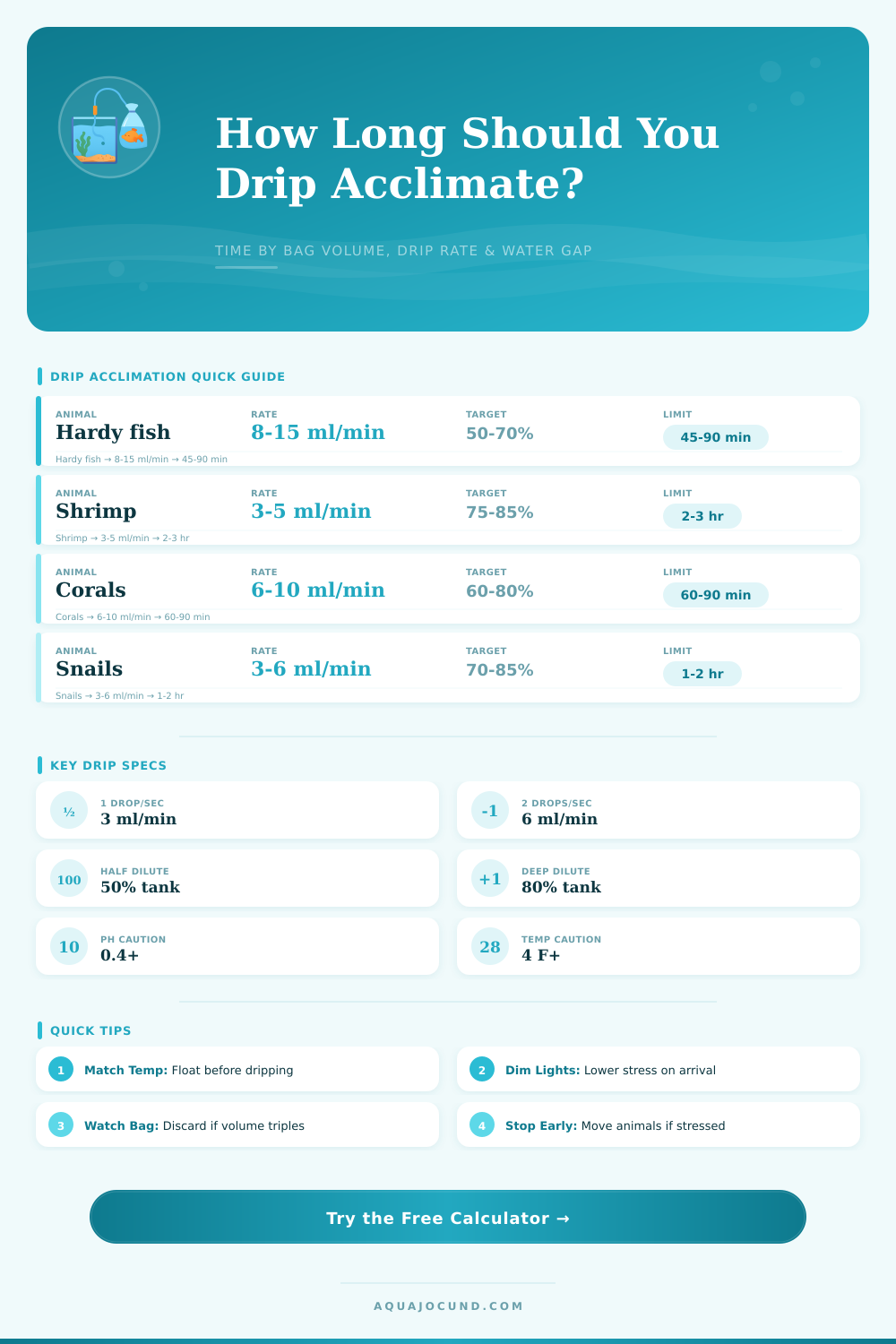
| Animal Type | Typical Rate | Target Tank Water | Common Time | Watch Closely For |
|---|---|---|---|---|
| Hardy freshwater fish | 8-15 ml/min | 50-70% | 30-90 min | Fast breathing, rolling, jumping |
| Moderate community fish | 6-12 ml/min | 60-80% | 45-120 min | Color loss, clamped fins |
| Sensitive fish | 4-8 ml/min | 75-90% | 90-180 min | Loss of balance, gasping |
| Shrimp and snails | 3-5 ml/min | 80-90% | 120-180 min | Weak grip, immobility |
| Corals and frags | 6-10 ml/min | 60-80% | 45-90 min | Excess slime, tissue recession |
| Parameter Gap | Low Caution | Moderate Caution | High Caution | Calculator Response |
|---|---|---|---|---|
| Temperature | 0-2°F | 2-4°F | 4°F+ | Increase target or slow drip |
| pH | 0.0-0.2 | 0.2-0.4 | 0.4+ | Suggest slower acclimation |
| Freshwater salinity | 0-0.5 ppt | 0.5-2 ppt | 2 ppt+ | Warn for osmotic stress |
| Marine salinity | 0-1 ppt | 1-3 ppt | 3 ppt+ | Favor smaller drip rate |
| Container | Starting Volume | Best Use | Overflow Note |
|---|---|---|---|
| Small retail fish bag | 0.25-0.5 gal | Betta, nano fish | Move to cup if bag is narrow |
| Large fish bag | 0.5-1 gal | Community fish | Clip bag upright or use bucket |
| Specimen cup | 0.1-0.25 gal | Shrimp, snails | Use a very slow drip |
| Small bucket | 1-2 gal | Marine fish, corals | Safer for longer sessions |
| Quarantine transfer tub | 2-5 gal | Large fish | Aerate if session is long |
The calculator treats the drip as tank water added to the original bag volume. If the container gets too full, discard water and continue, keeping animals submerged.
Long acclimation can become risky when shipping water has ammonia, low oxygen, or rising temperature. The max session field flags when the plan is too slow.
Large osmotic or pH changes deserve a slower drip and a higher dilution target, especially for shrimp, snails, starfish, wrasses, and other sensitive animals.
Float the sealed bag or match the bucket temperature before dripping when the temperature gap is large. Drip acclimation alone changes temperature slowly.
Drip acclimation is a process that allow livestock to being moved from a shipping container into an aquarium. The water in the shipping container is often different than the water in the aquarium, and the livestock can experience stress due to these chemical difference. Drip acclimation allow for the water chemistry of the livestocks environment to change gradually.
If the change in water chemistry is to rapid, the livestock may experience problems such as gasping for air or remaining against the glass of the aquarium. To perform drip acclimation, there are several different variable that must be considered. These variables include the volume of water in the shipping container, the drip rate, and the difference in water chemistry between the shipping and aquarium water.
How to Acclimate Livestock to Aquarium Water
A calculator can help manage these variables by calculating the amount of time that the livestock need for drip acclimation. For instance, if the water chemistry difference are small, the time required will likely be less than one hour. However, large difference in water chemistry may require two or three hour of drip acclimation.
The different inputs for the calculator has specific meanings and purposes. For instance, the bag volume is the amount of water that will be dripping from the container, the drip rate is the speed at which the water will drip from the container, the target percentage is the percentage of water in the container that need to be replaced with aquarium water, and the time limit is the length of the drip acclimation process, which cannot be too long due to the potential problems with long acclimation sessions. For instance, ammonia level may increase, oxygen level may decrease, and the temperature of the water may drift during a long drip acclimation session.
The different species of livestock has different sensitivities to changes in water chemistry. For instance, some fish species are more hardy than others and can tolerate faster drip acclimation rate and lower target percentage. Other species, such as shrimp, snail, and corals, have less able to tolerate rapid changes in water chemistry.
Thus, the calculator determine a risk score for the species of livestock that will be acclimated, and uses that risk score to determine the length of the drip acclimation process. In addition to the calculator, the container in which the livestock will be acclimated also need to be managed. If you add aquarium water to the container without removing any of the water that was in the container prior to the addition of aquarium water, the volume of the liquid in the container may become too great for the container.
Thus, you will need to discard some of the shipping containers water prior to adding aquarium water, and the calculator will calculate the volume of water that will remain in the container following the discarding of some of the water. Temperature is another factor that need to be managed prior to the beginning of the drip acclimation process. You may float the shipping container and bag in the aquarium prior to beginning the drip acclimation process.
For instance, the bag may be floated for fifteen or twenty minute. This help to even out the temperature between the shipping and aquarium water. Since the drip rate will slowly even out the temperature in the container, it is helpful to even out the temperatures prior to the drip acclimation process.
Salinity and pH level are not typically evened out prior to the beginning of drip acclimation, though the calculator for drip acclimation place more importance on these two factor than the others. Prior to the beginning of the drip acclimation process, the variables will need to be entered into the calculator. Each of the variables will need to be measured prior to the drip acclimation process begins.
For instance, you will need to measure the bag volume. Each of the water parameter will need to be tested prior to beginning drip acclimation. Additionally, you will need to choose the drip rate for the species of livestock to be acclimated.
If the parameter entered into the calculator suggest that the drip acclimation session will take too long or pose a risk to the livestock, you can adjust the drip rate or the target dilution percentage to ensure that the plan for acclimation will take place within the tolerance of the livestock.