Protein Skimmer Sizing Calculator
Estimate reef skimmer rating, pump air draw, neck size, contact time, and total system volume from your display, sump, bioload, and feeding routine.
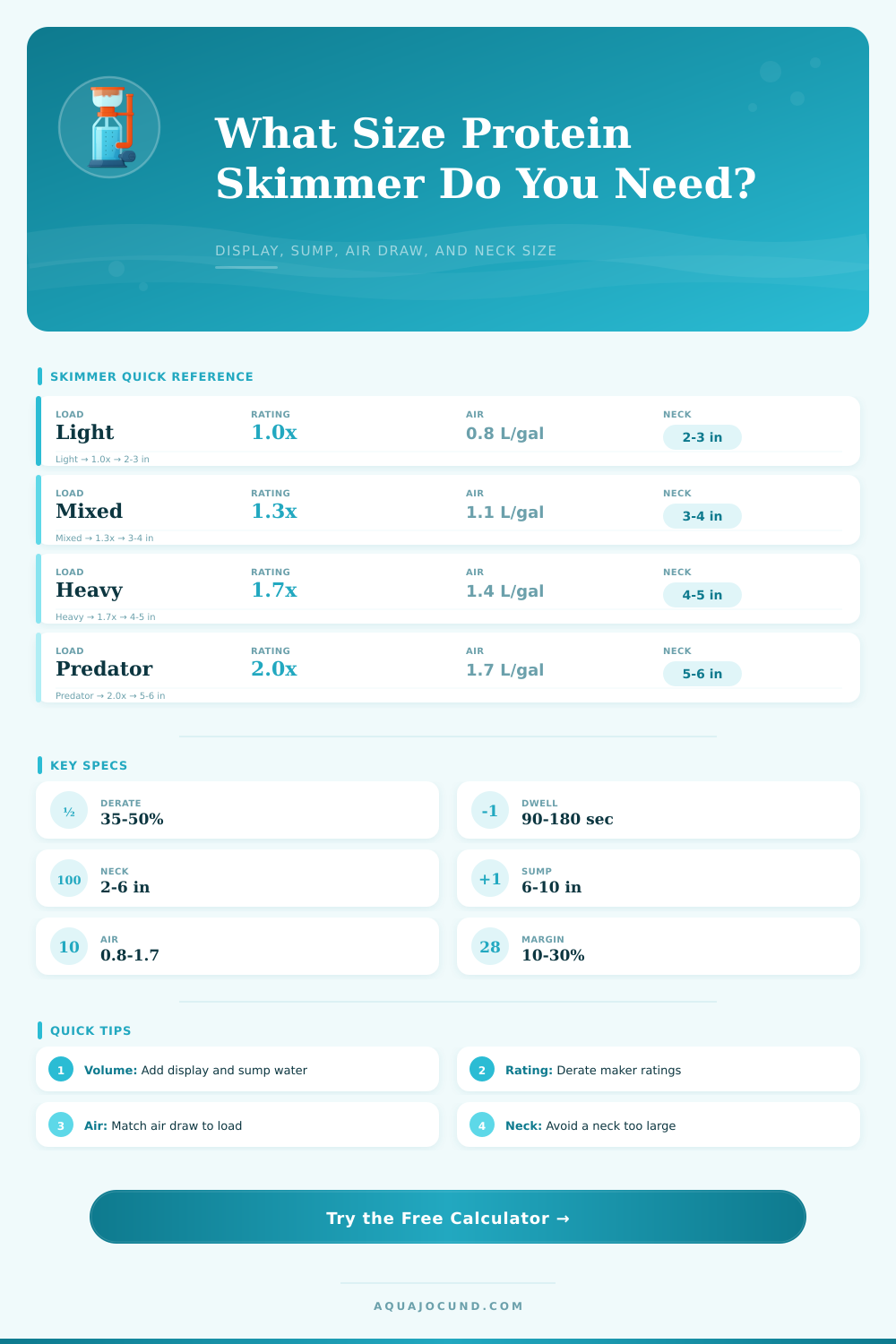
| Bioload | Effective Rating Target | Air Draw Target | Best Fit Note |
|---|---|---|---|
| Light reef | 1.0x total volume | 0.7 to 0.9 L/h per gal | Avoid oversize necks that stall foam. |
| Mixed reef | 1.2x to 1.4x total volume | 1.0 to 1.2 L/h per gal | Stable default for most reef tanks. |
| Heavy reef | 1.5x to 1.8x total volume | 1.3 to 1.5 L/h per gal | Useful for tangs, wrasses, and frozen food. |
| Predator FOWLR | 1.8x to 2.2x total volume | 1.5 to 1.8 L/h per gal | Prioritize waste export and cup capacity. |
| Frag system | 1.2x to 1.5x total volume | 0.9 to 1.2 L/h per gal | Account for food, coral slime, and racks. |
| ULN SPS | 0.9x to 1.2x total volume | 0.7 to 1.0 L/h per gal | Too much export can strip nutrients quickly. |
| Display | Typical Sump | Total Water | Mixed Reef Skimmer |
|---|---|---|---|
| 20 gal nano | 5 gal | 21 to 24 gal | 40 to 70 gal rating |
| 40 breeder | 12 gal | 43 to 48 gal | 80 to 130 gal rating |
| 75 gal reef | 20 gal | 82 to 90 gal | 140 to 220 gal rating |
| 120 gal reef | 35 gal | 135 to 150 gal | 230 to 360 gal rating |
| 180 gal reef | 50 gal | 200 to 220 gal | 340 to 520 gal rating |
| Neck ID | Typical Air Draw | System Range | Reading |
|---|---|---|---|
| 2.0 to 2.5 in | 150 to 300 L/h | Nano to 40 gal | Best with light to moderate foam heads. |
| 3.0 to 3.5 in | 300 to 700 L/h | 40 to 90 gal | Common sweet spot for midsize reefs. |
| 4.0 to 4.5 in | 700 to 1100 L/h | 90 to 150 gal | Needs enough organics to keep the neck active. |
| 5.0 to 6.0 in | 1100 to 2000 L/h | 150 to 300 gal | Works for high-air skimmers and heavy systems. |
| 6.5 in plus | 2000 L/h plus | 300 gal plus | Usually for large public or multi-tank systems. |
In order to select an apropriate protein skimmer for your reef tanks, there is a variety of different variables that you should consider. Each of these variable will influence the way that the protein skimmer perform within your tank. For instance, a protein skimmer that effectively performs its skimming duties will leave your tank water clear, but a protein skimmer that does not effectively performs its skimming duties will leave the water in your tank less clear then it should be.
One of the first variables to calculate when selecting a protein skimmer is the volume of the water in the tank. The volume of the water in the tank isnt the same as the volume of the tank indicated on the tank label, however. The volume of the water is less than the tank volume due to the fact that the rock, sand, and other tank equipments within the tank can displace some of the water in the tank.
How to Pick the Right Protein Skimmer for Your Reef Tank
Additionally, you must also include the volume of the water in the sump in the calculation of the total volume of the system. If these factors are not included in calculating the volume of the tank, the calculation of the apropriate protein skimmer will be inaccurate. Another factor to consider is the bioload of the tank.
Bioload refers to the amount of waste that is created by the inhabitants of the tank. For example, a reef tank with a low bioload may contain soft corals as its inhabitant, while a reef tank with a high bioload may contain many fish species. Because fish tend to produce more waste than corals, a reef tank containing many fish will require a protein skimmer with a higher capacity than a reef tank containing only soft corals.
You can use a calculator to adjust for the bioload of the tank to ensure that the protein skimmer is apropriate for that tanks waste production level. The air draw and the diameter of the neck of the protein skimmer are two mechanical factors related to the function of the protein skimmer. The protein skimmer must be able to move enough air through the system to effectively perform its skimming function.
Additionally, the diameter of the neck of the protein skimmer must be appropriate for the amount of air that is drawn into the protein skimmer. If the neck of the protein skimmer is too wide for the protein skimmer’s air draw, the formed foam may not be able to exit the protein skimmer. In the same way, if the neck of the protein skimmer is too narrow for the amount of air that is drawn into the protein skimmer, the air will not be able to properly move through the neck of the protein skimmer.
Thus, matching these two factors will ensure that the protein skimmer is stable, and that it does not require constant adjustment to its settings. Finally, one last factor to consider is the contact time of the protein skimmer. Contact time is the length of time that the formed foam in the protein skimmer remains in its chamber.
Contact time is one factor that allows the protein skimmer to effectively remove organic waste from the tank water. In order for the foam to effectively remove the organics from the water, there must be enough contact time for the organics to be removed prior to the water leave the protein skimmer. However, if the contact time is too long, the foam may become unstable.
If the contact time is too short, the protein skimmer will not remove the organics from the tank, and will pass through the protein skimmer with the tank water. The manufacturer ratings for the protein skimmers tend to be higher than the actual performance that the protein skimmer will exhibit in the reef tank. The manufacturers provide a rating based off the conditions under which they test the protein skimmer, but the real reef tank will often have different wastes than those introduce by the manufacturers.
In order to account for this, it is recommended that you utilize a calculator to derate the manufacturer’s figure for the manufacturer’s protein skimmer capacity, this will provide a more accurate figure for the capacity of a protein skimmer that is needed to effectively clean the chosen reef tank. The feeding routine for the fish in the reef tank will impact the organic load in the tank. The higher the organic load in the tank, the more the protein skimmer will have to accomplish in the tank.
Feeding foods that contain more organic matter will increase the organic load in the water, and thus, the protein skimmer will have to have greater capacity to remove the organics from the tank. Thus, you should adjust the feeding level in the calculation of the protein skimmer that is to be installed in the reef tank. It is additionally recommended to include a margin of safety in the installation of a protein skimmer.
The margin of safety will provide protective measure for the tank in the case that additional fish or coral are added to the reef tank. Adding more fish will increase the bioload of the tank, and an increased bioload will require an increased capacity for the protein skimmer to effectively remove waste from the tank. Therefore, providing a margin of safety prevents the need to purchase an additional protein skimmer with increased capacity if additional fish are added to the reef tank.
After the protein skimmer is purchased and installed into the reef tank, it is recommended that you observe the protein skimmer for several week. During these several weeks, it is important to ensure that the height of the foam, the collection rate of the protein skimmer, and the dryness of the protein skimmer’s collection cup are within the normal limits. If the values of any of these parameter are outside of the expected limits, you should adjust the inputs into the calculation of the necessary capacity for the protein skimmer.
This procedure should of been performed each time the protein skimmer’s parameters change, as it is essential that the protein skimmer is always in accordance with the needs of the reef tank at any given time.