📦 Aquarium Empty Weight Calculator
Estimate empty glass or acrylic tank weight from dimensions, thickness, rim style, panel mass, and handling class.
Empty aquarium weight estimate
Panel-by-panel dry tank weight with rim and handling allowance.
| Material | Density | Weight vs Glass | Calculator Use |
|---|---|---|---|
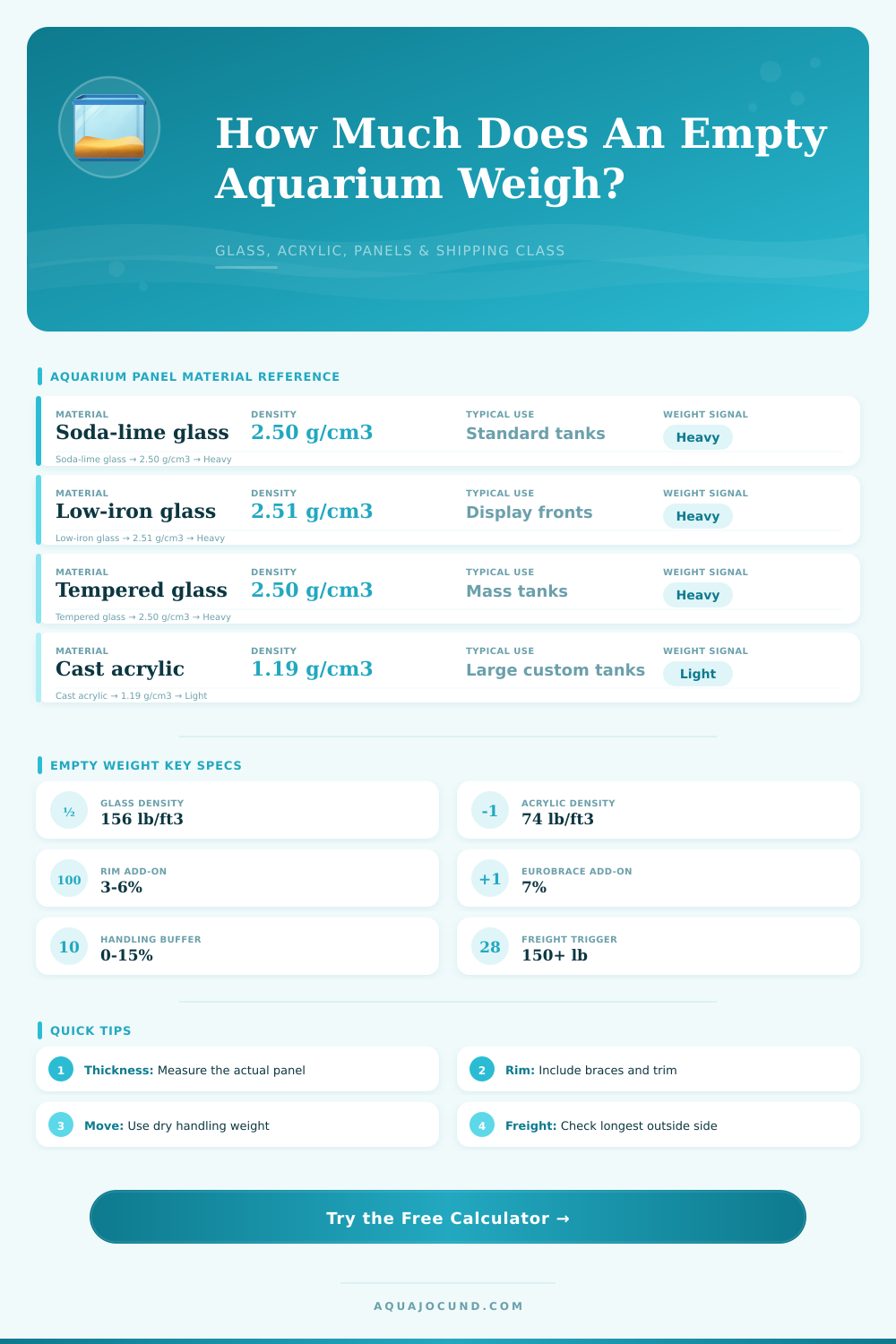
| Soda-lime glass | 2,500 kg/m3 | Baseline | Most standard aquariums |
| Low-iron glass | 2,510 kg/m3 | About 0.4% heavier | High clarity display panels |
| Tempered glass | 2,500 kg/m3 | Baseline | Mass-made bottom or side panels |
| Cast acrylic | 1,190 kg/m3 | About 52% lighter | Large or custom aquariums |
| Polycarbonate | 1,200 kg/m3 | About 52% lighter | Impact-resistant specialty panels |
| Laminated glass | 2,550 kg/m3 | About 2% heavier | Safety laminate with interlayer allowance |
| Tank Size | Dimensions | Typical Thickness | Estimated Empty Weight |
|---|---|---|---|
| 10 gallon | 20 × 10 × 12 in / 51 × 25 × 30 cm | 1/8 in / 3 mm glass | 10-12 lb / 4.5-5.4 kg |
| 20 gallon long | 30 × 12 × 12 in / 76 × 30 × 30 cm | 1/4 in / 6 mm glass | 25-30 lb / 11-14 kg |
| 40 breeder | 36 × 18 × 16 in / 91 × 46 × 41 cm | 1/4 in / 6 mm glass | 45-55 lb / 20-25 kg |
| 55 gallon | 48 × 13 × 21 in / 122 × 33 × 53 cm | 1/4 in / 6 mm glass | 70-80 lb / 32-36 kg |
| 75 gallon | 48 × 18 × 21 in / 122 × 46 × 53 cm | 3/8 in / 10 mm glass | 120-140 lb / 54-64 kg |
| 125 gallon | 72 × 18 × 22 in / 183 × 46 × 56 cm | 3/8 in / 10 mm glass | 190-230 lb / 86-104 kg |
| 180 gallon | 72 × 24 × 24 in / 183 × 61 × 61 cm | 1/2 in / 12 mm acrylic | 140-180 lb / 64-82 kg |
| 220 gallon | 72 × 24 × 30 in / 183 × 61 × 76 cm | 1/2 in / 12 mm glass | 330-390 lb / 150-177 kg |
| Dry Handling Weight | Typical Class | Handling Signal | Best Use |
|---|---|---|---|
| 0-70 lb / 0-32 kg | Parcel Light | One-person lift if size allows | Small desktop tanks |
| 71-150 lb / 32-68 kg | Oversize Parcel | Two-person lift | Mid-size glass aquariums |
| 151-300 lb / 68-136 kg | LTL Freight 150 | Crate recommended | Large glass tanks |
| 301-700 lb / 136-318 kg | LTL Freight 175 | Pallet or liftgate | Heavy display aquariums |
| 700+ lb / 318+ kg | LTL Freight 200+ | Rigging plan | Extra-large custom builds |
Moving an empty aquarium requires an accurate estimation of its weight. Empty aquariums can be much heavier than people expects. People may underestimate the weight of an empty aquarium due to it’s dimension.
Additionally, people may not consider the weight of the material of which the aquarium are made. Therefore, calculating the weight of the empty aquarium is essential. The material of which the empty aquarium is made is one of the first factor that affects its weight.
How to Calculate the Weight of an Empty Aquarium
If the aquarium is made out of glass, then each cubic foot of the tank weigh 156 pounds. Acrylic and polycarbonate tanks weighs roughly half as much as glass tanks. For instance, a 75-gallon glass tank may weigh 120 pounds when empty.
However, the same 75 gallons of acrylic may weigh only 60 or 70 pound when empty. As the material change the weight of the empty aquarium, it is essential to know the material of the empty aquarium that is to be moved. The second factor to consider is the thickness of the panels of the empty aquarium.
You must measure the thickness of the panels. Depending on the weight of the empty aquarium, it may be necessary to move the empty aquarium. If it is, the measurement of the thickness of the panels may be needed to calculate the weight of the empty aquarium correct.
Additionally, if the empty aquarium is of a different shape than a rectangular tank, such as a bow-front or cylinder tank, then the area of the tanks surface will change the weight of the empty aquarium. The calculator will adjust for the different shape of the tanks. Another factor that may change the weight of the empty aquarium is its rim and bracing.
An empty aquarium that is rimless will weigh less than an empty aquarium with bracing made out of steel. In such a scenario, it may be appropriate to add an allowance for the handling of the empty aquarium to the weight of the empty aquarium. Such an allowance may include the weight of crates, edge guard, or the wrapping of the empty aquarium in moveable materials.
These additions may seem small to the empty aquariums total weight. However, they are essential to determining if one person or two people will be required to move the empty aquarium. Finally, another factor to consider is the shipping classification for the empty aquariums.
Shipping companies may classify empty aquariums according to the weight of the empty aquarium and the longest dimension of that empty aquarium. If the empty aquarium weighs less than 70 pound and has at least one side that is shorter than 60 inches, it may be sent via a parcel service. However, if the empty aquarium weighs 150 pounds or more, it will be classified as freight.
Freight items are moved different than parcels. The calculator will show what class of shipping the empty aquarium will fall into to determine the proper packaging for the empty aquarium. When moving an empty aquarium, there are other physical considerations beyond its calculated weight.
For example, empty aquariums may have corner that are sharp enough to chip the protective coating of the aquariums acrylic panels. Additionally, these same panels can get scratched when the empty aquarium is handled careless. Lastly, if the empty aquarium uses glass for its panels, it is possible that the panels will develop hairline crack if the empty aquarium is subjected to uneven pressure.
Considering these risk to the empty aquarium, many people will choose to place a full handling buffer into their weight calculations rather than use the minimum weight for the empty aquarium. The reference table provided with the calculator allow people to understand how the material of the empty aquarium may change its weight. Each table displays the different materials from which empty aquariums may be made.
Additionally, the tables display how the density of these materials affect the weight of the empty aquarium. Other tables show common sizes and thicknesses of tanks so that people can easily compare their empty aquarium to these common tanks. Another table displays the different shipping classes according to the weight of the empty aquarium so that people know whether a parcel van or a freight truck will transport the empty aquarium.
A common mistake when calculating the weight of an empty aquarium is to refer to the gallon rating of that empty aquarium. Two empty tanks might have the same number of gallon but weigh differently due to the different materials out of which they are made. Due to this potential for inaccuracies, people should never use the gallon rating of an empty aquarium to calculate its weight.
Instead, the dimension and thickness of the empty aquarium should be measured to determine the empty aquariums weight. This same process is helpful when purchasing an empty aquarium that has already been used in an aquarium. The seller does not know the weight of the used aquarium.
Therefore, it is to the buyers advantage to measure the length, width, height, and thickness of the used empty aquarium themselves. By taking these measurement, the buyer can calculate the weight of the empty aquarium that is to be transported. Additionally, these measurements will allow the buyer to calculate the weight of two different empty aquariums so that a comparison can be made between them.
Finally, the weight that is calculated by this calculator is a functional number. This number will help people to determine whether they can complete the task of moving the empty aquarium themselves or if they will need to enlist another empty aquarium mover. By knowing the weight of the empty aquarium, people will be able to plan their aquarium move more effective.