🌊 GPH to LPH Converter
Convert pump flow between US GPH, UK GPH, and LPH while estimating turnover after head loss.
| Pump type | Typical head limit | Common use | Loss note |
|---|---|---|---|
| Submersible utility | 7 ft / 2.1 m | Tank return, fountain | Moderate curve |
| Canister filter | 5 ft / 1.5 m | Closed-loop filtration | Media-sensitive |
| Sump return | 10 ft / 3.0 m | Overflow to display | Elbows matter |
| Pond pump | 14 ft / 4.3 m | Skimmer, falls, pond | Higher lift |
| Sponge or airlift | 3 ft / 0.9 m | Gentle biofiltration | Low pressure |
| Wavemaker | 0 ft / 0 m | In-tank circulation | No lift flow |
| Rated flow | US GPH to LPH | UK GPH to LPH | Good for |
|---|---|---|---|
| 50 GPH | 189 LPH | 227 LPH | Nano filters |
| 100 GPH | 379 LPH | 455 LPH | 10-20 gal tanks |
| 300 GPH | 1,136 LPH | 1,364 LPH | 40-75 gal tanks |
| 500 GPH | 1,893 LPH | 2,273 LPH | Large aquariums |
| 1,000 GPH | 3,785 LPH | 4,546 LPH | Small ponds |
| 2,000 GPH | 7,571 LPH | 9,092 LPH | Pond waterfalls |
| Setup | Target turnover | Example volume | Effective flow target |
|---|---|---|---|
| Community aquarium | 4-6x per hr | 55 US gal | 833-1,249 LPH |
| Planted aquarium | 5-10x per hr | 40 US gal | 757-1,514 LPH |
| Goldfish aquarium | 8-12x per hr | 75 US gal | 2,271-3,407 LPH |
| Cichlid aquarium | 6-10x per hr | 75 US gal | 1,703-2,839 LPH |
| Reef circulation | 10-20x per hr | 90 US gal | 3,407-6,814 LPH |
| Pond circulation | 0.5-1.5x per hr | 1,000 US gal | 1,893-5,678 LPH |
| Koi pond | 1-2x per hr | 2,000 US gal | 7,571-15,142 LPH |
| Water volume | Metric volume | 5x turnover | 10x turnover |
|---|---|---|---|
| 10 US gal | 38 L | 189 LPH | 379 LPH |
| 20 US gal | 76 L | 379 LPH | 757 LPH |
| 40 US gal | 151 L | 757 LPH | 1,514 LPH |
| 55 US gal | 208 L | 1,041 LPH | 2,082 LPH |
| 75 US gal | 284 L | 1,420 LPH | 2,839 LPH |
| 125 US gal | 473 L | 2,366 LPH | 4,732 LPH |
| 500 US gal pond | 1,893 L | 9,464 LPH | 18,927 LPH |
| 1,000 US gal pond | 3,785 L | 18,927 LPH | 37,854 LPH |
To ensure that your aquarium or pond has proper movement of the water, you need to understands the actual movement of water that the pump will provide once installed into the water feature. The flow rate that is listed on the pump box are the rated flow of the pump. However, the flow of water that will leave the aquarium or pond will rarely be the same then the rated flow due to the way that gallons are measure, the head height of system, and the restrictions created by the plumbing and filter media.
Thus, while it is necessary to convert the flow in gallons per hour to liters per hour, it is additionally necessary to account for each of these other factors that can impact the actual flow of water. The flow rate of water in gallons per hour may be based off US gallons rather than UK gallons. For instance, a 500 GPH pump rated in US gallons will move less water than a 500 GPH pump whose flow rate the manufacturer rated in UK gallons.
How to Find the Real Water Flow in Your Aquarium or Pond
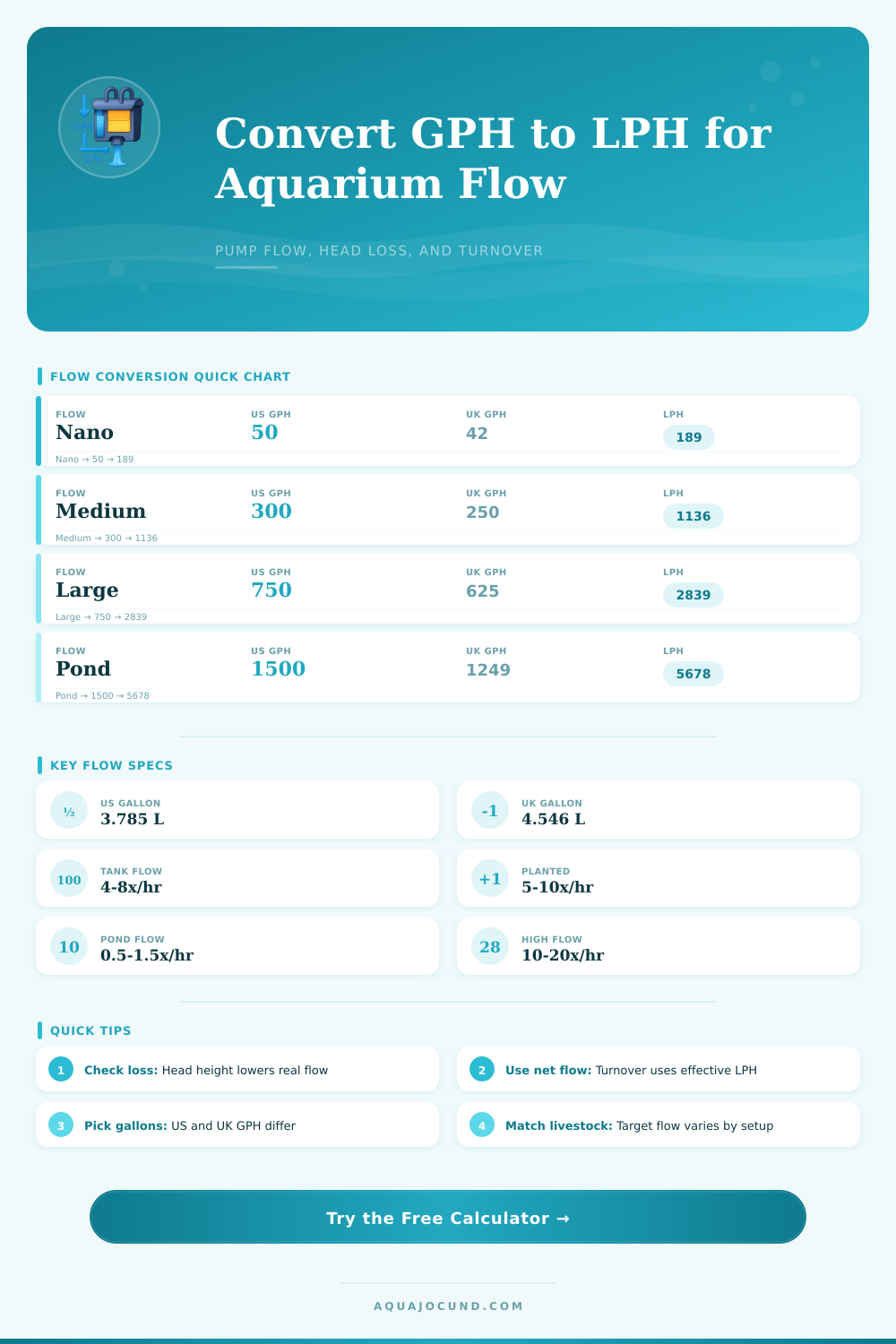
Each US gallon contain 3.785 liters of water, while each UK gallon contains 4.546 liters. Thus, a calculator that determines the flow of water in liters per hour can take into account the size of the gallon that is use to rate the pump. Another factor that will impact the actual flow of water is the head height.
Head height is the distance in feet or meters that the water must travel from the pump to the point at which the water is returned to the aquarium or pond. Each foot or meter of head height reduces the flow of the water that can emerge from the aquarium or pond. Furthermore, the flow of water decrease in a non-linear fashion as the head height increases, with the capacity of the pump to deliver water decreasing at a more faster rate as the head height approaches the maximum head height of the pump.
Thus, a calculator that determines the actual flow of water can also take into account the head height of the system. Another factor that can reduce the flow of water is the restrictions created by the plumbing and filter media. Each component of the plumbing system and each type of filter media creates some friction for the movement of water through the system.
Additionally, the density of the filter media and the cleanliness of the prefilters can additionally create resistance to the movement of water. Each of these restrictions can be accounted for in the calculator to provide a better understanding of the actual flow of water that will leave the aquarium or pond. The turnover rate of the aquarium or pond is a measurement of the number of times that the water in the aquarium or pond is completely replace within one hour.
The turnover rate requirements for aquariums and ponds of different types vary. For instance, community tanks should have turnover rate between four and six times per hour. Planted tanks, however, may require higher turnover rates.
Tanks that contain goldfish or cichlids may require higher turnover rate due to the waste that these types of fish produce. Reef systems will also require high turnover rate. Ponds and koi systems will require lower turnover rate, however, since the goal is to provide gentle movement to the water in these systems.
Real water systems are rarely as clean as the conditions under which manufacturers test pumps. The flow rate of water may be excellent for the pump when the manufacturer tested it, but as soon as the pump is placed into an aquarium or pond, the flow will decrease due to the addition of elbows, filters, and the clean water of the aquarium or pond. The longer the system is used, the more the flow of the pump will decrease due to the build-up of the debris that is circulating through the system.
Thus, aquarists may find that a filter is insufficient based upon the flow rates indicated for that filter when new, but once installed in an aquarium or pond, will not provide enough water movement for the aquarium or ponds inhabitant. Thus, head height and restriction factor must be included in the calculation of flow rates for pumps. The type of pumps that are placed in the systems can also impact the flow of water throughout the tanks.
Submersible utility pumps can handle head heights of a few feet, but are not designed for continuous operation at high rates of pressure. Canister filters often have motor that are located outside of the filter, which means that they are sensitive to the resistance that the media within those filters create. Similarly, sump return pumps are often built to allow the water to travel long distances with minimal drop in flow rates, but water movement within long runs of plumbing may reduce the flow of water that emerge from the return pump.
In addition, pond pumps are designed to provide for the toleration of debris and the presence of dirt, as ponds often contain such element, but display tanks often do not. Thus, each type of pump may have different flow capabilities. Based upon the calculations of the flow that will emerge from the aquarium or pond, an aquarist may need to decide whether the aquarist should accept the flow that was calculated, or if additional adjustment must be made to the systems components.
Various adjustments could be made, and the decision of which adjustment to use may be based upon the recommendation that emerges from the calculator. For instance, if the determined flow is too low to be considered acceptable, the aquarist may need to adjust the system to include the installation of a larger pump, the shortening of the plumbing run that connect the pump to the aquarium or pond, or the change in the type of tubing that is use throughout the aquarium or pond. In other instances, though, the aquarist may find that the current system is within the target band of flow rates for the type of aquarium or pond that is established.
In these case, the determination of the required flow will allow the aquarist to avoid adjustments to the existing system. The flow of water in an aquarium or pond can impact various aspects of the system. For instance, if the flow is too low, the waste that the fish create will settle at the bottom of the tanks, and the levels of dissolved oxygen in the water will drop.
Should the flow, however, be too high for the inhabitant of the tank, the fish may become stressed, and the strong movement of the water may blow the plants that may be established in the aquarium or pond backward. Thus, the useful flow rate of water will be that which remain after the reduction of flow due to head height, plumbing, and media. A single tool for calculating each of these variable will allow the aquarist to gain an understanding of the actual movement of the water within the system, and to decide if that movement is an adequate movement to maintain the health of the system and its inhabitants.