🐟 Aquarium Substrate Depth Calculator
Estimate substrate volume, weight, slope depth, cap layer, settling allowance, and bag count from your tank footprint.
| Type | Density | Metric density | Typical depth | Notes for calculation |
|---|---|---|---|---|
| Pool filter sand | 90 lb/cu ft | 1.44 kg/L | 0.75-2 in | Compact, heavy, easy to slope shallow |
| Washed play sand | 85 lb/cu ft | 1.36 kg/L | 1-2 in | Fine grains settle more than gravel |
| Fine aquarium gravel | 95 lb/cu ft | 1.52 kg/L | 1.5-3 in | General planted or community use |
| Pea gravel | 100 lb/cu ft | 1.60 kg/L | 1.5-3 in | Larger gaps; keep caps thicker if mixed |
| Aquarium soil | 45 lb/cu ft | 0.72 kg/L | 2-4 in | Light and porous; bag volume varies by brand |
| Aragonite sand | 105 lb/cu ft | 1.68 kg/L | 1-2.5 in | Dense marine or cichlid substrate |
| Crushed lava rock | 55 lb/cu ft | 0.88 kg/L | 1-3 in | Porous base layer, lower weight per volume |
| Mineralized soil mix | 65 lb/cu ft | 1.04 kg/L | 1-2 in plus cap | Usually capped with sand or fine gravel |
| Tank | Dimensions | Footprint | 2 in substrate | Approx sand weight |
|---|---|---|---|---|
| 10 gallon | 20 x 10 in / 51 x 25 cm | 200 sq in | 1.7 gal / 6.6 L | 21 lb / 9.5 kg |
| 20 long | 30 x 12 in / 76 x 30 cm | 360 sq in | 3.1 gal / 11.8 L | 38 lb / 17.2 kg |
| 29 gallon | 30 x 12 in / 76 x 30 cm | 360 sq in | 3.1 gal / 11.8 L | 38 lb / 17.2 kg |
| 40 breeder | 36 x 18 in / 91 x 46 cm | 648 sq in | 5.6 gal / 21.2 L | 68 lb / 30.9 kg |
| 55 gallon | 48 x 13 in / 122 x 33 cm | 624 sq in | 5.4 gal / 20.4 L | 65 lb / 29.5 kg |
| 75 gallon | 48 x 18 in / 122 x 46 cm | 864 sq in | 7.5 gal / 28.3 L | 90 lb / 40.8 kg |
| 90 gallon | 48 x 18 in / 122 x 46 cm | 864 sq in | 7.5 gal / 28.3 L | 90 lb / 40.8 kg |
| 125 gallon | 72 x 18 in / 183 x 46 cm | 1296 sq in | 11.2 gal / 42.5 L | 135 lb / 61.2 kg |
| Layout | Front depth | Back depth | Suggested settling | Cap layer |
|---|---|---|---|---|
| Open sand bed | 0.75-1 in | 1-1.5 in | 5-8% | None |
| General gravel | 1.25-1.5 in | 2-2.5 in | 5-10% | None |
| Low tech planted | 1.5-2 in | 3-3.5 in | 8-12% | Optional 0.5 in |
| Soil under sand | 1 in soil | 2 in soil | 10-15% | 0.75-1.5 in |
| Steep aquascape | 1-1.5 in | 4-5 in | 10-20% | As needed |
Substrate depth is another important measurement for you’re aquarium. The substrate depth will determine how well the plants is able to root into the substrate. If the substrate is too shallow, the plant will struggle to establish themselves.
However, if the substrate is too deep, you will be wasting your money on substrate that you cant see in the aquarium, and the substrate may make the front of your aquarium look too deeply. In order to determine the correct substrate depth, you can consider the slope of the substrate, the thickness of a cap layer, and the settling of the substrate. One way of determining the substrate depth that is appropriate for your aquarium is by using a substrate depth calculator.
How to Use a Substrate Depth Calculator
Substrate depth calculator allow you to input different measurements of your aquarium to determine the amount of substrate that you will need to purchase. Many individuals attempt to use a single depth as the substrate depth for their aquarium. However, the average substrate depth is often not accurate for the aquarium as a whole.
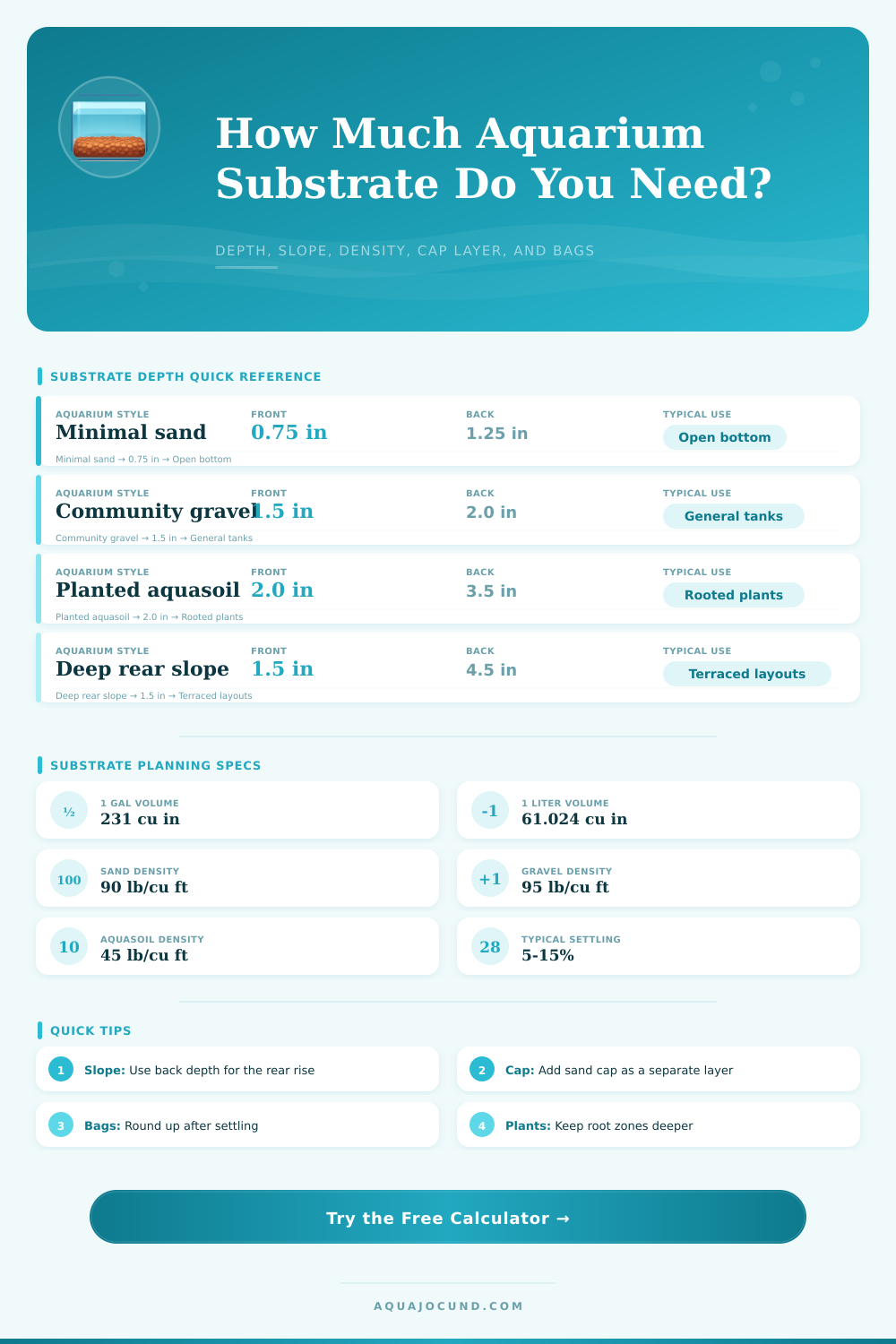
The front of the aquarium may have a different substrate depth then the back of the aquarium. For example, the substrate depth at the front of the aquarium may be shallower in order to make it easy to clean that area of the tank. In contrast, the substrate at the back of the aquarium may be deeper in order to provide substrate for the plants to root into and for the aquarium equipment to hide behind.
Aquarium substrate depth calculators allow you to divide up the footprint of your aquarium into these different areas. The substrate depth calculator will then weight each portion of the substrate according to the percentage of the footprint that each area contains. The calculator will then provide you with an average base depth that you will need for your aquarium substrate.
The type of substrate that you select for your aquarium can impact the total amount of substrate that you purchase for your aquarium. For instance, sand is more dense than gravel. Therefore, sand will weigh more than gravel, and it will take up more of your substrate volume.
Aquasoil is a substrate that is light and porous. Therefore, you will need more aquasoil than another substrate to reach the same depth in your aquarium, and aquasoil will settle more than other substrate. A substrate depth calculator will allow you to factor in the density of your selected substrate so that the calculator can tell you the total weight of the substrate that you will purchase.
A cap layer is a layer of substrate that is placed on the substrate base layer. Many people will use a nutrient rich soil as the base layer, but then will place a cap layer of sand or gravel on top of that substrate. Many people use a cap layer to prevent the nutrient rich base layer from clouding the water in the aquarium, giving the aquarium a cleaner appearance.
This layer does, however, use some of the total depth of the substrate. Substrate depth calculators often have a separate calculation for the cap layer, allowing you to see how much substrate is required for that layer and the additional weights of that layer. After placing the substrate into the aquarium and adding the water, the substrate will settle.
Some substrate will shift due to the water pressure, as well as due to the growth of the rooted plant. The substrate will settle to different degree depending upon the type of substrate. For instance, sandy substrate may settle by 5-8%, while substrate based upon soil may settle by a higher percentage.
In order to account for this settling, an additional substrate depth calculation is performed. The inclusion of a handling margin for substrate depth will ensure that you dont have to purchase additional substrate for the settling that occurs. The shape of your aquarium may also have an impact upon the amount of substrate that your aquarium will need.
For instance, a rectangular aquarium is easy to calculate the surface area of. However, the surface area of an aquarium with a bow front or a cube aquarium will be different than the rectangular aquarium of the same volume in gallon. Aquarium substrate depth calculators account for this different area by including a “shape adjustment factor” into the substrate depth calculation.
Once you have determined the correct footprint for your aquarium, the depth calculation will remain the same regardless of the shape of the aquarium. Aquarium substrates often contain items like rocks and wood that take up some of the substrate volume. Substrate needs to be displaced by the filter intakes and heaters for example.
In areas where terraces are constructed using the hardscape items, more substrate may be needed. In this case, the substrate depth calculator will provide you with a baseline amount of substrate needed for your aquarium. However, you should still make any adjustments to the substrate depth calculations by eye once you have placed the first layer of substrate into your aquarium.
Using a substrate depth calculator will allow you to order the substrate that you will use in your aquarium. The calculator will tell you the weight of the substrate that you will need to purchase, as well as how many bag of substrate you will have to purchase. This will remove the need for you to second guess the substrate depth calculation that you have made.
Instead, you can simply purchase the substrate and ensure that the substrate depth that you select for your aquarium does not require the math that you have just performed with the substrate depth calculator. You should of used a calculator to make sure your substrate depth is correct.