🌊 Brackish Water Mixing Calculator
Blend freshwater and saltwater, correct SG readings, and plan staged salinity changes.
✅ Mixing Results
| Range | Salinity ppt | Approx SG at 25°C | Stockwater Fraction From 35 ppt | Mixing Note |
|---|---|---|---|---|
| Fresh to trace | 0-1 | 1.0000-1.0008 | 0-3% | Measure carefully; small SG shifts are hard to read. |
| Low brackish | 2-6 | 1.0015-1.0045 | 6-17% | Small stockwater volumes make a large difference. |
| Medium brackish | 7-12 | 1.0053-1.0091 | 20-34% | Common target zone for many brackish setups. |
| High brackish | 13-20 | 1.0098-1.0151 | 37-57% | Use a refractometer or corrected hydrometer reading. |
| Near marine | 21-30 | 1.0159-1.0227 | 60-86% | Marine stock strength controls most of the batch. |
| Full marine | 31-35 | 1.0235-1.0265 | 89-100% | Use marine mixing instructions as the final check. |
| Tank | Volume | 25% Change | 35 ppt Stock For 8 ppt | Freshwater For 8 ppt |
|---|---|---|---|---|
| 5 gal Nano | 18.9 L | 1.25 gal | 0.29 gal | 0.96 gal |
| 10 gal | 37.9 L | 2.5 gal | 0.57 gal | 1.93 gal |
| 20 long | 75.7 L | 5 gal | 1.14 gal | 3.86 gal |
| 29 gal | 109.8 L | 7.25 gal | 1.66 gal | 5.59 gal |
| 40 breeder | 151.4 L | 10 gal | 2.29 gal | 7.71 gal |
| 55 gal | 208.2 L | 13.75 gal | 3.14 gal | 10.61 gal |
| 75 gal | 283.9 L | 18.75 gal | 4.29 gal | 14.46 gal |
| 125 gal | 473.2 L | 31.25 gal | 7.14 gal | 24.11 gal |
| Sample vs Calibration | SG Correction | Example Reading | Corrected SG |
|---|---|---|---|
| 10°F cooler | -0.0012 | 1.0080 | 1.0068 |
| 5°F cooler | -0.0006 | 1.0080 | 1.0074 |
| Same temp | 0.0000 | 1.0080 | 1.0080 |
| 5°F warmer | +0.0006 | 1.0080 | 1.0086 |
| 10°F warmer | +0.0012 | 1.0080 | 1.0092 |
Brackish water setup falls somewhere in the middle between freshwater and marine fish setups. A brackish water setup contain more salt than a freshwater aquarium, but less salt than a marine aquarium. The amount of salt that must be provided to the aquarium is dependent upon the species of fish that will be kept in the aquarium, but you should avoid the amount of salt such that expensive equipment often required for marine aquariums are not purchase for brackish aquariums.
In both cases, achieving the correct salinity for the aquarium is important, and understanding how the factors of mixing math, temperature, and salinity affect one another is one way of achieving that desired salinity for the brackish water aquarium. One of the factors that can indicate the salinity that should be targeted within a brackish aquarium is the type of fish that is to be kept within that aquarium. For instance, low level of salinity are appropriate for species like mollies and gobies.
How to Mix and Control Brackish Aquarium Water
In contrast, medium to high levels of salinity is required to maintain species like archerfish, puffers, and scats. Each of these different species require different salinity range within their water, which indicates the importance of choosing the proper salinity range for a given type of fish. Furthermore, the chosen salinity range will determine how to adjust the salinity of the water in the aquarium to that desired level.
The math behind adjusting the salinity of the water in the aquarium involves calculating how much saltwater stock is to be mixed with the freshwater that is to be added to the aquarium. You can determine the strength of the saltwater stock with the salinity of the freshwater and the target salinity of the aquarium. Furthermore, the temperature in which the salinity measurements are taken will impact the salinity reading of the water; salinity measuring tools like hydrometers is calibrated to specific temperatures.
Thus, the temperature of the water can impact the measurements of the salinity within the aquarium, and those measurements must be corrected to ensure that the target salinity is achieve. The calculator included in this article allows individuals to calculate the amount of saltwater and freshwater required to achieve the target salinity for their aquarium. The calculator can help individuals that wish to prepare a batch of brackish water of specific characteristics, or those that wish to adjust only part of the water within an existing aquarium to adjust the salinity of the water.
In the case of adjusting an existing aquarium, the strength of the water that is prepared may have to be either stronger or weaker than the target salinity for the aquarium; this is due to the fact that only part of the total volume of water within the aquarium is to be replaced. In addition to adjusting the salinity of the water within an aquarium, staged changes can be made to the salinity of the water. Staged changes involve changing the salinity of the water within the aquarium in stages rather than all at once; large changes in salinity can be stressful to the fish within an aquarium, so changes in salinity are often limited to 2 part per thousand (‰) at a time.
Thus, the aquarium salinity change calculator can help divide a large desired salinity change into several stage, and indicate the strength of the replacement water for each stage. Furthermore, staged changes allow for individuals to turn one large change in salinity into several smaller changes that the fish can handle. Beyond calculating the amount of saltwater and freshwater that is required to prepare the water that will go into a brackish aquarium, the calculator can also provide estimates of the amount of dry salt that will be required to prepare the saltwater stock for that aquarium.
The amount of dry salt in grams is an important measure to prepare a batch of saltwater stock, or to add salt to a reservoir of water to prepare the water for the brackish aquarium. Furthermore, you can select the salt measurements according to the specific salt that will be prepared. These estimates are not exact, but they provide an start to adding the salt to the water.
In addition to the calculations that are provided by the calculator, the salinity of a brackish water aquarium can be altered by a number of other factors. For instance, the substrate and rocks within the aquarium will displace some of the water within the aquarium, meaning that the actual volume of water in the aquarium may be less than that indicated by the rated volume of the aquarium. Furthermore, water can evaporate from the aquarium, and the evaporation of only pure water will increase the salinity of the water in the aquarium.
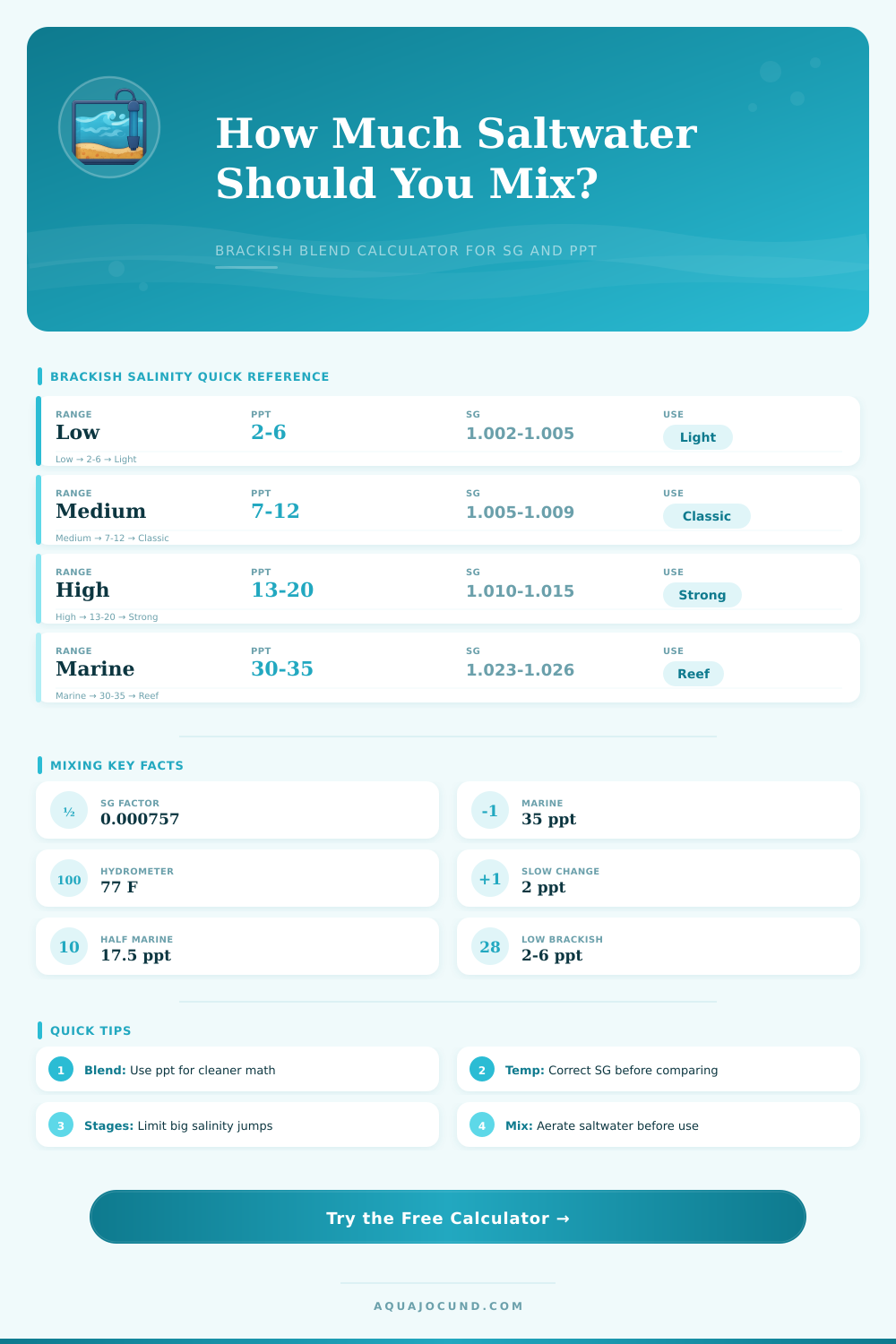
In addition, the salinity of the water that is added to the aquarium can contain some of the salinity that is to be maintained in the aquarium. These factors will impact the salinity of the aquarium; thus, the calculator is merely a starting point in establishing the salinity that is required in a brackish aquarium; the salinity of the aquarium should also be measured to ensure accuracy. The reference tables provided include common salinity ranges, as well as the fraction of saltwater stock that is required to achieve those salinities when starting with a 35‰ stock of marine saltwater.
Low brackish aquarium salinities require only small amounts of saltwater stock to achieve those salinities, meaning that small error in the measuring of the amount of stock will have a large impact upon the salinity of the tank. High brackish aquarium salinities require more saltwater stock than low brackish aquarium salinities, meaning that the strength of the saltwater stock will have a more significant impact upon high brackish aquarium targets. Finally, another habit that those that manage brackish aquariums should develop is the habit of consistency.
The salinity of the water in the aquarium can be adjusted in small amounts over time, as opposed to being adjusted in large amounts. Furthermore, the salinity change calculator removes the difficulty of performing the calculations necessary to adjust the salinity of the water, allowing individuals to focus upon the fish within the aquarium. Thus, by making small adjustment to the salinity of the water over time, individuals can maintain the salinity of the brackish aquarium.