🐟 Aquarium Glass Weight Calculator
Estimate pane-by-pane aquarium glass weight, total glass area, braces, covers, and handling load.
✅ Glass Weight Estimate
| Glass Type | Density Used | Weight Change | Aquarium Use | Handling Note |
|---|---|---|---|---|
| Soda-Lime Float | 2.50 g/cm³ | Baseline | Most standard rimmed tanks | Green edge tint at thicker sizes |
| Low-Iron Extra Clear | 2.50 g/cm³ | Same weight | Display fronts and reef tanks | Clearer view, similar lifting load |
| Tempered Safety | 2.50 g/cm³ | Same weight | Some bottoms and lids | Cannot be drilled after tempering |
| Laminated Safety | 2.55 g/cm³ | About 2% heavier | Custom public displays | Interlayer makes thick panels bulky |
| Borosilicate | 2.23 g/cm³ | About 11% lighter | Special lab or heat applications | Rare in normal aquarium construction |
| Nominal Thickness | Metric Approx. | Weight per ft² | Weight per m² | Typical Aquarium Range |
|---|---|---|---|---|
| 1/8 in | 3 mm | 1.59 lb | 7.8 kg | Small covers and very small tanks |
| 3/16 in | 5 mm | 2.39 lb | 11.7 kg | Lids, nano tanks, baffles |
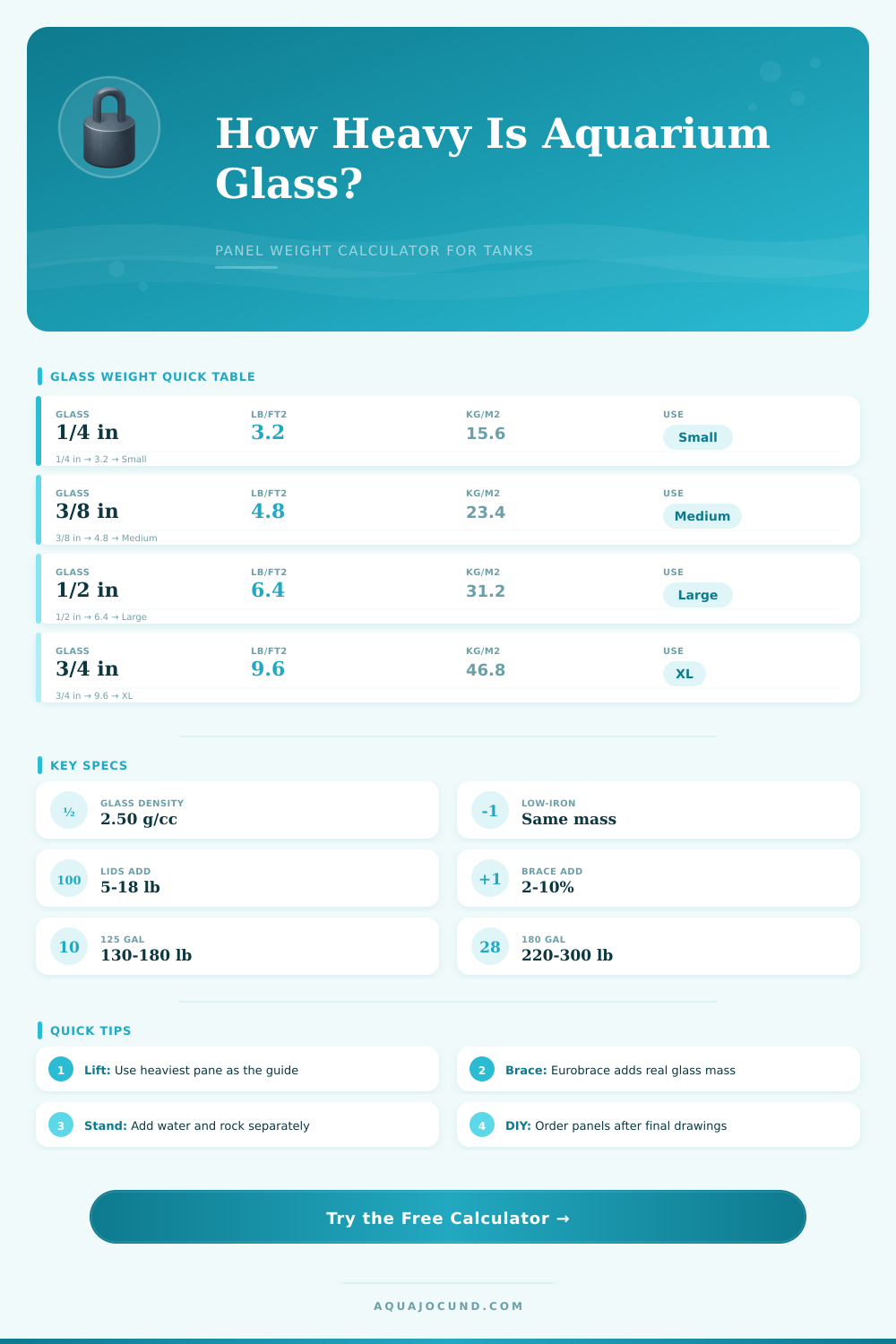
| 1/4 in | 6 mm | 3.19 lb | 15.6 kg | 10-40 gallon rimmed tanks |
| 5/16 in | 8 mm | 3.98 lb | 19.5 kg | Medium custom tanks |
| 3/8 in | 10 mm | 4.78 lb | 23.4 kg | 55-90 gallon builds |
| 1/2 in | 12 mm | 6.38 lb | 31.2 kg | Large rimless and 120+ gallon tanks |
| 5/8 in | 15 mm | 7.97 lb | 38.9 kg | Deep display panels |
| 3/4 in | 19 mm | 9.56 lb | 46.7 kg | Extra-large custom displays |
| Tank | Common Dimensions | Typical Glass | Approx. Glass Weight | Moving Note |
|---|---|---|---|---|
| 10 gallon | 20 x 10 x 12 in | 1/8-3/16 in | 9-16 lb | One person empty lift |
| 20 long | 30 x 12 x 12 in | 3/16-1/4 in | 22-36 lb | Awkward but light |
| 40 breeder | 36 x 18 x 16 in | 1/4-5/16 in | 45-70 lb | Two hands, protect bottom |
| 55 gallon | 48 x 13 x 21 in | 1/4-3/8 in | 70-105 lb | Two-person carry |
| 75 gallon | 48 x 18 x 21 in | 3/8-1/2 in | 95-145 lb | Two strong lifters |
| 120 gallon | 48 x 24 x 24 in | 1/2 in | 160-210 lb | Plan route first |
| 125 gallon | 72 x 18 x 22 in | 3/8-1/2 in | 130-180 lb | Long panel flex risk |
| 180 gallon | 72 x 24 x 24 in | 1/2-5/8 in | 220-300 lb | Team lift required |
| Layout Option | What Gets Added | Typical Added Area | Best Use |
|---|---|---|---|
| Standard 5 panel | Front, back, two sides, bottom | Baseline | Most rectangular aquariums |
| Eurobrace | Four perimeter brace strips | 2-8 ft² | Large rimless displays |
| Glass center brace | One cross strip across the top | 0.5-2 ft² | Rimmed medium tanks |
| All-in-one divider | Full or partial rear chamber panel | 1-6 ft² | Nano reefs and filter chambers |
| Peninsula overflow | End overflow wall panel | 1-4 ft² | Room-divider reef tanks |
| Glass lid | Full or split cover panes | Tank footprint | Evaporation and jump control |
This calculator covers dry glass only. A complete aquarium system also includes water, substrate, rock, equipment, canopy, and stand. For stand planning, add those loads separately because water usually dominates the final installed weight.
Use calculated pane sizes as a planning estimate, then confirm final dimensions with the tank builder, silicone gap, polished-edge specification, bottom support style, and whether sides fit inside or around the front and back panes.
When you plan to build your new aquarium, you must determine the weight of the glass that will be use to create the tank. The weight of the glass impacts the number of people that are required to move the tank, as well as the weight that is placed upon the stand (and the floor) upon which the aquarium will stand. Because glass is a very dense material, even small increment in the thickness of the tank will have a large impact upon the weight of the aquarium.
The calculator will calculate the weight of the tank once you enter the dimension of your tank, the thickness of the glass that will be used to build the aquarium, and the type of layout that you would like to use for the aquarium. The calculator will calculate the weight of the tank based off the area of the tank that is to be covered in glass of such a thickness. For instance, a pane of glass that is half-inch in thickness will weigh twice as much as a pane of glass that is quarter-inch in thickness; the thicker the pane of glass, the more weight that will be associate with moving that aquarium.
How to Find the Weight of Aquarium Glass
The type of glass that you use in the aquarium will not impact the weight of the aquarium as much as the thickness of the glass will impact the weight of the aquarium. Soda-lime float glass, the most common type of aquarium glass, will have a consistent density within the tank. Low-iron glass also has a consistent density, and therefore will weigh the same as soda-lime glass.
Tempered glass and laminated glass provide additional safety in the case of the aquarium breaking, but will not impact the weight of the tank. However, the layout of the glass will impact the weight of the tank. If you choose to include element like eurobraces, center strips, or divider panels, the additional weight of the additional glass required for those elements will impact the weight of the tank.
Additionally, the lid for the tank will also add to the weight of the tank. The reference table within the calculator will allow you to view the weight of the tank based upon the thickness of the tank. This can assist you in reviewing your calculation prior to finalizing your tank design.
For instance, a 125 gallon tank made with three-eighths inch thick glass will weigh between 130 and 180 pounds. An 180 gallon tank made with half-inch thick glass will weigh between 220 and 300 pounds. The weight of the tank will impact your decision of whether you would like to build a rimmed tank or a rimless tank; a rimless tank will require additional glass for the braces.
A common mistake with these calculations is to consider the weight of the glass the same as the weight of the completed tank when assembled. The weight of the glass is only one component of the tank that will weigh; the remaining components include the weight of the water, sand substrate, rocks, and the aquarium equipment. Because the weight of the water and rocks will be significantly more than the weight of the glass, the calculator only calculates the weight of the glass to allow for planning of the weight of each component of the tank separately.
Additionally, you should add a safety margin to the calculations for the weight of the glass; the thickness of the silicone that is used to adhere the panes of glass and the fit of the panes of glass may impact the actual weight of the glass. The weight of the single heaviest pane of glass is another important factor in the building of the tank. While the total weight of the aquarium will allow for determination of the difficulty of the move of the tank, the weight of the front panel or the bottom panel will indicate the difficulty in lifting that tank.
Tanks that are of even length will have very wide panes of glass for their front panel; the wider the pane, the more difficult the tank will be to move. The calculator will indicate the weight of the heaviest pane of glass; this will assist in the determination of whether temporary bracing will be required for that tank, or whether additional people will be required to move it. There are tradeoffs in the thickness of the glass that will be used in the aquarium.
Thicker glass will provide more security in tanks of large dimensions, but the weight of the tank and the cost of the tank will increase as a result. Some builders may opt for using thinner glass and bracing the sides of the tank with additional materials, while other builders may opt for the use of thicker glass to allow for a more attractive appearance with the rimless tank. Thus, the aquarium calculator allows for these different variable to be tested.
Additionally, the order of the aquarium may have an impact upon the size of the individual panes of glass. For example, the choice of the edge polish of the glass, the cut of the panes of glass, and the construction of the panes will all impact the size of the tank’s panes. Thus, it is recommended that the figures for the weight of the panes of glass be calculated prior to ordering those panes of glass.
For example, the weight of the bottom pane of glass compared to the sides may allow the builder to determine whether the bottom pane should be the same thickness as the remaining panes, or whether it should be a thicker pane of glass. Use the calculator to determine the dry weight of the glass that will be used in the aquarium, based upon the dimensions and layout of the tank. Once you have determined the weight of the glass, add the weight of the water that will be contained within the tank.
Additionally, add the weight of any rocks that may be contained within the substrate. Based upon the weight of the tank, you can determine if additional people will be required to move the empty tank, and if the stand upon which the aquarium will rest will be able to support the weight of the tank when the tank is assembled. Thus, the weight of the glass is a critical detail in determining whether the move of the aquarium will be successful.