🧂 Pond Salt Calculator
Calculate koi and goldfish pond salt by pond volume, current salinity, treatment goal, and water change amount.
✅ Pond Salt Recommendation
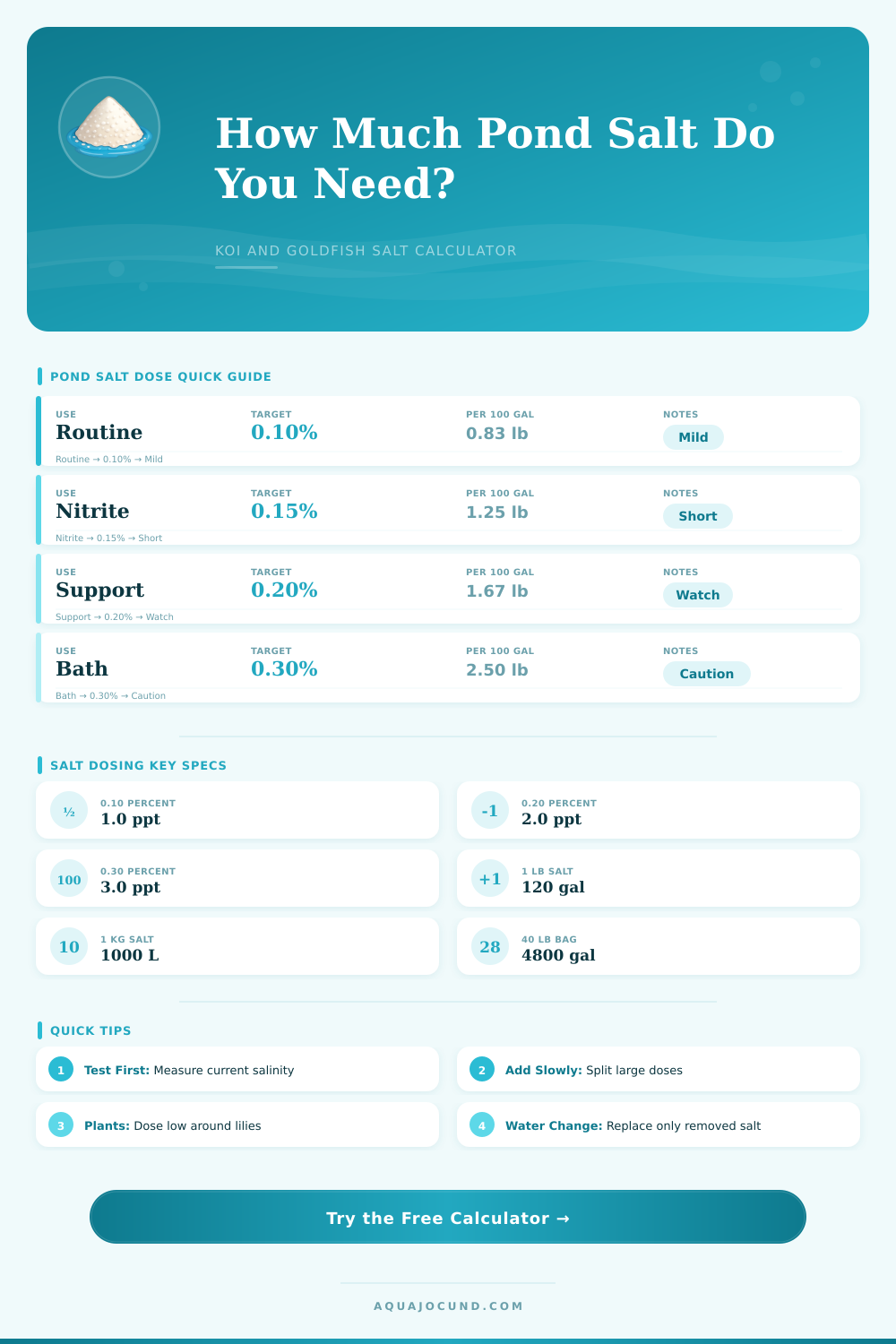
| Use Case | Target ppt | Percent Salt | Salt per 100 gal | Typical Duration | Caution Level |
|---|---|---|---|---|---|
| Routine support | 1.0 ppt | 0.10% | 0.83 lb | Short seasonal use | Low |
| Nitrite uptake support | 1.5 ppt | 0.15% | 1.25 lb | Until nitrite clears | Medium |
| Stress recovery | 2.0 ppt | 0.20% | 1.67 lb | Several days | Medium |
| Short-term elevated level | 3.0 ppt | 0.30% | 2.50 lb | Brief, supervised | High |
| Salt Type | Use in Pond | Typical Purity | Grain Size | What to Avoid |
|---|---|---|---|---|
| Pond salt crystals | Best general option | 99.5% | Medium crystal | Added iodine, fragrances |
| Plain solar pool salt | Good if additive-free | 99.6% | Coarse crystal | Anti-caking agents |
| Pure kosher salt | Works for small ponds | 98.0% | Flake or coarse | Yellow prussiate additives |
| Softener solar salt | Only if plain sodium chloride | 99.0% | Large pellets | Rust remover, cleaners |
| Natural sea salt mix | Usually not needed | 95.0% | Mixed | Marine buffers for freshwater |
| Epsom salt | Not a pond-salt substitute | 0% NaCl | Fine crystal | Using for salinity dosing |
| Pond Style | Typical Dimensions | Approx Volume | Salt for 1 ppt | Salt for 2 ppt |
|---|---|---|---|---|
| Patio goldfish tub | 5 ft × 4 ft × 1.7 ft | 250 gal | 2.1 lb | 4.2 lb |
| Starter koi pond | 8 ft × 6 ft × 2.2 ft | 790 gal | 6.6 lb | 13.2 lb |
| Backyard koi pond | 12 ft × 8 ft × 3 ft | 2,155 gal | 18.0 lb | 35.9 lb |
| Oval display pond | 16 ft × 10 ft × 4 ft | 3,760 gal | 31.4 lb | 62.7 lb |
| Large koi pond | 20 ft × 12 ft × 4.5 ft | 8,078 gal | 67.4 lb | 134.7 lb |
| Pond Life | Salt Tolerance | Suggested Range | Calculator Setting | Practical Note |
|---|---|---|---|---|
| Koi | Moderate to good | 1.0-3.0 ppt | Standard | Increase gradually and aerate well. |
| Goldfish | Moderate | 1.0-2.0 ppt | Standard | Avoid sudden changes in small ponds. |
| Water lilies | Limited | 0.5-1.0 ppt | Plants | Higher levels can yellow leaves. |
| Marginal plants | Variable | 0.5-1.0 ppt | Plants | Remove sensitive pots if treating high. |
| Snails and mussels | Low | 0-0.5 ppt | Inverts | Use a separate hospital tank when possible. |
| Sturgeon or orfe | Species dependent | Ask a specialist | Sensitive | Do not assume koi dosing applies. |
When you adds salt to a pond, you have to be careful about an amount of salt that you add. If you add too little salt, the fishes will not benefit from adding the salt to the pond. If you add too much salt, high levels of salt can harm the plant and snails in the pond.
The goal is to reach a specific salinity level that will benefit the fish, but without harming the other inhabitant of the pond. The best way to calculate the amount of salt to add to a pond is to guess the volume of the pond. Guessing the volume of the pond is incorrect, though.
How to Measure the Right Amount of Salt for Your Pond
Ponds has slopes and shelves that can hold water but that have a different volume than the pond itself. Calculators take into account the slopes and shelves of the pond so that you dont add too much salt to the pond. Adding too much salt to the pond can lead to a chemical accident in the pond.
Thus, using a calculator to determine the volume of the pond will allow you to accurately add the amount of salt that is required. The salinity level of the pond should be measured in parts per thousand. The salinity level will depend upon the needs of the fish in the pond.
Low dose of salt help the fish maintain there internal fluid balance. This fluid balance helps to reduce the stress of the fish. If you are treating the fish for nitrites, the salt will compete with the nitrites.
This competition will prevent the nitrites from entering the bloodstream of the fish. Increasing the salinity level of the pond can be used in cases of more serious illness in the fish, but higher levels of salinity can impact the other inhabitant of the pond. Because koi fish is hardy, the other inhabitants of the pond that should be protected from increased salinity level are the water lilies and the marginal pond plants.
High levels of salinity can cause the pad of the water lilies to turn yellow. These same high levels of salinity can also negatively impact the snails that live in the pond. Snails may not be able to survive high levels of salt that are safe for the koi fish.
Thus, if there are many different type of inhabitants in the pond, it is best to treat the fish in a quarantine tank. The type of salt that you add to the pond also has an impact upon the health of the fish. Using table salt is not recommended because table salt contain iodine and anti-caking agent that are toxic to fish.
Instead, use pure solar salt or pond salt. Pure solar salt and pond salt contain only sodium chloride. Because the purity of the salt can vary, though, it is important to use a calculator that accounts for the percentage of purity of the salt.
If water change are performed in the pond, these change will impact the salinity levels of the pond. Salt does not evaporate from the pond, but salt can leave the pond if water is removed from the pond. For instance, if twenty percent of the water is changed, twenty percent of the salt will leave the pond.
Adding a full dose of salt after every water change can cause the salinity level of the pond to become more high. A tool that calculates the amount of salt that will leave the pond during a water change will allow you to only add the amount of salt that is necessary to replace the salt that has left the pond. When adding salt to the pond, avoid dumping the salt in one location in the pond.
Dumping the salt in only one location in the pond will create a pocket of salt in that area of the pond. This salt pocket could burn the fish that pass through that area of the pond. Instead, add the salt to a bucket of water first, or spread the salt throughout the pond in area of high water flow.
If you are increasing the salinity level of the pond significantly, increase the salinity level slowly over several days. Sudden changes in salinity level can stress the fish in the pond. A salinity meter will allow you to reliably and easy measure the amount of salt in your pond.
Because salt is invisible, it is difficult to remember how much salt has been added to the pond previously. Using a salinity meter and calculating the amount of salt to be added to the pond will allow you to avoid guesswork in adding the salt. Using a salinity meter will ensure that the salinity level of the pond remains within the level required to maintain the health of the fish and the other inhabitant of the pond.