💧 Bentonite Clay Pond Calculator
Estimate sodium bentonite amount for pond sealing by shape, slope, soil texture, leak severity, and application method.
✅ Bentonite Sealing Estimate
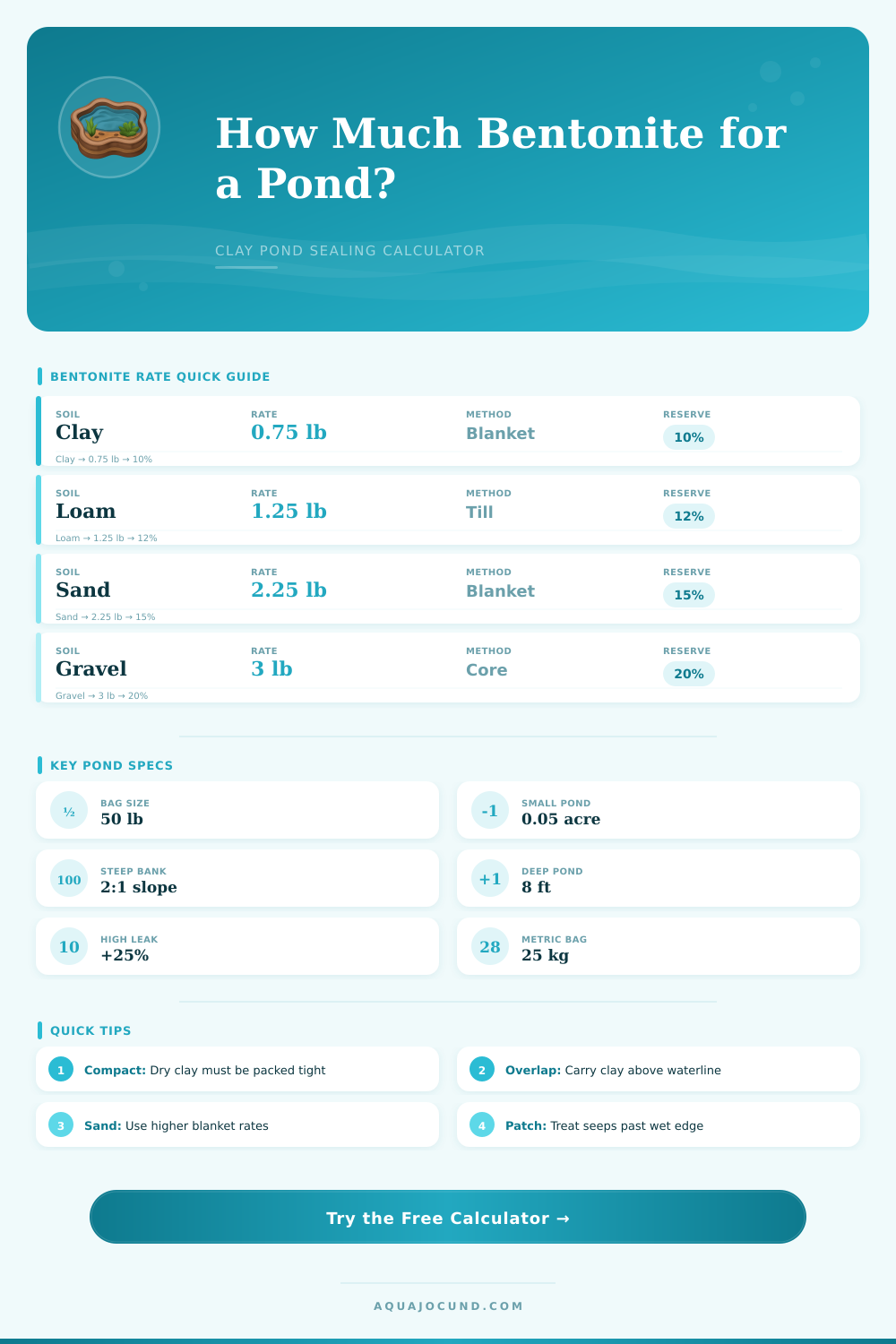
| Soil condition | Base rate | Best method | Notes |
|---|---|---|---|
| Tight clay | 0.75 lb/sq ft | Blanket or till | For minor seepage and good native clay. |
| Clay loam | 1.00 lb/sq ft | Till into surface | Good sealing soil with small pores. |
| Silt loam | 1.25 lb/sq ft | Blanket layer | Moderate seepage potential. |
| Sandy loam | 1.75 lb/sq ft | Blanket layer | Common pond leak condition. |
| Clean sand | 2.25 lb/sq ft | Thick blanket | Needs stronger seal and compaction. |
| Gravelly soil | 3.00 lb/sq ft | Core or imported fines | Coarse voids may need extra soil work. |
| Cracked clay | 1.50 lb/sq ft | Till and compact | Fill shrink cracks before refilling. |
| Seep zone | 4.00 lb/sq ft | Spot patch | Use for targeted leaks, not whole pond average. |
| Method | Multiplier | Use case | Field note |
|---|---|---|---|
| Drain and blanket | 1.00 | Whole basin sealing | Spread evenly, cover with soil, compact. |
| Disc or till | 0.90 | Dry accessible bottom | Blends clay into the top 4 to 6 inches. |
| Sprinkle over water | 1.35 | No drain access | Less precise, often needs repeat treatment. |
| Pumpable slurry | 1.15 | Focused seep lanes | Useful near banks and visible loss zones. |
| Core trench | 1.45 | Dam keyway leaks | Treats concentrated flow paths. |
| Spot patch | 1.10 | Small wet seep area | Extend beyond the wet mark. |
| Pond type | Waterline size | Avg depth | Approx seal area |
|---|---|---|---|
| Small garden oval | 35 x 22 ft | 4 ft | 900 to 1,100 sq ft |
| Backyard wildlife pond | 70 x 45 ft | 5 ft | 3,400 to 4,100 sq ft |
| Farm stock pond | 120 x 80 ft | 8 ft | 9,000 to 11,000 sq ft |
| Half acre basin | 180 x 120 ft | 10 ft | 21,000 to 26,000 sq ft |
| Dam face seep | Measured patch | n/a | 100 to 1,000 sq ft |
| Layer detail | Target | Why it matters | Calculator effect |
|---|---|---|---|
| Overlap band | 1 to 3 ft above water | Protects against waterline seepage. | Adds bank strip area. |
| Mixed depth | 4 to 6 inches | Bonds bentonite to native soil. | Uses till-in multiplier. |
| Cover soil | 3 to 6 inches | Prevents clay from floating or eroding. | Not added to bentonite weight. |
| Compaction | Moist and firm | Reduces voids before swelling starts. | Reserve covers small uneven spots. |
| Seep patch | Past wet edge | Leaks spread beyond visible water marks. | Use measured area shape. |
Measure the waterline dimensions, average depth, and bank slope before draining. Bentonite should extend above the planned waterline so wave action and changing levels do not bypass the clay layer.
For whole-pond sealing, the calculated weight includes the basin bottom, sloped banks, overlap band, method multiplier, leak factor, and reserve margin. For known seep patches, use measured seal area.
When digging a pond, it is possible that the soil will lead to the loss of the water from the pond. Soil often contain pockets of sand and gravel within it. Sand and gravel allow water to pass through it, leading to the loss of water from the pond.
Sodium bentonite is a volcanic clay that you can add to these ponds to prevent the loss of water from the pond. Sodium bentonite will swell when it becomes wet, creating a plug of clay within the soil that prevents water from leaving the pond. The rate at which you add the sodium bentonite will depend upon the type of soil within the pond.
How to Use Sodium Bentonite to Seal a Pond
If the soil within the pond is heavy with native clay, you will need less sodium bentonite than if the pond sand is clean sand. The best way to calculate the amount of sodium bentonite that is needed for the pond is with a sodium bentonite calculator. These types of calculators accounts for the different types of soil within the pond, which prevents the need for individuals to guess at how much sodium bentonite will be needed.
One of the most common mistake that is made when calculating the amount of sodium bentonite is to only calculate the surface area of the water within the pond. You must also calculate the surface area of the banks of the pond, as these are the locations where the water will leak from the pond. A gentle slope on a bank will increase the area of that bank compared to one that is more steep sloped.
A larger area requires more sodum bentonite than a smaller area. Thus, failing to calculate the slope of the banks of the pond may lead to an individual running out of sodum bentonite before sealing the pond. The method in which you add the sodium bentonite will also impact the amount of sodium bentonite that is required to seal the pond.
There are several method for applying sodium bentonite to a pond. One method is to lay a blanket of sodium bentonite over the drained pond and compact the sodium bentonite to create a permanent seal. Another method is to till the sodium bentonite into the top few inches of the soil to assist the sodium bentonite in bonding to the soil.
Finally, if the pond cannot be drained, you can sprinkle the sodium bentonite over the surface of the pond; however, sprinkling is less precisely and may require more bentonite to allow the clay to settle correctly. It is also important to apply the sodium bentonite above the waterline for safety and protection. If you only apply the sodium bentonite to the level of the ponds water, rain or the movement of pond water may push water into the soil.
By applying the sodium bentonite a foot or two above the ponds normal water level, the material will provide protective benefits to the pond during seasonal changes. Additionally, if repairing an active leak in the pond, apply the sodium bentonite to a larger area than the area of the leak. Applying the patch of sodium bentonite beyond the edge of the leak ensures that water do not move around the patch of bentonite.
After applying the sodium bentonite to the pond, compact the sodium bentonite. Dry sodium bentonite will remain in powder form and will not stop the pond from filling. By compacting the sodium bentonite, the sodimum bentonite will remain moist and eliminate any air pocket within the sodimum bentonite.
Without compacting the sodimum bentonite, the sodimum bentonite may float or erode when refilling the pond. You should of use a tamper to compact the sodimum bentonite and a little bit of soil to ensure the sodimum bentonite is packed as tight as possible to allow the sodimum bentonite to swell and seal the pond.