💧 Farm Pond Size Calculator
Estimate surface area, acre-feet, watershed fit, and practical farm use capacity from pond dimensions and site conditions.
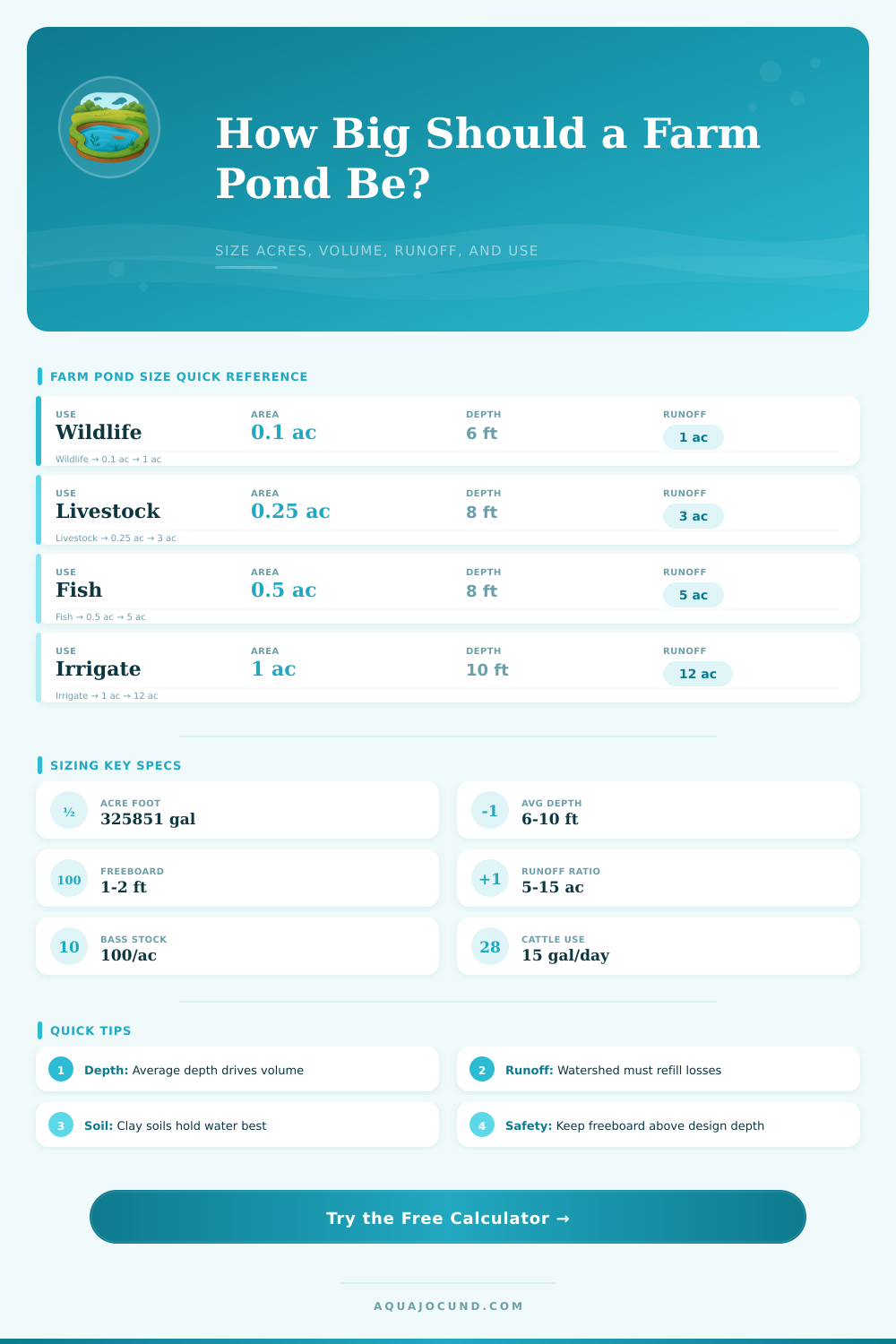
| Pond Class | Surface Area | Average Depth | Approx Volume | Common Use |
|---|---|---|---|---|
| Small wildlife pond | 0.05 to 0.15 ac | 4 to 6 ft | 0.2 to 0.9 ac-ft | Wildlife, ducks, insects |
| Livestock watering pond | 0.15 to 0.35 ac | 6 to 8 ft | 0.9 to 2.8 ac-ft | Cattle, horses, sheep |
| Fish production pond | 0.5 to 1.0 ac | 8 to 10 ft | 4 to 10 ac-ft | Bass, bluegill, catfish |
| Irrigation storage pond | 1.0 to 3.0 ac | 8 to 12 ft | 8 to 36 ac-ft | Seasonal crop water |
| Fire protection pond | 0.5 ac or larger | 8 ft or deeper | 4 ac-ft or more | Emergency drafting reserve |
| Watershed Type | Runoff Coefficient | Typical Watershed Need | Best Pond Match |
|---|---|---|---|
| Sandy, flat, grassy | 0.08 to 0.15 | 12 to 25 acres per pond acre | Small wildlife ponds or lined basins |
| Loam pasture, moderate slope | 0.16 to 0.25 | 8 to 15 acres per pond acre | General farm ponds |
| Clay pasture, firm slope | 0.25 to 0.35 | 5 to 10 acres per pond acre | Livestock and fish ponds |
| Rocky, compacted, farmyard | 0.35 to 0.50 | 3 to 7 acres per pond acre | Runoff capture and fire reserves |
| Basin Material | Seepage Risk | Design Adjustment | Field Note |
|---|---|---|---|
| Heavy clay | Low | Use 90% storage factor | Usually suitable after compaction |
| Clay loam | Low to moderate | Use 82% storage factor | Often works with good core trench |
| Silty loam | Moderate | Use 68% storage factor | May need bentonite or clay blanket |
| Sandy soil | High | Use 52% storage factor | Usually needs liner or imported clay |
| Use / Species | Rule of Thumb | Minimum Pond | Sizing Caution |
|---|---|---|---|
| Beef cattle | 12 to 20 gal/head/day | 0.25 ac common | Fence banks and pipe to troughs when possible |
| Horses | 8 to 15 gal/head/day | 0.15 ac common | Protect slopes from hoof damage |
| Sheep or goats | 1 to 3 gal/head/day | 0.05 ac common | Shallow access areas need firm footing |
| Bass and bluegill | 100 bass + 500 bluegill/ac | 0.5 ac preferred | Keep at least 8 ft average fish refuge |
| Catfish | 100 to 150 fish/ac | 0.25 ac possible | Feeding increases oxygen demand |
| Irrigation | 1 ac-ft covers 1 acre 12 in | Depends on crop | Allow losses before counting usable water |
Surface area controls oxygen exchange, fish carrying capacity, shoreline length, and evaporation exposure. A wide shallow pond may look large but store less reserve than expected.
Average depth controls acre-feet. For farm use planning, average depth is usually more useful than maximum depth because shelves, side slopes, and silt reduce stored water.
Watershed acres should refill normal seepage, evaporation, and use. In dry climates or sandy soils, a small watershed can leave a correctly shaped pond underfilled.
Freeboard is not daily storage. Keep it above normal pool for storm events, wave action, and dam safety instead of counting it as reliable farm water.
When planning to build a pond, it is essential to have an understanding of how a pond work and the different factors that must be balanced for the pond to remain functional. Many believes that simply digging a hole will form a pond; however, a pond require a balance of several factors in order to remain functional. One of those factor is the relationship between the surface area of the pond and the volume of the pond.
The surface area and the volume of the pond will affect how much water will be able to remain within the pond. For instance, if the surface area of the pond is too large for the ponds volume, the pond will lose it’s water rapid due to evaporation. Additionally, if the volume of the pond is too small, the pond may dry up during periods of low rainfall.
How a Pond Works and What to Check
Ponds naturaly loses water due to the sun and the wind that passes over the pond. The more greater the surface area of a pond, the more water that will be lost to evaporation. Thus, the depth of the pond is another important factor in the security of the pond.
If the pond is deeper, it will have a more greater volume of water. The greater the volume of water within the pond, the more water that will be able to remain within the pond during dry months. Additionally, deeper ponds provide a thermal refuge for fish during the summer months when temperature are higher.
Furthermore, focusing on the volume of the pond beneath the surface of the pond is another critical component of pond building; the volume of the pond is what keep the pond system alive. Another critical component of the pond system is the watershed. The watershed is the land surrounding the pond that captures rainwater and channels that water into the pond.
The size of the watershed should be appropriate for the pond. For instance, if the watershed area is small but the pond is large, the watershed will not provide enough water to fill the pond. The soil type within the watershed also affects how much water will reach the pond; sandy soil will allow more water to infiltrate into the ground than clay soil, thus providing less water to the pond.
The soil type within the pond basin is another critical component. The soil type will determine how much water infiltrate into the ground. Heavy clay soils is good for ponds because they pack tightly and do not allow for water to seep out of the pond.
Sandy soils are poor for ponds because water will leak out of the pond. If the pond is built on sandy soil, a pond builder will need to add a liner to prevent the water from leaking into the water table beneath the pond. Some water will always infiltrate into the earth; thus, there will always be a balance between the usable storage of the pond and the gross volume of the pond.
Calculating the usable storage will allow pond builder to understand how much water will remain within the pond. Another factor that must be considered is the balance between the demand for the water within the pond and the refill rate of the pond. If the livestock will use the water within the pond to water livestock, it is essential to understand how much water the livestock will drink.
The amount of water that livestock will drink will change depending on the temperature and the life cycle of the livestock. Additionally, if using the pond to fish, the volume of the pond must be great enough to contain all of the fish that the pond is to raise within the pond. If the volume within the pond is too small for the number of fish that are to live in the pond, the fish will grow slow and the water quality within the pond will diminish.
Finally, another essential component of the pond system is the freeboard of the pond. The freeboard is the depth of the pond from the normal water level to the top of the dam that contains the pond. The freeboard should not be used as additional storage for the ponds water.
The freeboard protect the dam from flash floodwaters. If the pond is filled to the top of the dam, heavy rainfall can damage the dam and wash it away. By considering each of these component of a pond system, a pond builder can be sure that the built pond will be a permanent asset to the landowner.