💧 Waterfall Pond Pump Size Calculator
Estimate the pump rating, delivered waterfall flow, head height, hose size, and pond turnover for a clean spillway.
📋 Calculation Breakdown
Easy, mid head
Continuous use
Large koi systems
Lowest friction
| Waterfall Look | Typical Flow | Visual Result | Best Use |
|---|---|---|---|
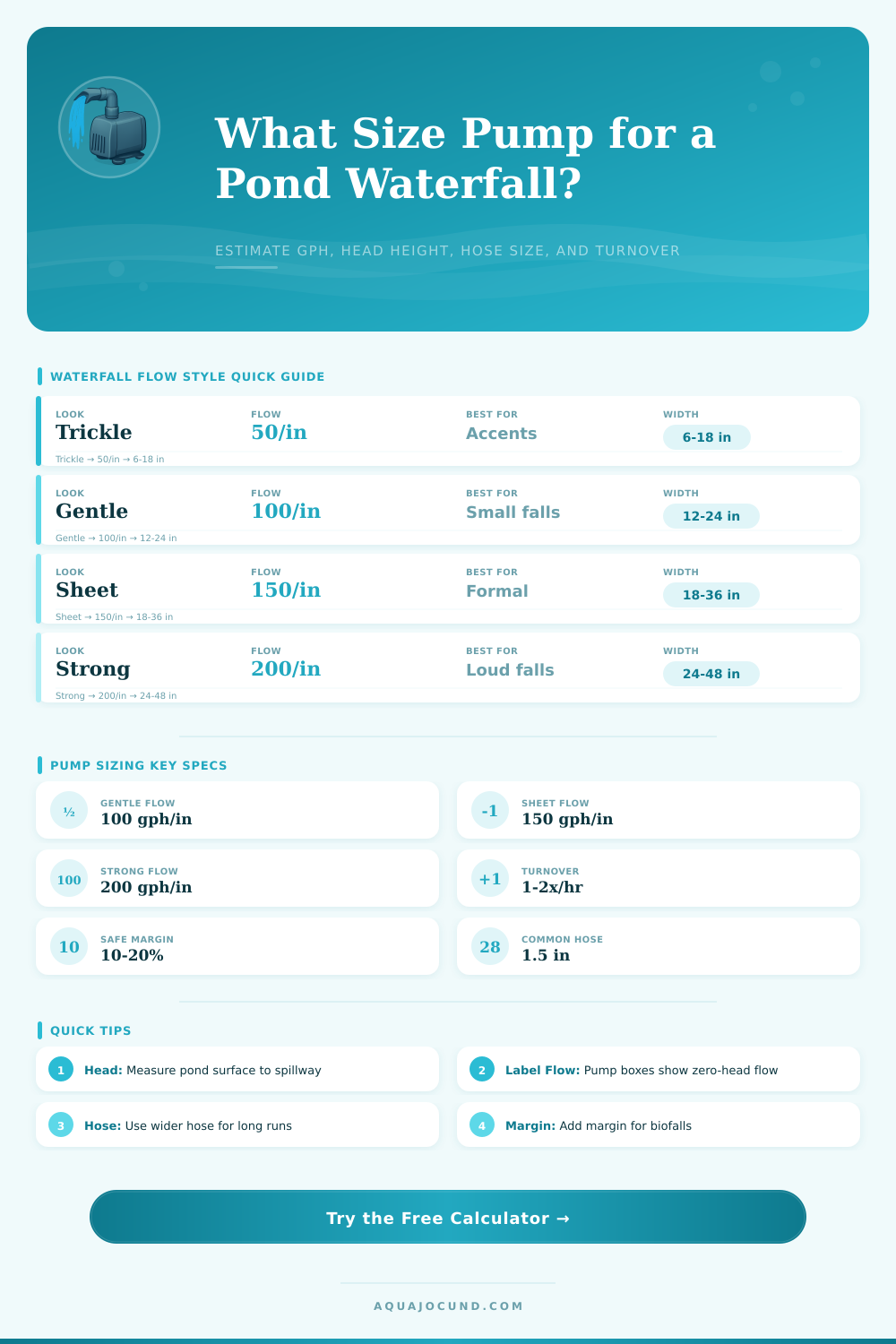
| Trickle accent | 50 GPH per inch | Thin streams, quiet texture | Mini ponds, urns, patio bowls |
| Gentle curtain | 100 GPH per inch | Light sheet with visible rock | Small garden waterfalls |
| Solid sheet | 150 GPH per inch | Continuous sheet across the lip | Formal spillways and wall weirs |
| Strong splash | 200 GPH per inch | Whitewater, louder impact | Koi ponds and natural cascades |
| Heavy whitewater | 250 GPH per inch | Forceful, aerated waterfall | Wide, high-energy streams |
| Tubing ID | Comfortable Flow | Use Case | Friction Risk |
|---|---|---|---|
| 3/4 in | Up to 600 GPH | Small spouts and urns | High |
| 1 in | 600-1,000 GPH | Short small falls | Medium |
| 1-1/4 in | 1,000-1,800 GPH | Medium garden falls | Medium |
| 1-1/2 in | 1,800-3,000 GPH | Most backyard waterfalls | Low |
| 2 in | 3,000-5,500 GPH | Large koi waterfalls | Low |
| 3 in | 5,500+ GPH | Commercial or wide streams | Lowest |
| Pond Setup | Spillway Width | Target Flow | Typical Pump Rating |
|---|---|---|---|
| Patio bowl with short spill | 6-10 in | 300-900 GPH | 500-1,200 GPH |
| Small goldfish pond | 12-18 in | 1,200-2,700 GPH | 1,800-3,600 GPH |
| Formal wall spillway | 18-36 in | 2,700-5,400 GPH | 4,000-7,500 GPH |
| Natural rock cascade | 24-48 in | 3,600-9,600 GPH | 5,000-12,000 GPH |
| Large koi waterfall | 36-60 in | 7,200-15,000 GPH | 10,000-18,000 GPH |
| Factor | Low Loss | Medium Loss | High Loss |
|---|---|---|---|
| Vertical lift | 1-3 ft | 4-7 ft | 8+ ft |
| Pipe run | Under 10 ft | 10-25 ft | 25+ ft |
| Fittings | Few bends | Several elbows | Valves, tees, UV |
| Filter load | Open weir | Biofalls box | Pressure filter |
| Practical response | 10% margin | 20% margin | 30% margin |
💡 Measuring Head Height
Static head is the vertical distance from the pond water surface to the waterfall outlet. Add friction from hose length, elbows, filters, and UV units to estimate total dynamic head.
💡 Choosing a Pump Curve
Use the flow at your calculated head, not only the box label. A 4,000 GPH pump at zero head may deliver much less after a tall lift and narrow tubing.
When you builds a pond waterfall, you must select a water pump based on more than an number printed on the pump box. Many people makes the mistake of selecting a pond pump based on the flow rate printed on the manufacturer’s label. The pump only measures the flow rate when it is moving water into a open bucket that is on a flat surface.
However, when the pump is moving water into the pond, it has to overcome the force of gravity as well as the friction that result from the plumbing. Therefore, understanding how gravity and plumbing friction affects a water pump allow you to select the correct waterfall pump. The flow rate of the pump that you select will determine the visual appearance of your waterfall.
How to Choose the Right Pump for Your Pond Waterfall
The flow rate will be expressed in gallons per hour per inch of the weir’s width. The weir is the edge of the waterfall where the water fall over the edge of the rocks. If you dont provide enough gallons per hour for the width of the weir, the water will not fall in a sheet, but will cling to the rocks and create gap in the waterfall.
Therefore, calculating the proper amount of gallons per hour that is required for your weir’s width is essential to building a visually pleasing waterfall. Another concept that you must consider when building a waterfall is the concept of total dynamic head. The total dynamic head of a waterfall include the vertical height of the fall as well as the friction that occurs from the plumbing of the fall.
Many times, people only measure the vertical distance of a fall from the ponds surface to the top of the falls. However, other measurements of total dynamic head are the number of elbow in the plumbing as well as the number of feet of tubing. A narrow hose will also create more friction than a wide pipe, which will reduce the amount of water that the pump can move to the top of the falls.
Another factor to consider with the water flow that you select for your waterfall is the health of your pond. Waterfalls provides a form of aeration for the pond. However, the pump will have to create a flow rate for the pond to achieve the necessary turnover rate for that specific pond.
For instance, the turnover rate for a koi pond is more higher than that of a plant pond, since the koi requires the water to be clean. Therefore, selecting a pump flow rate based off the higher value (waterfall or pond requirements) will make it easier to control the water flow with a valve than to increase the flow if the pump is too small for the number of fish in the pond. A final consideration with pond water pumps is that over time, the pump will lose efficiency.
The impellers in the pump may wear down, and the filters in the pond may become clog with debris. Both of these problems will reduce the number of gallons per hour that your pump can deliver to the pond. Therefore, to prevent the waterfall from having a reduced flow in the future, it is a good idea to add a margin to the gallons per hour that you calculate for your waterfall.
Adding a margin of twenty percent, for instance, will provide an “insurance policy” for your waterfall so that the aging of the pump and clogging of the filters will not negative affect the waterfall. The waterfall manufacturer provides the flow rate of the pump. However, you should also consider the size of your tubing when purchasing the pump.
If you calculate that you need a large pump to move the water to the falls, you may want to consider a wider pipe instead. By using a wider pipe, you will reduce the friction in the plumbing, which is considered to be a more energy-efficient method of increasing the flow of water over the falls. By considering the vertical height of the falls, the friction in the plumbing, and the biological requirements of the pond, you can ensure that the pump can provide the amount of water that your waterfall require.