💧 Pond Surface Area Calculator
Estimate water surface area, treatment coverage, plant cover, pond volume, and shoreline length from real pond shapes.
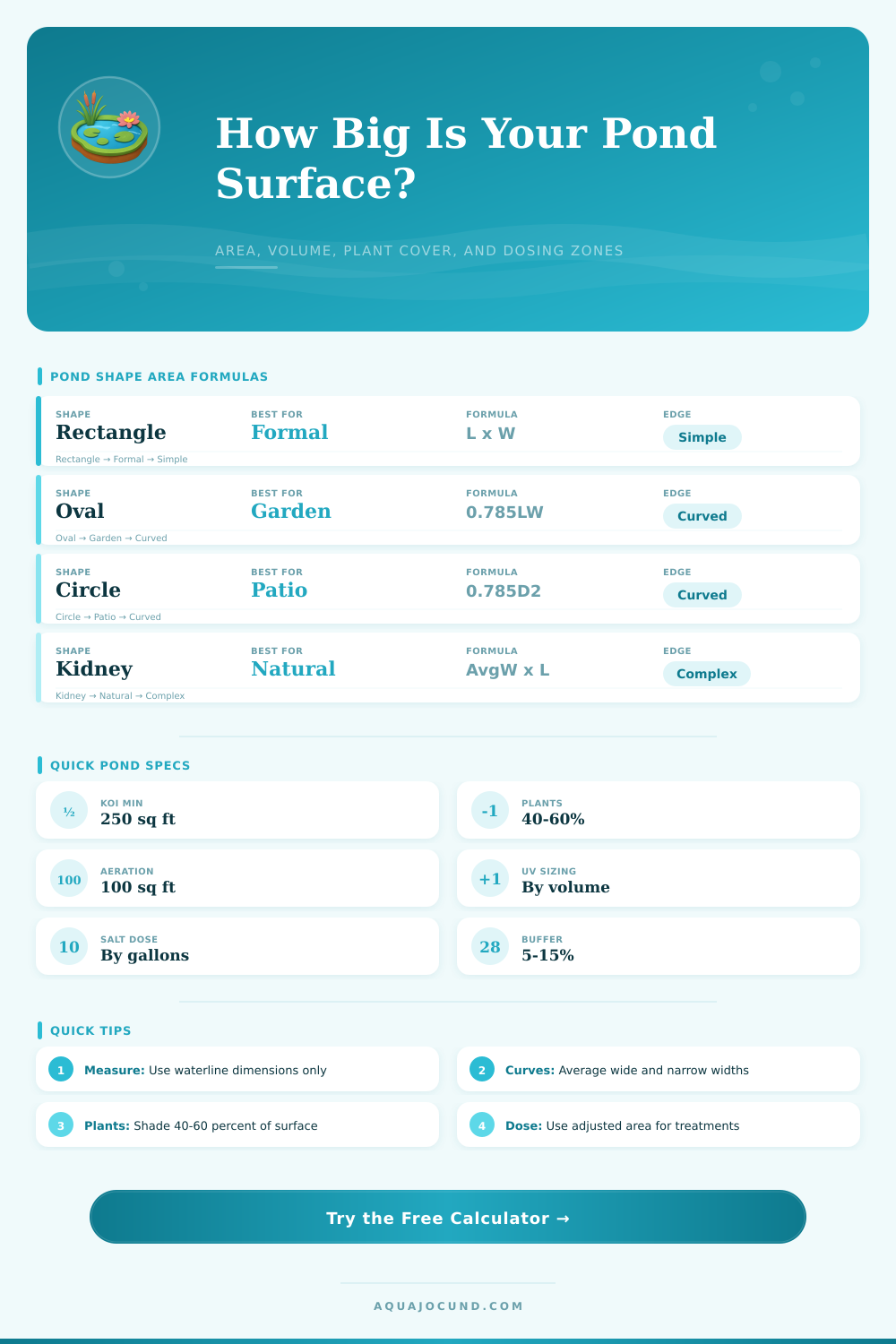
| Pond Shape | Surface Area Formula | Best Measurement Method | Accuracy Notes |
|---|---|---|---|
| Rectangle or square | Length × width | Measure waterline length and width | Best for formal block, raised, and patio ponds. |
| Oval or ellipse | 0.785 × length × width | Measure longest and widest waterline spans | Good for most preformed garden ponds. |
| Circle | 0.785 × diameter² | Use length field as diameter | Width is ignored for round ponds. |
| Kidney shape | Length × average width × 0.85 | Average wide and narrow widths | Matches curved ponds with one main inward bend. |
| Irregular natural | Length × average width × 0.78 | Measure bounding length plus two widths | Use a 10% to 15% margin for treatments. |
| Use Case | Area Rule | Related Input | Practical Target |
|---|---|---|---|
| Floating plants | 25% to 70% of surface | Target plant cover | 40% to 60% for algae shading without blocking oxygen exchange. |
| Pond dye or shade cover | Total surface area | Treatment margin | Add 5% to 10% if the outline is hard to measure. |
| Aeration layout | One zone per 100 to 250 sq ft | Surface area and depth | Use more zones for shallow, warm, or heavily stocked ponds. |
| Netting and leaf cover | Surface plus edge allowance | Edge complexity | Complex shorelines need extra overlap around coves and shelves. |
| Fish load planning | Surface oxygen exchange | Area and volume | Koi need more surface and depth than goldfish or wildlife ponds. |
| Pond Type | Waterline Size | Approx Area | Common Use |
|---|---|---|---|
| Small patio oval | 6 x 4 ft | 19 sq ft | Container lilies, small fountain, wildlife water. |
| Wildlife mini pond | 8 x 5 ft | 31 sq ft | Marginal plants, frogs, insects, no large fish load. |
| Goldfish garden pond | 10 x 8 ft | 63 sq ft | Goldfish, lilies, compact pump and filter systems. |
| Formal rectangle | 12 x 8 ft | 96 sq ft | Reflecting pond, raised edging, clear geometry. |
| Natural kidney pond | 14 x 9 ft | 83 sq ft | Curved planting shelves and mixed wildlife habitat. |
| Koi starter pond | 18 x 12 ft | 170 sq ft | Small koi group if volume and filtration are strong. |
| Large koi pond | 24 x 16 ft | 302 sq ft | Koi, skimmer circuits, deeper oxygen reserve. |
| Pond Category | Typical Area | Depth Range | Surface Planning Note |
|---|---|---|---|
| Wildlife pond | 20 to 80 sq ft | 1 to 2 ft | Plant cover can be high, but leave open water for gas exchange. |
| Goldfish pond | 50 to 150 sq ft | 2 to 3 ft | Moderate surface area helps oxygen stability in warm months. |
| Koi pond | 250 sq ft or more | 3 to 5 ft | Depth and filtration matter, but surface drives oxygen exchange. |
| Plant display pond | 30 to 120 sq ft | 1.5 to 3 ft | Keep 40% to 60% cover for lilies and floating plants. |
| Farm or retention pond | 600 sq ft or more | 4 ft or more | Use direct measured area or a mapped outline for better accuracy. |
💡 Measuring Tip
Measure the visible waterline, not the liner edge, coping, or surrounding rocks. For curved ponds, take the longest length, widest width, and one narrow width so the calculator can average the shape.
💡 Treatment Tip
Surface area is useful for coverage products, but salt, dechlorinator, and many medications are dosed by water volume. Use the volume card as a planning estimate, then confirm with actual fill data when possible.
To calculate the surface area of a pond, you must determine how much algaecide you need to add to the water. The surface area of the pond determine how much algaecide you need to add to the waters. Most people will attempt to calculate the surface area of the pond by multiply the length of the pond by the width of the pond.
However, this does not account for curve or planting shelves that most pond have. By underestimating the area of the pond, the algaecide will not work correct in the pond. However, if you overestimate the surface area of the pond, you will add too much algaecide to the pond, which can be harmfull to the fish in the pond.
How to Measure Your Pond Surface Area
To calculate the surface area of your pond, you need to measure the pond at the waterline. Many peoples will make the mistake of measuring the pond from the outer stone coping or the outer edge of the pond liner. However, the outer edge of the pond include land, not the water.
Any measurement will be incorrect due to the extra space that the pond liner or stones takes up. You should measure at the waterline. This is where gas exchange and floating plant sits on the ponds surface.
This will give you the most accurate measurement of the ponds surface area. For ponds with irregular shape, such as kidney-shaped pond, you must account for the curves of the pond in the calculation of the surface area. Kidney pond have a concave curve that take up part of the ponds area.
To calculate the area, you can average the widest point and the narrowest point of the pond. You can also use a calculator that calculate the area of ponds with irregular shapes using coefficient. Using a calculator will make it easier to calculate the area of your pond with irregular shore.
The surface area of your pond is important in determining how to adequately aerate your pond. Oxygen enter your pond through the ponds surface. Therefore, ponds with a long and narrow shape will have more oxygenation then deep and circular ponds.
To determine how much aeration equipment to buy for your pond, you must calculate the surface area. If you have a large pond, you will need multiple air stone to aerate the entire pond. If the edge of your pond do not receive enough aeration, algae will grow in these areas of the pond.
The surface area of your pond will determine how much shade you should provide to your pond. Experts recommends providing shade to part of your pond to keep the water cool and prevent the algae from getting the sunlight they need to grow. However, if you shade too much of your pond, you may prevent the fish from adequately exchanging the gases in the pond.
You should shade approximately half of the ponds surface area. Knowing the exact square footage of your pond will help you determine how many plant you need to shade the pond apropriately. For ponds with very irregular shoreline, you should add a safety margin to the calculated area.
Deep cove and jagged edge on the shorelines of ponds are difficult to measure correct. Adding a safety margin to the calculated area of the pond will ensure that you do not underdose the pond with algaecide. If you underdose the pond, part of the pond will not be treated with algaecide.
It is better to have a slight overlap in treatment for part of the pond than to leave a section untreated. For koi pond, you must consider the surface area. Koi pond have a high amount of waste produce by the fish.
The volume of the pond will tell you how many fish it can hold. However, the surface area of the pond will tell you whether or not the fish in the pond can breathe. Once you have calculate the area of your pond, you can buy the correct amount of netting and dye for your pond.
By calculating the surface area of the pond, you remove the guesswork in how much algaecide you need to treat your pond and how you can treat it to maintain your pond and fish.