🌊 Reef Flow Calculator
Size wavemakers, return flow, and coral turnover from tank volume, aquascape density, pump style, and reef type.
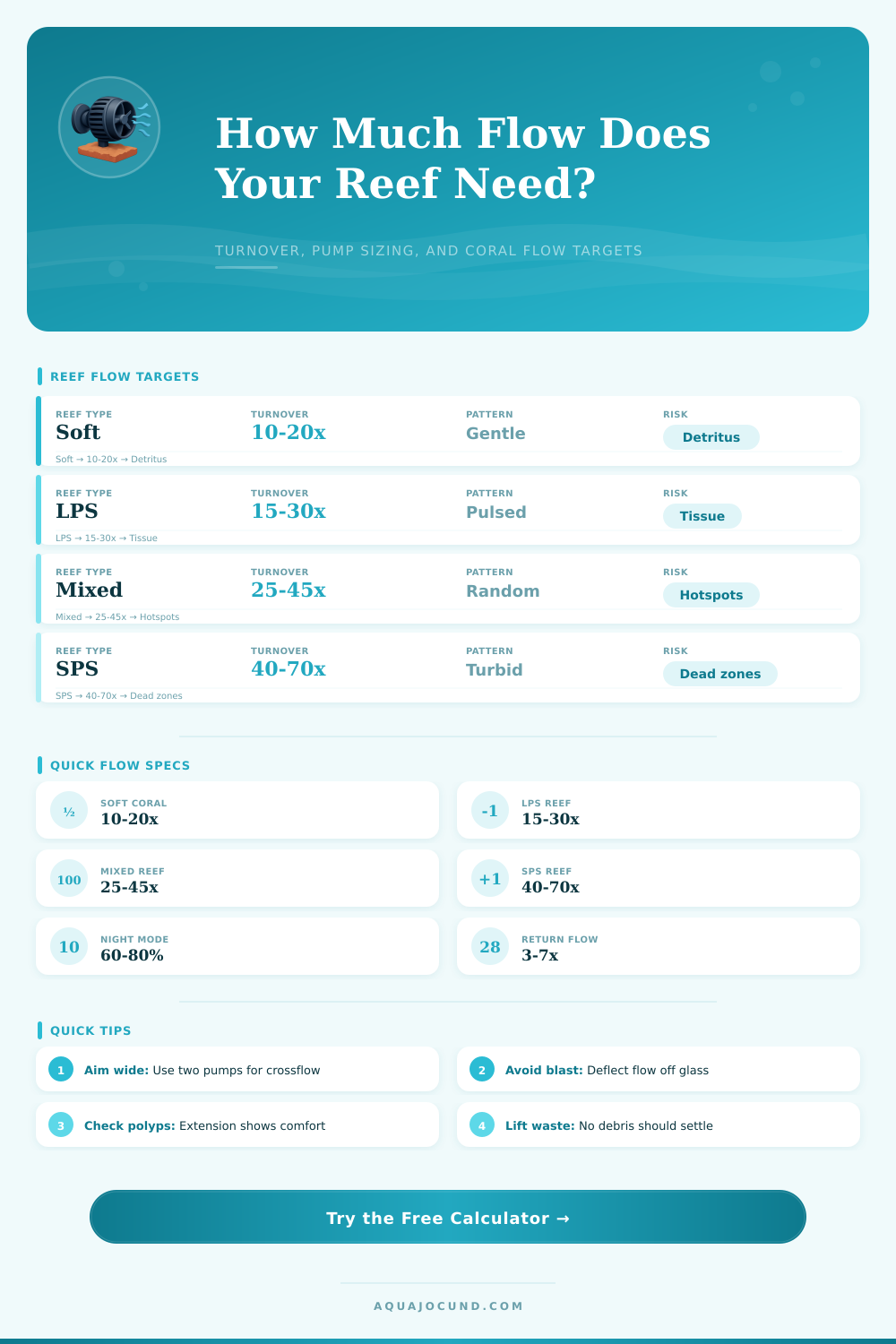
| Reef Type | Target Turnover | Preferred Pattern | Placement Note | Flow Warning |
|---|---|---|---|---|
| Fish-only live rock | 8-15x display volume | Steady circulation | Keep waste suspended behind rock | Dead spots grow detritus mats |
| Soft coral reef | 10-20x display volume | Gentle swaying motion | Use broad pumps across the front pane | Direct jets make polyps retract |
| LPS garden | 15-30x display volume | Pulsed indirect flow | Flow should bounce off glass or rock | Tissue tearing means the stream is too hard |
| Mixed reef | 25-45x display volume | Random alternating flow | Create low and high zones in one tank | One fixed pump creates hot spots |
| SPS dominant | 40-70x display volume | Turbulent crossflow | Aim pumps to collide above coral tips | Still zones cause base recession |
| Shallow frag system | 30-60x display volume | Laminar sweep plus random pulse | Keep racks clear of settling debris | Too much upward blast lifts frags |
| Display Size | Typical Dimensions | Soft / LPS Flow | Mixed Reef Flow | SPS Flow |
|---|---|---|---|---|
| 13.5 gal nano | 22 x 12 x 15 in | 160-405 GPH | 340-610 GPH | 540-945 GPH |
| 20 gal long | 30 x 12 x 12 in | 240-600 GPH | 500-900 GPH | 800-1400 GPH |
| 40 breeder | 36 x 18 x 16 in | 480-1200 GPH | 1000-1800 GPH | 1600-2800 GPH |
| 55 gallon | 48 x 13 x 21 in | 660-1650 GPH | 1375-2475 GPH | 2200-3850 GPH |
| 75 gallon | 48 x 18 x 21 in | 900-2250 GPH | 1875-3375 GPH | 3000-5250 GPH |
| 120 gallon | 48 x 24 x 24 in | 1440-3600 GPH | 3000-5400 GPH | 4800-8400 GPH |
| 180 gallon | 72 x 24 x 24 in | 2160-5400 GPH | 4500-8100 GPH | 7200-12600 GPH |
| Pump Style | Usable Flow Factor | Best Use | Placement | Calculator Effect |
|---|---|---|---|---|
| Broad propeller pump | 90% | General reef circulation | Side glass, angled forward | Baseline sizing |
| Horizontal gyre pump | 95% | Long tanks and peninsula aquascapes | High across the long pane | Lower per-pump demand |
| Narrow jet powerhead | 75% | Behind rock or bare-bottom sweep | Deflect off glass, not coral | Adds capacity for narrow stream loss |
| Random-flow nozzle | 80% | Return outlet turbulence | At water surface or rear corner | Counts as supplemental flow |
| Surge assist | 105% | SPS shelves and natural pulse | Above rockwork with overflow margin | Credits intermittent turbulence |
| Tank Layout | Suggested Pump Count | Flow Aim | Dead Zone Check |
|---|---|---|---|
| Cube reef | 2-3 compact pumps | Opposing sides, slightly upward | Watch rear corners and overflow box |
| Standard rectangle | 2 pumps plus return | Crossflow collision near center | Check behind rock stacks after feeding |
| Peninsula reef | 1 gyre plus 1-2 helpers | Long horizontal sweep | Inspect base of island aquascape |
| Rock wall aquascape | 3-4 pumps | One pump behind or under rock line | Look for sand piles and cyanobacteria |
| Bare-bottom SPS | 3-6 high-output pumps | Bottom sweep plus top turbulence | No mulm should collect under racks |
Total flow is the coral target after rockwork, pump style, and return contribution are included. Use the per-pump value as the useful running output, not the box rating at full power.
Coral response wins. Polyps should move without folding shut, food should stay suspended, and detritus should reach mechanical filtration instead of gathering behind the aquascape.
Water Flow
Water flows is a critical component of establishing and maintaining a reef tank. Water flow is responsible for moving nutrients to the corals and removing waste from the coral tissues. While many people believe that using a powerful pump will provide the proper flow of water throughout the reef tank, the flow of water that moves through the tank is actualy responsible for providing the proper movement of water throughout the tank.
If a powerful pump creates a narrow jet of water, the result will be a tank with a zone with high movement of water and a zone with stillness of water. This zone with stillness of water is referred to as a dead zone. These dead zones in reef tanks allow for the waste products from the corals to accumulate within the reef tank.
Water Flow in a Reef Tank
The turnover of a reef tank are a measurement of the water flow within the reef tank. The turnover of a reef tank is calculated as an amount of times the entire volume of the reef tank passes the corals in a 24 hour period. The turnover can be high in a reef tank, yet there can still be dead zones in the tank if the water movement within the tank is only performing in a circular pattern within the tank.
Different types of corals requires different types of water movement within the reef tank. For instance, soft corals and mushroom corals require more gently movements of water within their tank than other types of corals because the gentle movement of water will not stress the soft and mushy corals. In contrast, SPS (stress-bearing corals) require zones of turbulent and chaotic movement of water because the movement helps to remove the mucus layer that covers the polyps of the coral and provides oxygen and food to the polyps.
Because different types of corals require different types of water movements, a reef keeper will have to establish different zones of water movement within the same reef tank. A reef tank will have losses in water flow due to the plumbing that is used to establish the water movement within the tank. Every elbow or valve in the plumbing will lose some of the total gallons per hour of the return pump.
You should calculate the wavemaker after determining the impact that plumbing will have on the reef tank. Another factor that will impact the water flow within a reef tank are the aquascapes within the reef tank. The rocks within the reef tank may create some blockage of the movement of water within the tank.
A dense rockscape will create more movement of water then an open rockscape. Therefore, reef tanks that contain dense aquascapes will require more power in the pumps to ensure that the water reaches the center of the tank. The pump that is established within a reef tank will also impact the way that the water moves within the tank.
Gyre pumps will create a horizontal sweep of water within the tank. Propeller pumps will create a wider and softer spread of water within the tank. These factors must also be considered when establishing the water movement within a reef tank.
After all the pumps are established in a reef tank, it is important to observe the corals within the tank. If the corals are extending their polyps, this is an indication that the water flow is sufficient to that coral. If the corals are retracting or folding shut, this is an indication that the water movement is too highly for those corals.
The settings of the pumps will have to be continually refined to provide the correct water flow for each type of coral in the tank.