
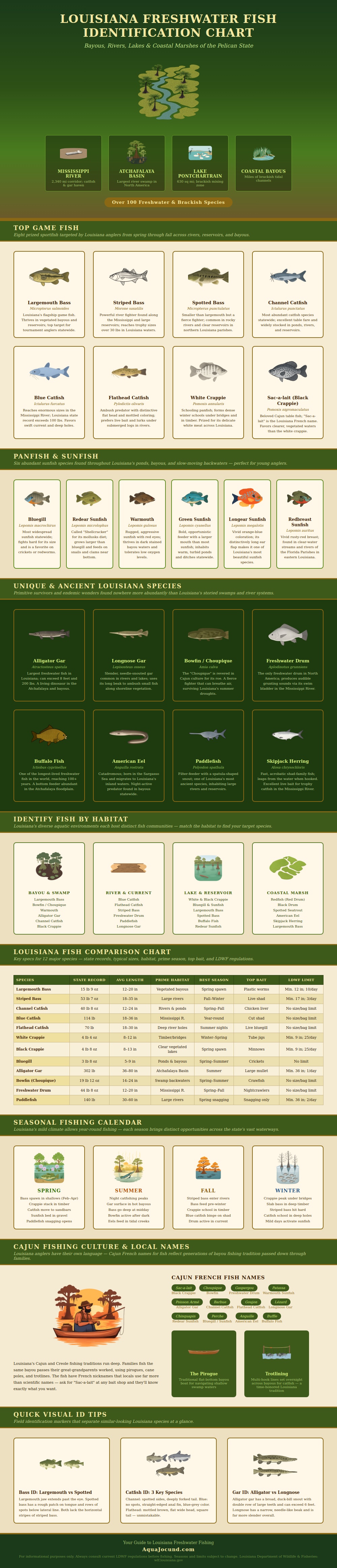
Within Louisiana is a great amount of biological diversity. This biological diversity lead to numerous different species of fish living within the waters of the state. The waters of Louisiana range from muddy rivers like the Mississippi River to the brackish waters of the state’s coastal marsh.
Due to the diversity of these waters, a person may become confuse if they catch a fish in Louisiana due to the fact that they may not be familiar with the different species of fish that live in these waters. Therefore, it is important for individuals to learn how to identify the different species of fish that live in these environments to determine whether the caught fish is suitable for consume or should be returned to it’s habitat. Depending upon the behavior and environment of the fish, Louisiana feature different groups of fish.
Types of Fish in Louisiana and How to Identify Them
For instance, there are groups of aggressive game fish, groups of steady panfish, and groups of fish species that have remained unchanged for millions of year. Additionally, the environment in which an individual is fishing will help to inform the type of fish that can be encountered. For instance, if an individual is fishing in a vegetated reservoir, they can expect to encounter bass or crappie fish.
In the same way, if an individual is fishing in deep and swift holes within one of Louisiana’s major river, they are likely to encounter large fish such as blue catfish or paddlefish. Some of the freshwater fish species in Louisiana may be more difficult to identify than others due to the number of fish species that exist in the state and the similarity between the different species. For instance, an individual may struggle to identify whether they have caught a largemouth bass or a spotted bass but the differences in jaw line and markings can reveal the species of bass.
Similarly, there are different species of catfish in Louisiana as well. However, each of these species have similar physical features. For instance, all species of catfish has whiskers but the channel catfish have spotting on their bodies, the blue catfish are a sleekly grey color, and the flathead catfish have a mottled brown color with a wide flat head.
These different features can help individuals to identify the different species of catfish. In addition to the fish that live in Louisiana and how they can be identified, there are also fish survivor that live in the state. These fish have remained the same for millions of years.
For instance, the alligator gar have a body that features armor and a snout that resemble a duck bill. Another of these survivors is the bowfin fish, which is also known as a choupique. These fish are able to breathe air which allow them to live in the stagnant waters of Louisiana.
Due to the survival of this species in the bayous of Louisiana, the bowfin is a significant fish in Cajun culture and the reproduction of the bowfin is also a significant occurrence in that culture. Additionally, many of the fish in Louisiana have different names then their scientific names. For instance, instead of hearing the term black crappie, individuals will hear the term sac-a-lait.
Furthermore, instead of hearing the term freshwater drum, individuals will hear the term gaspergou. Additionally, instead of hearing the term warmouth, individuals will hear the term patassa. Therefore, knowing these local names of the fish will help individuals to communicate with others within the local fishing culture of Louisiana.
Finally, the time of year during which individuals goes fishing changes with the temperature and the seasons within Louisiana’s climate. Due to the mild climate within the state, there are fishing seasons year round. However, the types of fish that are caught will change with the change in temperature.
For instance, during the spring season, bass and crappie fish are spotted in areas with timber. During the summer season, the catfish species seeks the shade and eat during the night. During the fall season, striped bass begins to move into the rivers of Louisiana.
These seasonal fish migrations can be followed with the aid of a seasonal calendar.
