🌊 Conductivity to Salinity Calculator
Convert aquarium conductivity readings into salinity, practical salinity, specific gravity, and TDS with temperature-aware interpretation.
✅ Converted Water Reading
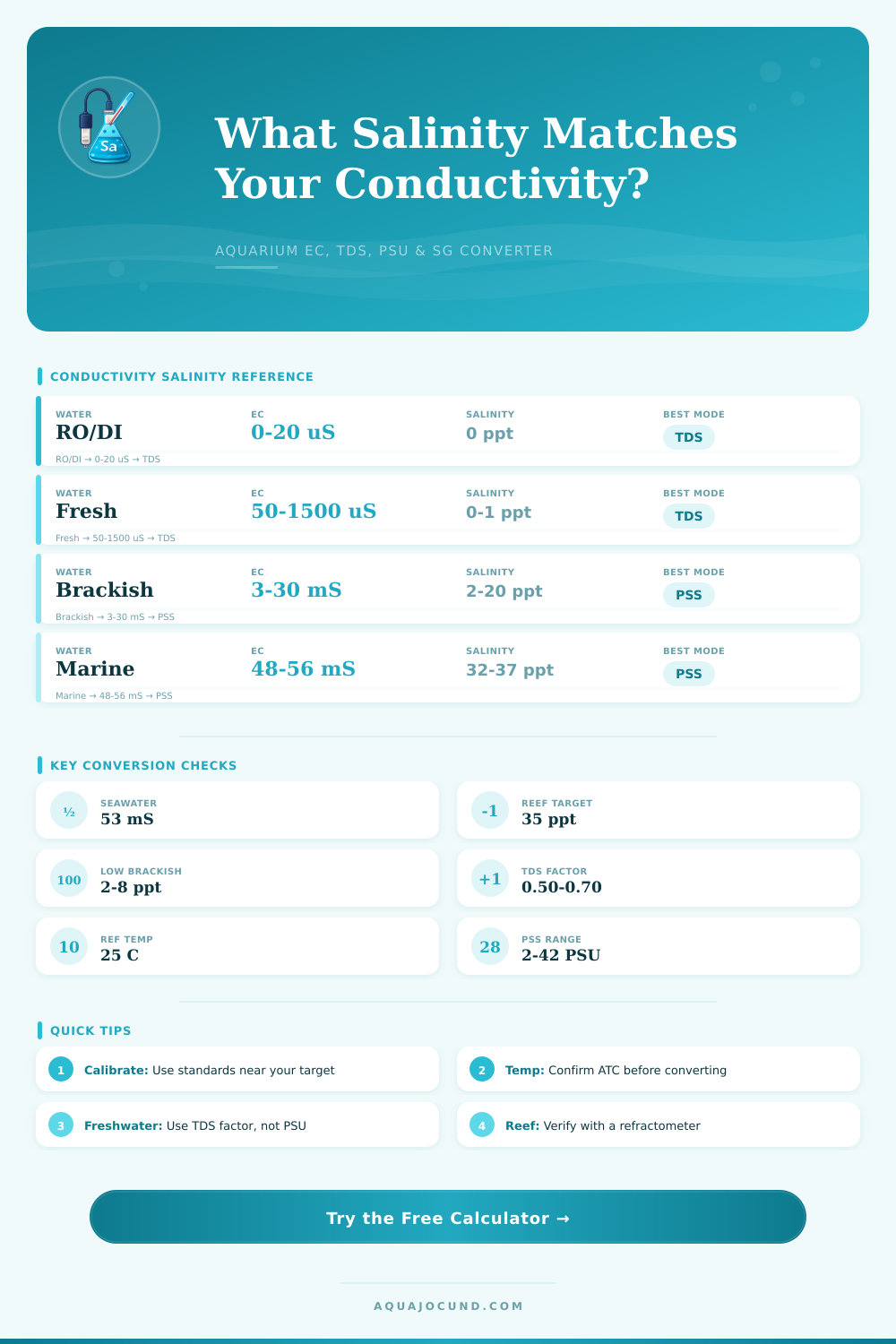
| Water Type | Typical Conductivity | Approx Salinity | Specific Gravity | Best Interpretation |
|---|---|---|---|---|
| RO/DI product water | 0 to 20 uS/cm | 0 ppt | 1.000 | Purity check |
| Soft freshwater | 50 to 250 uS/cm | 0.03 to 0.16 ppt | 1.000 | TDS factor |
| Planted community | 300 to 900 uS/cm | 0.2 to 0.6 ppt | 1.000 to 1.001 | TDS factor |
| Hardwater cichlid | 1.0 to 2.5 mS/cm | 0.6 to 1.6 ppt | 1.001 | Mineral EC |
| Low brackish | 3 to 12 mS/cm | 2 to 8 ppt | 1.002 to 1.006 | PSS estimate |
| High brackish | 15 to 30 mS/cm | 10 to 20 ppt | 1.008 to 1.015 | PSS estimate |
| Natural seawater / reef | 50 to 55 mS/cm | 33 to 36 ppt | 1.025 to 1.027 | PSS-78 |
| Target | Salinity Range | Approx EC at 25°C | Common Livestock | Watch Point |
|---|---|---|---|---|
| RO/DI top-off | 0 to 0.03 ppt | 0 to 50 uS/cm | All marine top-off | Rising EC means resin exhaustion |
| Soft blackwater | 0.03 to 0.15 ppt | 50 to 250 uS/cm | Discus, tetras, Caridina | Mineral salts affect breeding |
| Planted community | 0.10 to 0.70 ppt | 150 to 1100 uS/cm | Plants, rasboras, livebearers | Fertilizer raises EC daily |
| African cichlid hardwater | 0.50 to 1.20 ppt | 0.8 to 2.0 mS/cm | Mbuna, Tanganyika fish | Buffer minerals are not sea salt |
| Low brackish | 2 to 8 ppt | 3 to 12 mS/cm | Figure 8 puffers, nerites | Change salinity slowly |
| High brackish | 10 to 20 ppt | 15 to 30 mS/cm | Scats, monos, strong estuary fish | Use marine salt mix |
| Reef aquarium | 33 to 36 ppt | 50 to 55 mS/cm | Corals, reef invertebrates | Calibrate near 35 ppt |
| Fish-only marine | 30 to 35 ppt | 45 to 53 mS/cm | Marine fish systems | Lower salinity changes dosing |
| Hyposalinity treatment | 12 to 15 ppt | 18 to 23 mS/cm | Short-term marine treatment | Do not use with corals |
| Standard / Setting | Reference Temp | Coefficient | Use For | Calculator Effect |
|---|---|---|---|---|
| ATC to 25°C | 25°C | Meter applies it | Most hobby EC meters | Uses reading as EC25 |
| Raw conductivity | Sample temp | User selected | Lab probes and logging meters | Normalizes EC before TDS |
| NaCl temperature curve | 25°C | 2.0% per °C | Calibration solution | Best for NaCl mode |
| Natural water estimate | 25°C | 1.9% per °C | Aquarium water mixes | Default correction |
| Hard alkaline water | 25°C | 2.4% per °C | Rift lake buffers | Slightly stronger correction |
| PSS-78 seawater | 15°C ratio base | Temperature polynomial | Marine salinity | Uses seawater conductivity model |
| Standard | Conductivity at 25°C | Best Meter Range | Closest Aquarium Use | Notes |
|---|---|---|---|---|
| Low EC purity check | 84 uS/cm | RO/DI and soft water | Top-off, shrimp, blackwater | Use clean glassware and fresh standard |
| Freshwater standard | 1413 uS/cm | Fresh to hardwater | Planted, livebearer, cichlid | Common calibration point for TDS meters |
| High freshwater standard | 12.88 mS/cm | Brackish transition | Low brackish systems | Good second point for wide-range probes |
| Seawater standard | 53.0 mS/cm | Marine and reef | Reef salinity near 35 ppt | Preferred over RO calibration for reef probes |
| Specific gravity cross-check | 35 ppt solution | Refractometer check | Coral and invertebrate systems | Match calibration fluid to the device |
💡 Reading EC in Freshwater
Freshwater conductivity is mostly a dissolved-mineral signal, so the TDS factor matters more than PSU. Fertilizer, buffers, remineralizers, and evaporation can all raise EC while true salt salinity stays very low.
💡 Reading EC in Marine Water
Marine systems should be checked with a standard close to seawater strength. A meter calibrated only at 1413 uS/cm can look accurate in freshwater and still drift at reef conductivity.
Electrical conductivity is a measure of how easy an electrical current pass through water. Electrical conductivity is used to estimate the amount of dissolve ions in the water. Electrical conductivity meters has a digital display that display a number like 53.0 mS/cm.
The number do not tell a person the health of the aquarium, but electrical conductivity can provide an estimation of other value. For example, electrical conductivity can be used to determine whether the salinity of a reef tank are correct or whether the reverse osmosis unit used to prepare the water is remove the minerals from the water at the proper rate. The electrical conductivity of water is effected by the specific mineral contained within the water.
Using a Conductivity Meter in Your Aquarium
For example, nitrate and phosphate can effect the electrical conductivity of freshwater aquariums. However, sodium chloride is require to effect the electrical conductivity of the water in marine aquarium. Because different mineral have different effects upon electrical conductivity, persons must use a specific conversion profile to obtain the most accuratley reading of the salinity of the water in there aquarium.
Using the wrong conversion profile will result in inaccurate data from the meter. Electrical conductivity is also effected by the temperature of the water. The higher the temperature of the water, the more conductive the water become.
Most meters has the feature to automatically compensate for the temperature of the water so that the electrical conductivity reading are compensated to 25 degrees Celsius. However, the accuracy of the meters automatic temperature compensation is dependent upon the coefficient that the meter use. In coldwater or high-heat environment, the salinity reading could be false due to incorrect coefficient setting.
For brackish water aquarium, the salinity should be within a specific range to mimic the condition of an estuary. Electrical conductivity meters can be used to convert the electrical conductivity to salinity unit or parts per thousand. Using a conversion calculator allow the person to easily find the salinity of the water and ensure it is within the proper range for the brackish water aquarium.
Total Dissolved Solids (TDS) measure the total weight of the dissolve solids in the water. TDS is not a direct measurement of the water, but can be calculate using the electrical conductivity meter. TDS multiply the electrical conductivity measurement with a specific conversion factor.
However, if the conversion factor is set for pure sodium chloride in water but the water contain other minerals and acids, then the TDS reading will be incorrect. Many electrical conductivity meter user are unaware that this can happen, and trust the TDS reading without consideration. Reef tank should have a salinity of 35 parts per thousand.
If the salinity is too high, the coral will be exposed to osmotic stress. If the salinity is too low, calcium precipitation can occur in the tank. Because electrical conductivity probe may become coated or the reading may drift over time, it is recommended that electrical conductivity reading are cross checked with a refractometer.
A reference table can be used to compare the current electrical conductivity of the tank to standards of electrical conductivity for certain salinity. By comparing the two measurement, anomalies in the electrical conductivity measurement can be spotted. In order to maintain a healthy aquarium, stability in the water chemistry is require.
Electrical conductivity measurement can be manipulated to become a management tool. For instance, if the parameter of the water are known, the person can use the electrical conductivity meter to make small, controlled adjustment to the chemistry of the tank. By making these slow adjustment, large water change are avoided.