🌊 Saltwater Specific Gravity Calculator
Convert specific gravity, ppt, and PSU, then plan a controlled salinity correction for reef or marine fish systems.
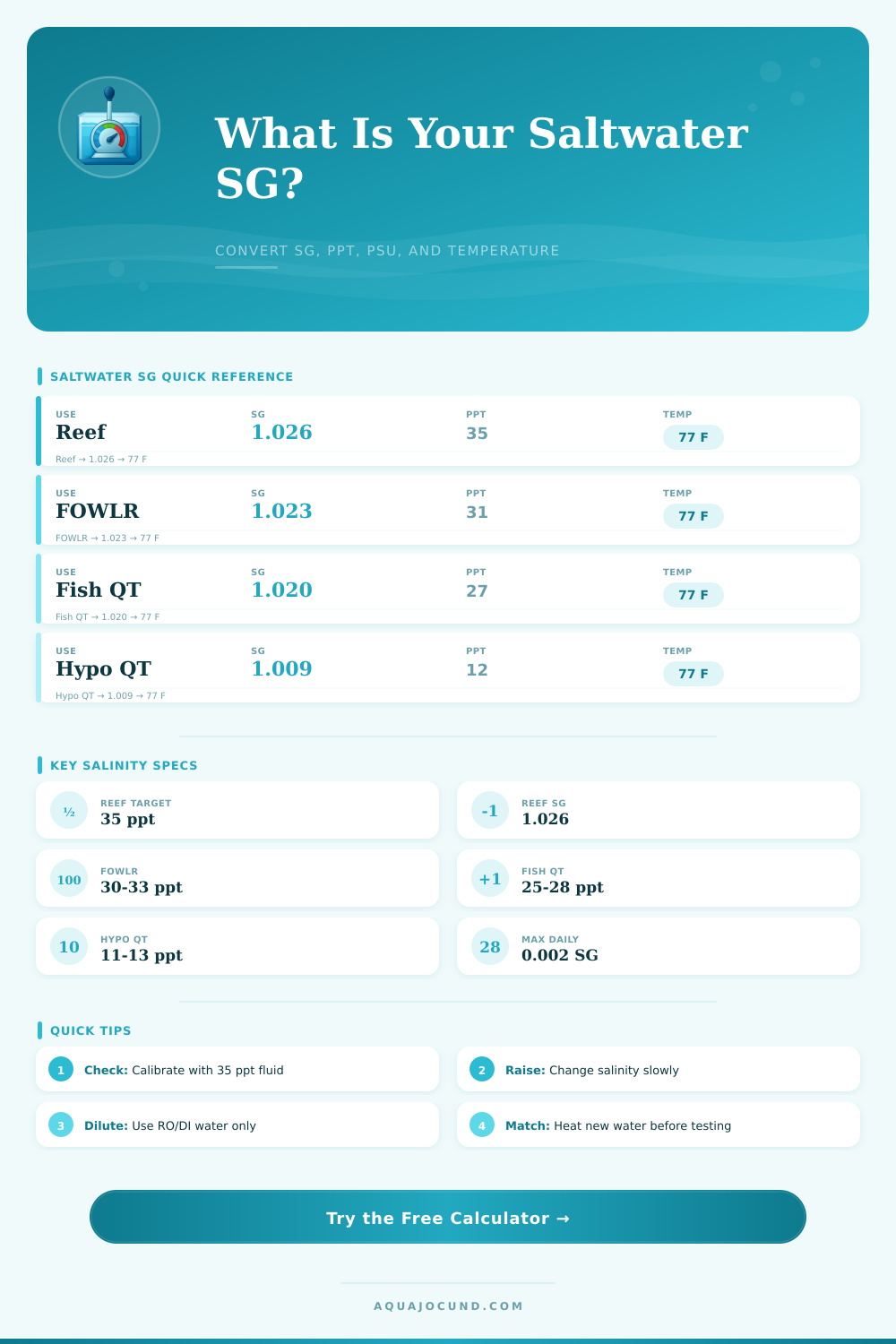
| Specific Gravity | Approx. ppt | Best Match | Notes |
|---|---|---|---|
| 1.0090 | 12 ppt | Hyposalinity QT | Treatment only; verify with calibrated refractometer. |
| 1.0180 | 24 ppt | Low fish holding | Below most display aquarium targets. |
| 1.0204 | 27 ppt | Fish quarantine | Useful for short-term marine fish QT when matched carefully. |
| 1.0234 | 31 ppt | FOWLR | Good fish-only range without coral demand. |
| 1.0256 | 34 ppt | Mixed reef | Often used when fish and corals share the system. |
| 1.0264 | 35 ppt | Reef | Natural seawater reference near 77°F / 25°C. |
| Device | Typical Calibration | Temp Sensitivity | Calculator Treatment |
|---|---|---|---|
| Refractometer with ATC | 68-77°F | Low if calibrated | Applies a small residual correction. |
| Swing-arm hydrometer | 77°F | Moderate | Applies the full hobby correction estimate. |
| Digital salinity meter | Factory / user | Low | Assumes internal compensation. |
| Conductivity probe | 35 ppt solution | Probe dependent | Assumes the controller compensates temperature. |
| Tank | Display Volume | Estimated Water | Reef Adjustment Example |
|---|---|---|---|
| 5 gal nano | 5 gal / 19 L | 4 gal / 15 L | 1 ppt change uses about 15 g salt mix. |
| 20 gal long | 20 gal / 76 L | 16 gal / 61 L | 1 ppt change uses about 61 g salt mix. |
| 40 breeder | 40 gal / 151 L | 32 gal / 121 L | 1 ppt change uses about 121 g salt mix. |
| 75 gal reef | 75 gal / 284 L | 60 gal / 227 L | 1 ppt change uses about 227 g salt mix. |
| 125 gal FOWLR | 125 gal / 473 L | 100 gal / 379 L | 1 ppt change uses about 379 g salt mix. |
| Goal | Method | Daily Limit | Important Check |
|---|---|---|---|
| Raise salinity | Add premixed saltwater or dissolved salt mix slowly. | 0.001-0.002 SG | Never pour dry salt into a stocked display. |
| Lower salinity | Replace a measured amount with RO/DI freshwater. | 0.001-0.002 SG | Match temperature and aerate before retesting. |
| Water change correction | Mix the new batch above or below tank salinity. | Depends on volume | Keep new-water salinity within animal-safe limits. |
| Hyposalinity treatment | Use a separate bare hospital tank. | Protocol based | Do not use with coral, live rock, or inverts. |
💡 Reading Accuracy Tips
Calibrate near the target: A 35 ppt calibration fluid is more useful for reef tanks than plain RO/DI calibration.
Match temperature: Let the sample, meter, and calibration fluid sit in the same room before measuring.
Rinse every time: Salt residue on a prism, probe, or swing arm can make the next reading look higher than reality.
💡 Safe Adjustment Tips
Move slowly: Fish tolerate a stable salinity better than a fast correction, especially when lowering SG.
Mix outside the tank: Dissolve and aerate saltwater fully before adding it to a stocked aquarium.
Retest after circulation: Wait for pumps to mix the system before trusting the next number.
Salinity are the measurement of salt concentration in water, but the salinity also change based on the temperature of that water. The temperature of the water impact the density of the water, which impacts the accuracy of the salinity measurements of that water samples. Water molecule expand when the water is warm and the water molecules contract when the water is cool.
Thus, the density of the water change when the water is either warm or cool, even if the amount of salt in the water remain the same. Consequently, if a tool that measure the salinity of water is calibrated with cool water is used to measure warm water (or vice versa), the salinity measurement will be inaccurately. Thus, it is important to account for the temperature of the water when measuring its salinity to ensure that the measurement is accurate.
How to Measure and Keep Aquarium Salt Levels Steady
Two of the tools that may be used to measure the salinity of water are a refractometer and an hydrometer. The refractometer is generally more precise in its measurements than a hydrometer. However, the refractometer will provide inaccurate measurements if it isnt calibrate correctly.
Additionally, the hydrometer is often sensitive to changes in the temperature of the water, which can lead to inconsistent salinity measurements. In both case, however, the salinity calculator can be used to compensate for differences in temperature. The salinity calculator will ask for the salinity of the sample to be calculate, as well as the temperature at which the tool was calibrated.
The calculator will then provide the calculated salinity with the difference in temperature account for. Salinity can be expressed in a variety of units. For example, salinity can be measured in parts per thousand (ppt) or in Practical Salinity Units (PSU).
Parts per thousand measure the amount of grams of salt in one liter of water. Many individuals commonly use this unit to measure the salinity of water. Additionally, Practical Salinity Units is a scientific method of measuring the salinity of water.
However, the value of salinity in PSU is similar than the value of salinity in parts per thousand (ppt) for aquarium water at home. Thus, only one of these units should be used to ensure consistency in the measurements. Using one unit of measurement for salinity consistently in the aquarium will prevent any mathematical error from occurring within the tank.
Furthermore, using only one unit will aid in avoiding any accidental change to the salinity levels within the aquarium. Different types of aquariums contains different requirements for the salinity levels within the water. For instance, coral reef aquariums require higher salinity levels compared to other types of saltwater tank that contain only fish species.
Additionally, quarantine tanks for sick fish require specific salinity levels, though they may use hyposalinity. Using hyposalinity allow for the lowering of salinity levels in tanks to kill parasites from the fish. However, using hyposalinity is dangerous for tanks that contain coral or other invertebrate species, as low salinity can kill them.
Therefore, you must precisely monitor the salinity levels when carrying out a hyposalinity cycle for the sick aquarium fish. Another important aspect of maintaining salinity levels appropriately is knowing what to do should the salinity levels within the tank be detect as incorrect. In this case, the salinity should not be changed too quick.
If the salinity levels are changed rapidly within the tank, the fish will experience stress and potentially develop disease. The salinity should instead be changed slowly to allow the fish to adjust to the change in the tank. Whether saltwater or pure RO/DI water is being add to the aquarium, the change in salinity should be gradual and made in small increments to allow the fish to adjust.
The salinity levels in the aquarium can increase over time due to the evaporation of the water in the tank. Only the pure water evaporate from the tank, but the salt remain in the tank. As a result, the increased evaporation cause the salinity of the tank to increase over time.
To prevent the salinity of the aquarium from rising to harmful level for the fish, you must add pure RO/DI water to the tank regularly. By adding RO/DI water to the tank, the concentration of salinity levels will be maintained at a stable rate. Maintaining the salinity levels of the aquarium to remain stable is important for providing a consistent environment for the fish and other livestock living in the tank.