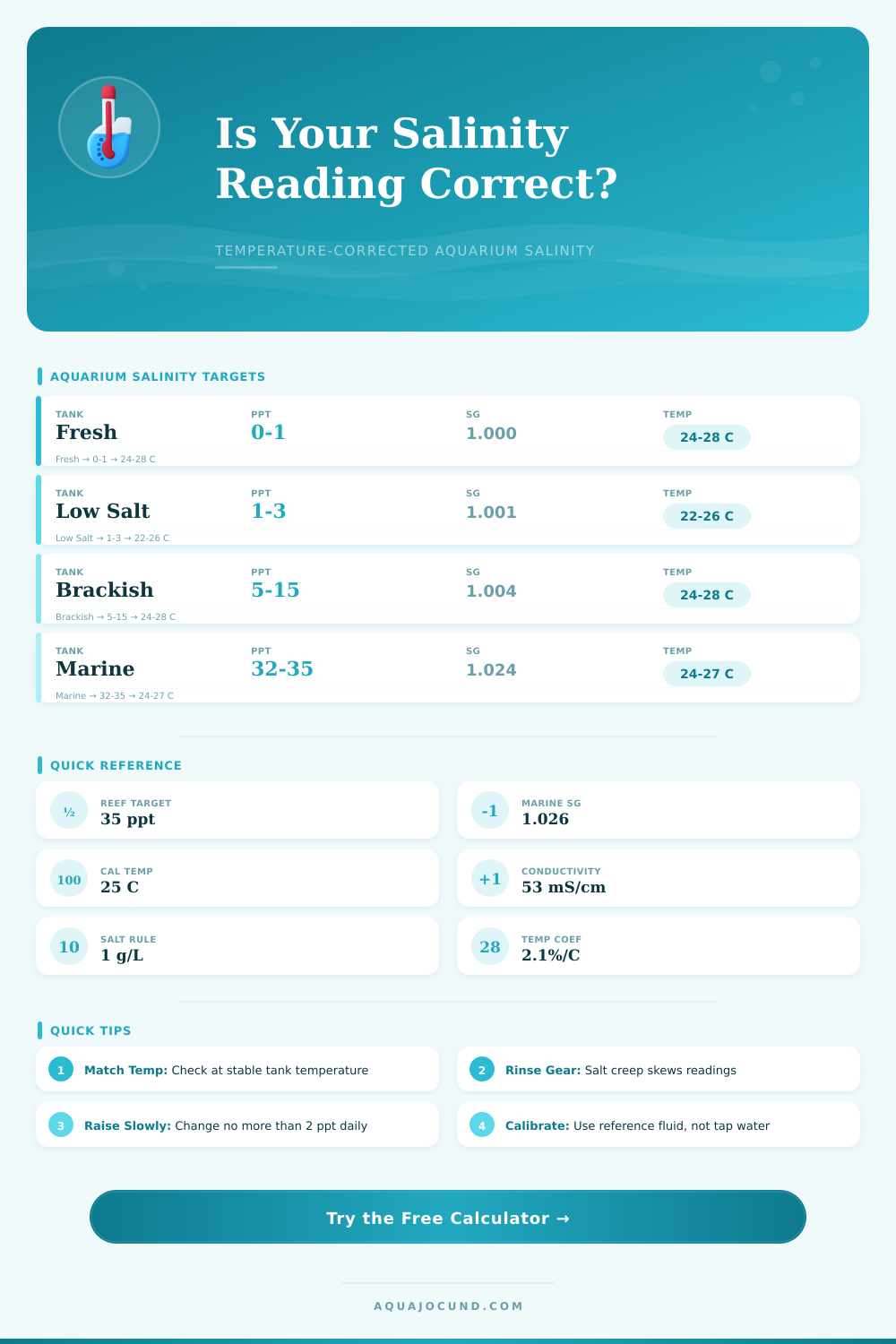
🌊 Salinity Temperature Calculator
Correct hydrometer, refractometer, and conductivity readings for aquarium temperature, then compare them with safe target ranges.
| Profile | Target PPT | Approx SG | Temp Range | Best For |
|---|---|---|---|---|
| Soft Freshwater | 0.0-0.5 | 1.0000 | 75-82°F | Bettas, discus, tetras, rasboras |
| Planted Community | 0.2-0.8 | 1.0002 | 72-80°F | Plants, corydoras, small schooling fish |
| Low Salt Freshwater | 1.0-3.0 | 1.0008 | 68-78°F | Goldfish, short-term supportive care |
| Mineralized Livebearer | 2.0-5.0 | 1.0023 | 74-80°F | Mollies, guppies, platies, swordtails |
| Low Brackish | 5.0-10.0 | 1.0060 | 75-82°F | Figure 8 puffers, bumblebee gobies |
| Mid Brackish | 10.0-18.0 | 1.0110 | 76-82°F | Mollies, archers, scats, monos |
| Marine Fish Only | 30.0-33.0 | 1.0225 | 75-80°F | Hardy marine fish, fish-only tanks |
| Reef Display | 34.0-36.0 | 1.0260 | 76-80°F | Corals, inverts, reef fish |
| Hyposalinity QT | 13.0-15.0 | 1.0100 | 76-80°F | Fish quarantine only, no inverts |
| Tool | Common Calibration | Temperature Effect | Calculator Treatment |
|---|---|---|---|
| Floating Hydrometer | 60, 68, or 77°F | Warmer samples shift density and SG | Uses pure-water density ratio correction |
| Swing-Arm Hydrometer | Often 77°F | Bubbles and salt creep can exceed temp error | Corrects SG but assumes clean needle movement |
| ATC Refractometer | 68 or 77°F | Small residual error outside room temp | Applies a light compensation factor |
| Conductivity Probe | 25°C standard | Conductivity changes about 2.1% per °C | Normalizes mS/cm to 25°C before ppt |
| Density Meter | Usually 20 or 25°C | Density falls as water warms | Converts kg/m³ to corrected SG and ppt |
| Tank Size | Water Volume | 1 PPT Dose | Marine Salt at 35 PPT |
|---|---|---|---|
| 10 gallon | 38 L | 38 g | 1.3 kg |
| 20 long | 76 L | 76 g | 2.7 kg |
| 29 gallon | 110 L | 110 g | 3.9 kg |
| 40 breeder | 151 L | 151 g | 5.3 kg |
| 55 gallon | 208 L | 208 g | 7.3 kg |
| 75 gallon | 284 L | 284 g | 9.9 kg |
| 125 gallon | 473 L | 473 g | 16.6 kg |
| Situation | Safe Change | Water Change Use | Retest Timing |
|---|---|---|---|
| Freshwater salt support | 0.5-1 ppt per day | Replace removed salt after each change | After 30 minutes of circulation |
| Brackish acclimation | 1-2 ppt per day | Use pre-mixed brackish water | After temperature equalizes |
| Reef correction upward | 1 ppt per day | Top off with saltwater only when planned | After full turnover through sump |
| Marine dilution downward | 1-2 ppt per day | Use lower-salinity replacement water | After two stable readings |
| Hyposalinity treatment | Follow veterinary protocol | Use calibrated refractometer checks | Morning and evening |
💡 Measurement Tip
Temperature compensation cannot fix dirty prisms, trapped bubbles, or salt crystals on a swing arm. Rinse tools with fresh water, dry the lens or arm, then take two readings before changing the aquarium.
💡 Livestock Tip
Salinity stress usually comes from speed, not just the final number. Raise or lower salinity over several maintenance sessions unless a quarantine protocol specifically calls for a faster change.
Temperature affect water density measurement and how water density behave in an aquarium. Density change with temperature. Warm water is less denser than cool water.
These tools dont measure the amount of salt in the water. Instead, these tools measure the density of the water. Since density change with temperature, the density of the water measured with a refractometer or an hydrometer will change with the temperature of the aquarium water.
How Temperature Affects Aquarium Salinity Readings
Thus, the salinity reading will change depending on the temperature of the water being measure. To account for this, you will need to account for the temperature of the water in determining the true salinity of the water in the aquarium. The salinity of the water should be measured at it’s calibration temperature.
Measurement tool are calibrated to a specific temperature. For example, salinity measurement tool are calibrated to either sixty-eight degrees or seventy-seven degrees. A salinity calculator can help bridge the gap between the calibration temperature of the measurement tool and the actual temperature of the water in the aquarium.
The salinity calculator will remove the effect of the temperature of the water on the salinity reading from the tool. Thus, using a salinity calculator will allow for the achievement of precise measurement of salinity. When managing a reef tank or a hyposalinity treatment, precise measurement are required.
Salinity change in water can lead to osmotic shock in fish species. Salinity change in the water affect the kidneys of the fish species. Salinity change that are too rapid for the fish kidneys to process can lead to stress in the fish.
A salinity calculator will allow for the viewing of the distance between the current salinity of the tank and the target salinity. Furthermore, the salinity calculator can provide a suggestion as to the specific dose of salt that would be required to reach the target salinity with the specific salt product that aquarium keeper should of used in the aquarium. Different salt product have different density and different chemical weights.
For instance, specialized reef mix salts contain calcium and magnesium in addition to the salts that increase the salinity of the water. Tonic salts, on the other hand, have no additional chemical except for sodium chloride. Because of the difference in chemical compositions in these salt products, there will be a difference in the amount of product that the aquarium require to raise the salinity of the water by one point.
Thus, using a product factor when adding salt to an aquarium will ensure that the amount of salt added is not an overdose of salt to the water in the aquarium. Brackish water tank salinity must be manage carefully. Different species of fish have different salinity tolerance level.
For instance, a Figure 8 puffer fish and a bumblebee goby have different salinity tolerance levels. Thus, the salinity levels must be balanced proper to the requirements of the different species of fish that are contained in the aquarium. Aquarium keeper can utilize tables of the target salinity profiles of different species of brackish water fish.
However, these target salinity value are targets that are to be hit and not law that must be adhered to without exception. Exceeding the target salinity levels can create problem for the health of the fish in the aquarium. In instances when lowering the salinity level of water in an aquarium, dilution should be used instead of adding fresh water all at once.
Planned water change allow for the salinity of the water to be lowered gradual and safely. Before changing the water in the aquarium, calculate the salinity of the water that is to be use for the water change. Although it may take more time to carry out a planned water change than adding fresh water all at once, using this method is the safest means of lowering the salinity of the water in the aquarium.
Salinity level should be managed consistently in the aquarium. Do not make large change to the salinity of the water based off a single salinity reading that has not been corrected for the temperature of the water. If salinity and salinity measurement tools are to be use, rinse them with the aquarium water to remove salt creep.
Take two separate salinity reading to ensure accuracy in the measurement of the salinity of the water in the aquarium. Calculate the salinity using the salinity calculator one more time to ensure that the salinity reading is correct. By treating change in salinity as a slow process, the livestock in the aquarium will remain healthy.