
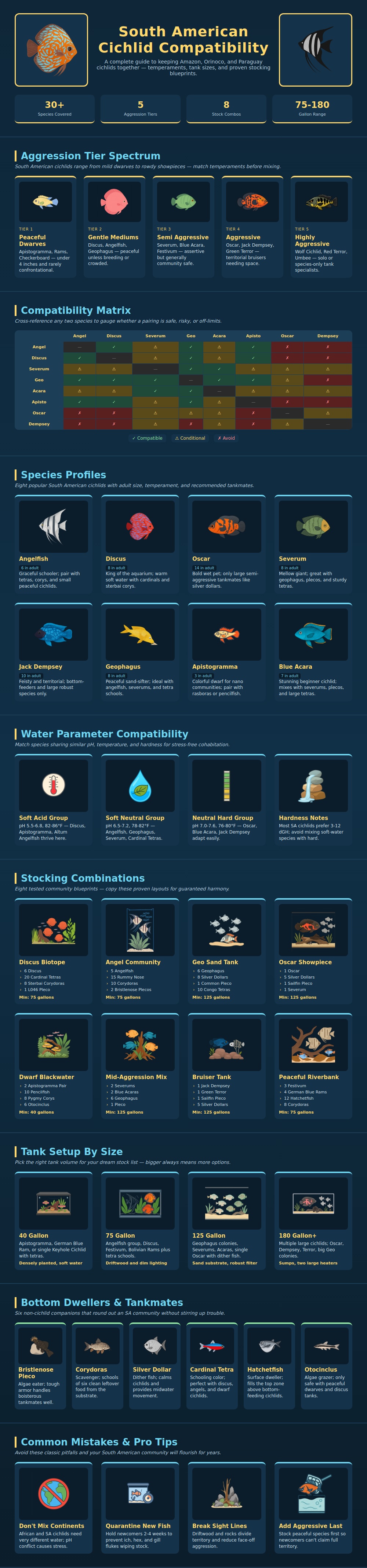
South American cichlids originate from three different river basins: the Amazon, Orinoco, and Paraguay. These fish has many different temperaments. If you choose the wrong kind of South American cichlid for you’re aquarium, they will fight with each other.
By using a compatibility chart for your tank, you can avoid these fights between your South American cichlid. South American cichlids can be divided into several different temperature tier. The smallest types of these South American cichlids, such as apistogrammas and rams, are known to be peacefully fish.
How to Choose and Keep South American Cichlids
These types of South American cichlids are best suited for smaller tanks. Medium-sized South American cichlids, such as discus and angelfish, are consider to be mellow fish. However, both of these type can become aggressive when they are breeding.
Semi-aggressive South American cichlids, such as severums and blue acaras, are more assertive fish. However, they can live in community tank with other similarly-sized fish. Each of these category can be further细分 on a compatibility chart for South American cichlids.
The aggressiveness or peacefulness of these fish is correlate with the behavior of these fish in the wild. Small species of South American cichlids like apistogrammas like to hide in the leaf litter on the ground to avoid conflict with other fish. In contrast, larger species like oscars are more likely to patrol the water and bully other fish in their tank.
For instance, if you paired a peaceful discus fish with a jack dempsey fish, the jack dempsey would stress the discus fish. If a fish is stressed out, it will lose it color and its immunity to illness will decrease. By using the compatibility chart for South American cichlids, you can identify which fish pair to avoid, which to monitor, and which are safe to keep together.
For example, angelfish and geophagus fish are compatible with one another since their swimming habit do not conflict with one another. However, oscars and apistogrammas fish are not compatible with one another since both the size and attitude of the two species do not match. The water chemistry in the tank also determine the survival of the South American cichlids.
Most species of South American cichlids originate from the blackwater rivers of South America. The blackwater rivers are known to have soft and acidic water. Discus fish prefer warm water with low pH level.
The ideal temperature for discus fish is around 82 degrees. However, other fish, like oscars, can live in more neutral, harder water conditions in their tank. Ensure that the water parameter of the tank match the requirements of the species of fish in the aquarium.
Incorrect water parameters for South American cichlids may lead to lethargic or fin-rot prone fish. You can group these fish by band of the water parameters. For instance, soft acid water fish can be grouped together, as can fish that require neutral water parameters.
Stocking blueprints assist in determining which fish to add to the tank. Additionally, stocking blueprints allow owners to balance the number of fish in the tank. For example, discus, cardinal tetras, and sterbai corys can be kept in a 75-gallon tank if the water is soft and warm.
Additionally, eartheaters and silver dollars prefers tanks with sandy substrate. Aggressive South American cichlids, such as oscars, need at least 125 gallon of tank space. One of the most critical factor in determining the type of fish that can live in a freshwater aquarium is the size of the tank.
For instance, a 40-gallon tank is large enough to contain dwarf South American cichlids and rasboras if the tank is densely planted. A 75-gallon tank is large enough to contain group of angelfish or groups of festivum and rams. Additionally, driftwood can be included in 75-gallon tanks to break the line of sight between the fish.
Finally, a tank that is 125 gallons or larger is large enough to contain group of severum or a single oscar. These larger tanks afford each species more room to establish there own territories, reducing the likelihood of fights between tank inhabitants. Non-cichlid fish can be used to fill the remaining areas of the tank.
These non-cichlid fish will reduce the chances of competition between cichlids and non-cichlids. For example, bristlenose plecos and corydoras will clean the scraps of food from the bottom of the tank. Silver dollars can act as dither fish for the South American cichlids.
Cardinal tetras tend to do well in peaceful tank setup. Hatchetfish will occupy the surface of the water. Lastly, otos will graze the area at the surface of the water in tanks that are relatively calm.
By adding these different type of non-cichlid fish, the competition for resources in the tank will be reduced. There are several mistake that should be avoided when adding South American cichlids to an aquarium. For starters, never attempt to keep these fish with African cichlids; the pH requirements for these two different types of cichlid are different.
Always quarantine the new fish that you add to the aquarium; this will prevent the spread of disease like ich. Add aggressive fish to the tank last so that peaceful species have time to establish there territory within the tank. Incorporate rocks or wood into the tank to divide the viewing area for each member of the tank community; this will reduce the chances of confrontations between the fish.
Additionally, ensure that the species that are being considered for addition to the tank have compatible temperaments, water parameters, and tank space requirements to one another.
