🐟 Trout Weight Calculator
Estimate weight for rainbow, brown, brook, lake trout & more using real angler formulas
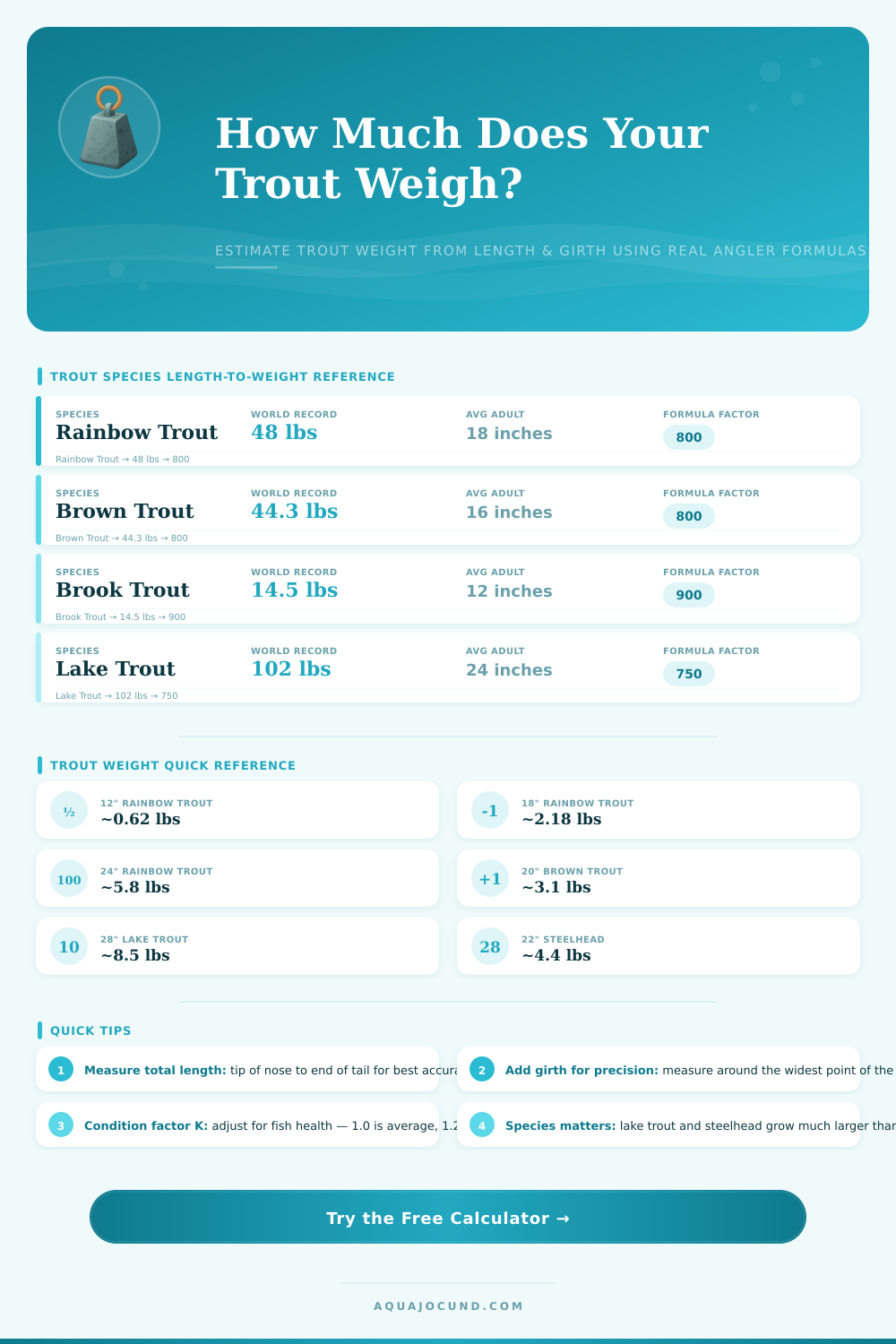
| Species | World Record | Avg Adult Length | Girth Factor |
|---|
| Length (in) | Length (cm) | Est. Weight (lbs) | Est. Weight (kg) |
|---|
| Species | Legal Size | Good Size | Trophy Size | Monster Size |
|---|
| K Value | Body Condition | Likely Cause | Notes |
|---|---|---|---|
| 0.80 – 0.89 | Very Poor | Disease, starvation, spawning stress | Fish is significantly underweight for length |
| 0.90 – 0.99 | Below Average | Limited food, post-spawn recovery | Lean but functional |
| 1.00 | Average | Normal healthy trout | Default; use unless you know otherwise |
| 1.01 – 1.10 | Good | Abundant food, growing season | Well-fed fish, slightly above average |
| 1.11 – 1.20 | Very Good | Rich forage, premium habitat | Fat fish — likely a great catch |
| 1.21 – 1.40 | Excellent / Obese | Lake-run or sea-run fish, exceptional forage | Trophy-quality condition |
To be able to estimate the weight of a rainbow trout without using a scale, two different measurement of the trout can be used: the length of the trout and the girth of the trout. Length is one of the most common measurements to use to estimate the weight of a trout; however, the length of the rainbow trout alone isnt accurate in determining its weight due to the different body shapes of the various species of trout. Rainbow trout has a different body shape than species like lake trout, therefore, the fisher must identify the species of the trout to accurately estimate its weight.
Should the species of the trout not be correctly identified, the estimated weight may be incorrect by fifteen percentage. The girth of the trout can be used to provide a more accurate estimation of the trout’s weight. The girth of the trout is the measurement of the thickness of the trout, taken around the thickest portion of the trout, which is just ahead of its dorsal fin.
How to Estimate the Weight of a Rainbow Trout
To determine the weight of the trout using the girth and length measurement, the girth measurement is squared, multiplied by the length of the trout, and the result is divide by a number that is specific to the species of trout. This process is the method that fishery agencies use to provide an estimation of the weight of live trout fish. Beyond length, girth, and species identification, the condition of the trout can also be used to estimate its weight.
The condition of the fish can be represented by a number (K) that represent the amount of fat or muscle contained by the trout. Trout that has little fat and muscle will have a low value of K (such as 0.85), while trout with alot of fat and muscle may have a high value of K (such as 1.4). If the condition of the trout is thought to be normal, the value of K is best represented by 1.0.
Using any other value will lead to inaccuracies in the estimation of the weight of the trout. The size of the trout may also be an issue in providing an accurate estimation of the weight of the trout. Size can be an issue in that an eighteen-inch trout may be large in one environment, yet may be of average size in another.
For instance, an eighteen-inch trout may be large in a small mountain creek, but may be of average size in a large reservoir. Additionally, each species of trout have different size ranges. For instance, brook trout tend to be of a smaller size than species like steelhead fish, which can grow much larger because they have access to the oceans food source.
To determine the weight of a rainbow trout, several step can be followed to correctly measure the fish. The length of the rainbow trout can be measured from its nose to its tail. The girth can be measured by placing a tape measure around the thickest portion of the trout, but not by pulling it so tight as to potentially strain or strain the trout.
The person should measure the rainbow trout using wet hand to properly slide the tape measure over the body of the trout, and the trout should be released quickly to avoid harming it. Tools or tables containing information about each species of trout, such as rainbow trout, can be used to determine its weight in pound. You should of used a scale if you want exact weight.
Its hard to be moddern with old methods, but these method works well enough.